
UK Outsourced Bookkeeping Services for Growth

Bookkeeping support should do more than clear a backlog. Outsourced bookkeeping services can cover sales and purchase records, ledger maintenance, bank reconciliations and VAT-related work, tailored to your business’s needs. A good arrangement also makes clear what’s being handled and what needs your attention.
You may want reliable records without adding every bookkeeping task to your working day. This guide explains how access and review can work, how bookkeeping can fit your existing accounting software, and how support can adapt as your business grows.
You’ll also see the practical differences between bookkeeping and broader finance services, how to set up a smooth working process, and how regular reporting can keep you informed. The aim is to help you identify the support that fits your business now and as its needs change.
Key Takeaways
- See how bookkeeping can fit with your existing accounting software and established finance processes.
- Understand how secure access, agreed responsibilities and review steps can keep work visible and organised.
- Learn what to consider when adjusting bookkeeping support as transaction volumes and business needs change.
- Compare the practical demands of outsourced support with employing an in-house bookkeeper, without relying on headline costs alone.
- Explore the range of bookkeeping tasks available and how Henderson & Co. Accountants’ services can support your next stage of growth.
Accounting software compatibility
Outsourcing doesn’t always mean replacing your accounting software. A bookkeeper can work within your existing system, preserving familiar workflows and avoiding unnecessary data migration. Before work begins, agree which software holds the main ledger, how documents are shared and who can access each record. This makes the handover clearer and supports consistent bookkeeping.
Compatibility involves more than the software name. Your bookkeeper needs to understand your chart of accounts, transaction categories, approval process and reporting period. For example, if your team codes supplier invoices by department, that structure should carry through to the bookkeeping workflow. A brief process review can identify where clearer instructions will help prevent inconsistent entries.
An accountancy or bookkeeping practice can outsource agreed processing tasks while retaining its client relationships and review responsibilities. The handover should define how source documents arrive, how queries are raised and when completed work returns for review. This can help practices manage workload changes without requiring every client to switch software.
Businesses can also use outsourced bookkeeping for routine records, reconciliations and report preparation. Define which records the bookkeeper can access, who approves payments and how unusual transactions are escalated. Your business should retain oversight of its internal controls and ensure the agreed process fits its financial procedures.
Management accounts are more useful when the underlying records are organised consistently. An agreed reporting period, such as a calendar month, gives managers a repeatable basis for reviewing income, costs and cash movements. Your bookkeeper can prepare reconciled records and supporting schedules, which the business can use to assess performance and inform decisions. A consistent close process also makes changes between periods easier to investigate.
Accounts payable and receivable workflows can be managed within the same software. For payables, the process may capture supplier invoices, assign categories, flag approvals and prepare payment information. For receivables, it may record customer invoices, match incoming receipts and identify overdue balances. Agreeing who approves transactions keeps processing separate from authorisation.
The main risks of outsourcing bookkeeping are less day-to-day oversight, communication delays and errors caused by unclear instructions or incomplete records. Manage these risks with defined access, documented processes, regular reviews and a clear way to resolve queries.
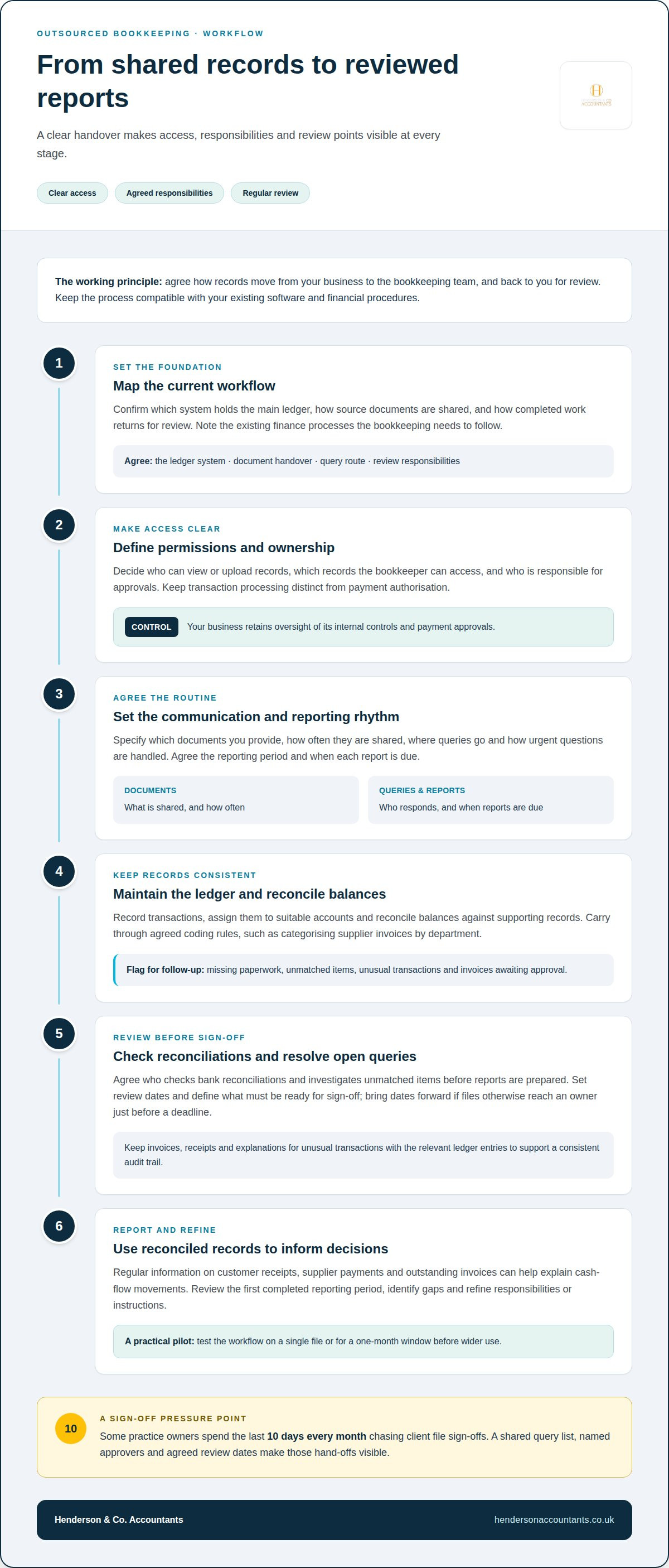
Test compatibility with a practical handover: map the current workflow, agree user permissions, share coding rules, then review the first completed reporting period. This helps both sides identify gaps early, maintain compliance routines and target any training to your accounting system.
Outsourcing workflow, access, review, and reporting
A clear workflow shows how records move from your business to the bookkeeping team and back for review. Agreeing access, responsibilities and reporting routines at the start keeps communication practical.
Cloud-based records and access
Online access can let you view financial records and reports as work progresses, rather than waiting for a report to arrive. Agree who can view or upload documents, where queries should go and how missing information will be flagged. For example, a sales invoice awaiting approval should have a clear status and a named person responsible for resolving it.
During onboarding, a UK management team can agree goals, responsibilities and processes with you. Set out which documents you provide, how often they are shared, and how urgent questions are handled. Clear communication helps the outsourced accounting team follow your existing procedures and gives you a reliable route to raise issues.
Ledger maintenance and review
Ledger maintenance involves recording transactions, assigning them to suitable accounts and reconciling balances against supporting records. Agree review points, such as checking bank reconciliations and investigating unmatched items before reports are prepared. This helps you spot missing paperwork or unusual entries before they affect management reporting.
Define who completes each review and what must be ready for sign-off. If files reach an owner just before a deadline, bring review dates forward and track outstanding queries. This can reduce last-minute pressure without removing the owner’s oversight.
Year-end reporting is easier when records stay orderly throughout the period. Keep invoices, receipts and explanations for unusual transactions with the relevant ledger entries. A consistent audit trail makes it easier to assemble schedules and supporting documents for annual accounts or audit preparation. Your bookkeeper can organise records, while the appropriate reviewer checks their accuracy and completeness.
Regular reporting can also clarify cash flow. Reconciled information on customer receipts, supplier payments and outstanding invoices helps explain expected movements, rather than relying on the bank balance alone. Agree the reporting period and when each report is due, so managers can use the information in planning and follow up overdue items.
Some practice owners spend the last 10 days every month chasing client file sign-offs. A shared query list, named approvers and agreed review dates can make those hand-offs visible. You can pilot the workflow on a single file or for a one-month window, then refine responsibilities before wider use.
Flexible support that scales with business growth
Bookkeeping needs can change as a business adds customers, products, staff or sales channels. A useful arrangement can adapt as transaction volumes grow, rather than treating today’s process as permanent. For example, a business moving from occasional invoices to regular online sales may need more frequent processing, clearer record categories and regular reporting. Agree how changes will be identified so your bookkeeper can adapt the process while maintaining continuity.
For UK small businesses, the right support depends on transaction volume, record-keeping habits and the decisions you need to make. A sole trader may prioritise organised income and expense records, while a limited company may need to keep business transactions distinct and support its reporting cycle. A growing retailer, for example, may need sales, refunds and supplier purchases recorded consistently across sales channels.
Which bookkeeping services are best for UK sole traders, limited companies and small businesses? Choose support that covers the records and reporting your business needs and can adapt as transactions and responsibilities change. That may mean regular bookkeeping, reconciliations, reporting support or a broader finance function, depending on the work involved.
Making Tax Digital for Income Tax is another reason to plan processes around future requirements. According to HM Revenue & Customs, from 6 April 2026, UK sole traders and landlords with combined self-employment and property income over £50,000 must use Making Tax Digital for Income Tax and make quarterly digital submissions to HMRC. The threshold falls to £30,000 from April 2027 and to £20,000 from April 2028, according to HM Revenue & Customs.
For affected sole traders and landlords, digital record keeping and quarterly submissions need to fit into the regular bookkeeping cycle. Set out how transactions are recorded, how records are reviewed and how submission information is prepared for each quarter. If you have several income sources, organising records consistently makes it easier to see activity across the reporting period.
As your business grows and adds processes, support can expand to cover more regular bookkeeping or wider finance needs. A small business might begin with transaction recording and reconciliation, then add more detailed reporting as management decisions become more complex. Review the arrangement when sales channels, transaction patterns or reporting needs change, so the work stays aligned with how the business operates.
Why Outsource Bookkeeping To Us?
Outsourced bookkeeping can combine accounting software with a dedicated bookkeeper, while in-house staff offer closer day-to-day control. Compare the workload, level of oversight required and full cost of employing someone.
Costs versus in-house hiring
Hiring can also take three months or more, including recruitment time.
These figures help show why salary alone gives an incomplete comparison. Outsourcing costs depend on the agreed work, transaction volume and reporting needs, and are given after a quote request. Compare the scope and expected workload with payroll, pension, recruitment, training and ongoing overheads for an employee. Consider whether you need continuous in-house capacity or support for defined bookkeeping tasks.
Benefits versus in-house options
How do outsourced bookkeepers compare with in-house staff and accounting software? A bookkeeper can apply judgement to coding, reconciliations and exceptions, while software records and organises transactions. In-house staff offer direct access but also require recruitment and ongoing employment costs.
Software supports efficient processing, but it doesn’t replace clear procedures or human review. Automation may import a bank transaction, for example, but someone still needs to resolve an unclear description or investigate a mismatch. Outsourced support can handle agreed tasks while your business retains approval responsibilities and oversight.
The right balance depends on the bookkeeping support you need. If transaction volumes vary, you can agree support around the work required instead of maintaining a full-time role throughout the year. If you need daily answers, immediate access or frequent changes that require an employee’s presence, in-house capacity may suit you better.
Compare the expected returns in time and efficiency, not just the headline cost. List routine tasks, how often they’re done and who reviews the results. Then weigh employment costs against the specific outsourced scope. This helps clarify the decision if you need reliable records but not a bookkeeper on your payroll all year.
Types of outsourced bookkeeping services
Outsourced bookkeeping can cover routine transaction processing, reconciliations and reporting, or a broader range of accounting services. The right scope depends on which records need attention and what financial information you need from them.
What do outsourced bookkeeping services include in the UK? They may include purchase and sales ledger management, processing takings and purchase records, bank reconciliations, VAT return preparation and supplier payment preparation. Some providers also offer payroll, tax preparation and accounts preparation as separate or combined services.
Common tasks can be grouped by the part of the bookkeeping cycle they support:
- Sales and purchase records: Recording invoices and organising customer and supplier balances, so outstanding amounts are easier to follow.
- Takings and purchases: Processing sales takings and purchase documents, then assigning entries to the appropriate ledger categories.
- Bank reconciliation: Matching accounting entries against bank records and investigating unmatched transactions before reports are prepared.
- VAT-related work: Organising transaction records and preparing VAT return information or rebates as part of an agreed scope.
- Supplier payments: Preparing payment information and routing it through the business’s approval process, with authorisation kept clear.
These tasks form traditional bookkeeping support, while full-service accounting may extend to tax work and annual accounts. Payroll can also be included when employee pay records need regular handling. The distinction matters: a business needing accurate ledgers and reconciliations has a different scope from one seeking broader accounting and tax services, such as specialist corporate tax compliance and advisory handled by professional firms like CTC Tax & Accounting.
For example, a growing online seller may need sales records grouped by channel, supplier purchases recorded consistently and bank transactions reconciled. Organised records help a director see how trading activity is reflected in the accounts. Bookkeeping supports reporting, but it doesn’t replace management decisions or the business’s review of its financial position.
Define each task before work begins. Set out which records are processed, how missing documents are flagged, who approves supplier payments and what reports are expected. A clear scope helps prevent errors from duplicate entries, incomplete paperwork or uncertainty about responsibilities. If your business later adds payroll or more detailed reporting, revisit the tasks and handover process.
Match the service to the work you need done, rather than choosing the broadest package by default. If you want to discuss a practical bookkeeping support plan, start with the records, processing tasks and reports your business relies on.
Henderson & Co. Accountants: Company Secretarial Services
Henderson & Co. Accountants provides bookkeeping and company secretarial services as your administrative and financial needs develop. If you’re managing records alongside company administration, bringing these needs together can help establish a clearer routine. For online sellers, eCommerce accounting can address the needs of trading through digital channels, while Xero cloud accounting setup can help establish a cloud-based bookkeeping system.
Turn to bookkeeping support when routine record keeping takes time away from running your business or you need a clearer system for financial records. Start by identifying the work you want covered and how it fits your current processes.
To discuss bookkeeping or company secretarial support, contact Henderson & Co. Accountants.
Make your next finance decision with clarity
As your business changes, your bookkeeping arrangements can change with it. Start with the records and decisions that need attention now, then review the scope when your processes or priorities shift. Outsourced bookkeeping services give you a structured way to manage the work while keeping sight of the information you need to run your business.
Henderson & Co. Accountants can support businesses with eCommerce Accounting, Xero Cloud Accounting Setup and VAT Return Preparation. If you’re ready to discuss what fits your current bookkeeping needs, contact Henderson & Co. Accountants.
A clear next step can make your financial processes easier to manage and leave you better placed to focus on growth.
Frequently Asked Questions
How to Choose the Right Bookkeeping Service Provider?
Choose a bookkeeping service that matches the records and decisions your business needs to manage. List recurring tasks, such as sales records, supplier invoices and bank reconciliations, then consider software compatibility, reporting expectations and how queries will be handled. An online seller, for example, may need sales data organised across channels. A clearly agreed scope makes responsibilities easier to understand and completed work easier to review.
Who is the service for?
Bookkeeping support can suit UK sole traders, startups, partnerships and established businesses that want help maintaining financial records. Henderson & Co. Accountants offers bookkeeping for businesses across the UK, with a dedicated bookkeeper available 24/7. A growing business might use support to keep transaction records organised, whilst an established company may need a steady process for ongoing bookkeeping as its operations develop.
Are you a certified Bookkeeper?
Henderson & Co. Accountants provides bookkeeping with a dedicated bookkeeper, but no certification claim is made. Certification and the scope of bookkeeping work are different things. For your decision, focus on the tasks covered, the person responsible for the work, and how records are reviewed. You can also consider whether the service fits your accounting software and the reporting your business relies on.
Can a business outsource only part of its finance function?
Yes, a business can outsource selected bookkeeping tasks without outsourcing its whole finance function. For example, it could assign transaction recording and reconciliations externally while keeping payment approvals and management decisions in-house. Henderson & Co. Accountants also offers an outsourced finance department for broader support. Defining which work stays in-house helps avoid duplicated tasks and keeps responsibilities clear.
How is financial data kept secure?
Henderson & Co. Accountants delivers services through cloud-based systems, but no specific security controls are described here. A sound working arrangement should define who can access financial records, how documents are shared and who handles access changes when responsibilities shift. For example, access for a staff member handling invoices should match their role, rather than automatically including every financial record.
How much do outsourced bookkeeping services cost in the UK?
The cost depends on the work required and is given after a quote request. Factors include transaction volume, the condition of existing records, the tasks included and the reporting needed. For example, a business with organised records and a limited processing scope has different requirements from one needing extensive catch-up work. Share the relevant scope and records so the proposed service can reflect the actual workload.
How are bookkeeping service fees calculated: hourly, monthly or per transaction?
The fee arrangement depends on the agreed bookkeeping scope and is clarified after a quote request. Transaction volume, record condition, reporting frequency and the division of responsibilities all affect the work involved. For example, processing regular sales records differs from preparing disorganised records for review. Focus on what work the fee covers and how changes to the workload are handled, rather than comparing billing labels alone.
What should UK businesses look for when choosing a bookkeeping provider?
Look for a clearly described scope, relevant compliance experience, software compatibility and a review process that suits your reporting needs. Ask how the provider will handle incomplete records, raise queries and keep you informed about work awaiting your decision. For an online retailer, the process should make sales and refunds understandable within its records. Clear responsibilities help you see what the service covers and what remains with your business.