
UK Outsourced Accounting Services: Buyer’s Guide

Keeping every accounting task in-house can seem like the safest option, but it isn’t always practical. Outsourced accounting services can take recurring, deadline-driven work off your team’s plate, leaving in-house staff more time for customers and business growth. The right fit depends on which tasks need covering, your available capacity and how closely your team wants to stay involved.
It’s sensible to weigh control and continuity against the time and resources needed to manage accounting internally. This guide compares the two approaches, explains what different pricing models may cover and shows how organised accounts preparation can support audit readiness without replacing an auditor.
You’ll also learn how accurate bookkeeping and well-prepared annual accounts make financial information easier to review, and when a hybrid arrangement may help. Use these considerations to decide which tasks to manage in-house and which could be outsourced.
Key Takeaways
- Compare in-house, outsourced and hybrid approaches by looking at the tasks, expertise and capacity your practice needs.
- Understand how the scope of work and pricing model shape outsourcing costs, without treating headline figures as a quote for your circumstances.
- Consider flexible support for recurring work and deadlines, so your team can protect time for client service and growth.
- See how organised records and prepared annual accounts can make information easier to review during an audit.
- Find out how Henderson & Co. Accountants’ Company Secretarial Services and accounting support may fit your operational needs.
Outsourcing vs In-House: Which Is Best for Accountants?
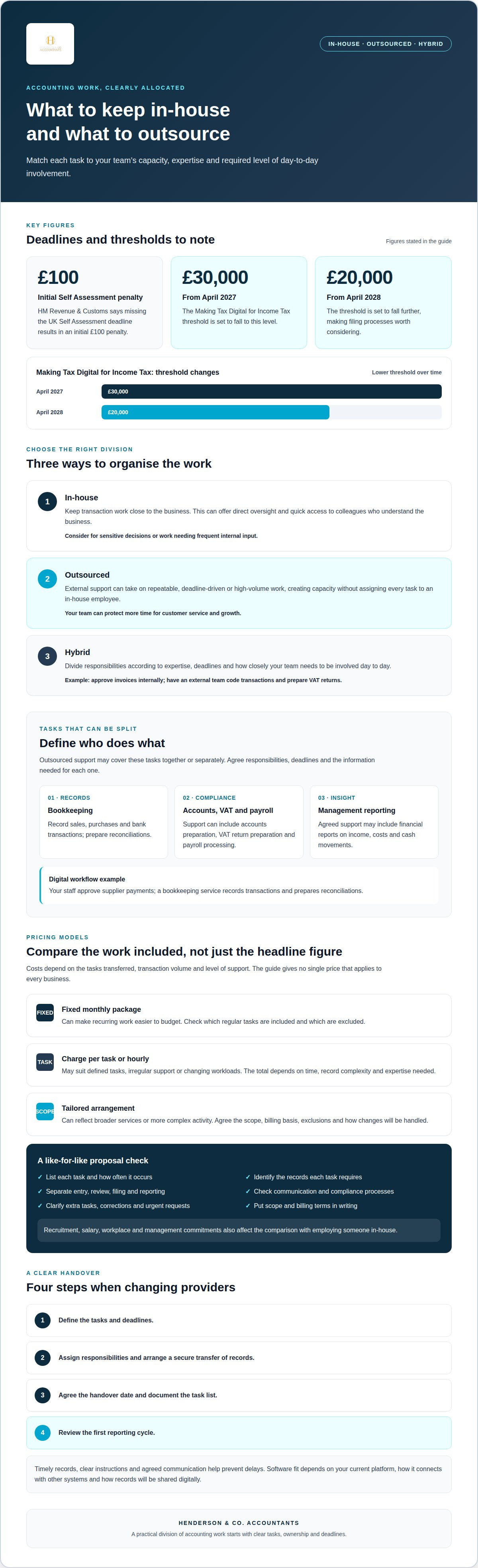
In-house teams keep transaction work close to the business, while outsourced support can handle repeatable tasks such as bookkeeping and payroll. A hybrid arrangement divides responsibilities according to expertise, deadlines and the level of day-to-day involvement you need.
Accounts, VAT and payroll preparation
Outsourced accounting can cover accounts preparation, VAT return preparation and payroll processing, either together or as separate tasks. For example, your team might approve invoices internally while an external team codes transactions and prepares VAT returns. The key is to define responsibilities, deadlines and the information needed for each task.
HM Revenue & Customs says missing the UK Self Assessment deadline results in an initial £100 penalty. That makes clear ownership of records and filing dates important, whether a task is handled by an employee or an outsourced team.
Management accounting support
Outsourced bookkeeping records sales, purchases and bank transactions, creating an organised foundation for management accounting. Depending on the agreed scope, support may also include financial reports to help managers review income, costs and cash movements. Check that the reporting frequency and level of detail suit the decisions your team needs to make.
Digital workflows can make it easier for internal staff and an external team to share records. For example, your staff might approve supplier payments while an external provider such as McConnell Bookkeeping records transactions and prepares reconciliations.
Outsourcing benefits and drawbacks
Outsourcing can provide capacity for recurring work without assigning every task to an in-house employee, leaving your team more time for customer service or growth. The trade-off is that external staff depend on timely records, clear instructions and agreed communication. Delays or unclear handovers can disrupt the workflow.
In-house work can offer direct oversight and quick access to colleagues who understand the business. Outsourcing may suit deadline-driven or high-volume tasks, while sensitive decisions or work needing frequent internal input may remain in-house. HM Revenue & Customs says the Making Tax Digital for Income Tax threshold is set to fall to £30,000 from April 2027 and £20,000 from April 2028, so changing filing processes may influence how you divide responsibilities.
To switch providers, define the tasks and deadlines, assign responsibilities, arrange a secure transfer of records and agree a handover date. Then review the first reporting cycle. A written task list helps prevent gaps between the outgoing team, the new provider and your staff.
There is no single accounting software package used by every UK outsourcing firm. The practical fit depends on your current platform, how it connects with other business systems and how records will be shared digitally.
Outsourcing service costs and pricing models
Outsourcing costs depend on the work transferred, its volume and the support required. Compare proposals against specific tasks, such as transaction processing, compliance deadlines and management reporting.
Typical outsourcing costs
UK accounting support may be priced as a fixed monthly package, a charge per task or a tailored arrangement. A package might cover routine bookkeeping, while a broader scope could include accounts preparation and ongoing finance support. More transactions and reporting responsibilities mean more work for the arrangement to cover.
Recruitment and employment costs also affect the comparison with an in-house team. Employing someone involves ongoing salary, workplace and management commitments; outsourced support is based on an agreed scope. For a growing business, compare what each option includes, not just its headline figure.
Hourly outsourcing rates
An hourly model charges for time spent, which can suit defined tasks or irregular support. For example, a business might use it to clear a bookkeeping backlog or prepare a particular report. The total depends on the hours needed, the complexity of the records and the expertise involved.
Fixed fees can make recurring work easier to budget, while hourly billing may suit changing workloads. A business operating across several systems may need more coordination than one using a single accounting platform. Before work begins, agree how additional tasks, corrections and urgent requests will be handled.
To assess a proposal, list each task, how often it occurs and which records it requires. Separate transaction entry from review, filing and management reporting, then match each task to a pricing line. For example, a package may include bookkeeping but exclude payroll, which could be charged separately. Comparing tasks individually helps reveal differences between offers that look similar.
Also check whether the proposed scope covers compliance processes and communication with your team. A straightforward operation may need limited support, while more complex activity may call for broader services and regular reporting. Get the scope, billing basis, exclusions and process for changes in writing, so the expected work and charges are clear from the outset.
For a practical next step, explore accounting support and consider which tasks your business needs covered. Clear priorities make it easier to define a suitable scope and assess the value of the work.
Benefits and flexibility of outsourcing for accountancy practices
For an accountancy practice, outsourced support can add capacity without turning every accounting task into an in-house role. The key question is how flexibly that support can match client demand and changes in workload.
Flexible resourcing
Practices can arrange outsourced accounting capacity on an ad hoc, half-time equivalent or full-time equivalent basis. Ad hoc support may help clear a temporary backlog, while a half-time equivalent arrangement can cover recurring work. Match the arrangement to the tasks, reporting deadlines and review capacity your practice can manage.
A specialist team can handle agreed work while your staff retain client relationships and oversight. For example, a practice could outsource routine accounts preparation while keeping complex client discussions in-house. Define who reviews the work and how questions are escalated to support accuracy.
Scaling support as needs change
Flexible resourcing can help a practice respond to changes in client numbers or workload. A full-time equivalent arrangement may suit sustained demand, while ad hoc capacity can cover a short-term increase. Set out the expected work and review points clearly so support can be adjusted as operations change.
If a practice downsizes, an outsourced arrangement may offer more flexibility than maintaining unused in-house capacity. Plan the transition by identifying work in progress, assigning responsibility for outstanding deadlines and agreeing how records will be handed back.
Capacity is useful only when it supports the practice’s service goals. Before assigning work, map the client jobs creating the most pressure and identify repeatable tasks suitable for external delivery. A seasonal increase in accounts work, for example, may call for extra preparation capacity, while ongoing reporting may need a steadier arrangement.
Use a simple allocation plan to connect internal and external work. List each task, its owner, the information required and the review point. A practice might outsource bookkeeping preparation, then have an internal manager review the figures before reporting to the client. This creates a clear route from source records to checked outputs.
Review the arrangement using practical measures, such as completed work, corrections required and missed handovers. These can show whether the chosen capacity suits the practice. If reporting quality or turnaround slips, clarify instructions, reassign tasks or adjust the level of support before clients are affected.
Outsourcing works best when the practice retains clear control of priorities and client commitments. Agree which tasks can be handled independently and which need internal judgement. A defined review process, consistent communication and flexible resourcing help practices respond to demand without losing sight of accuracy or service quality.
Freeing up time for core business activities
Outsourcing can move recurring finance tasks away from owners and employees, freeing time for customers, product development and daily operations. Its value depends on whether the work transferred supports your business priorities.
Businesses using outsourced accounting
Start-ups, owner-managed businesses and medium-sized enterprises use external support when they need accounting capacity without building every role internally. A growing business, for example, may outsource transaction processing whilst its founder focuses on sales. Consider which tasks absorb employee time and whether specialist expertise would help deliver them consistently.
You can divide work by task rather than transfer an entire function. A retailer might outsource bookkeeping and routine returns preparation while keeping payment approvals in-house. This creates a clear handover point and keeps operational decisions with the people making them.
Business goals and record-keeping
Choose support that fits your business goals, values and working practices. If customer service is a priority, for example, transferring routine finance administration may give employees more time to respond to customer needs. Set out the outcomes you expect, the records required and how the provider will share updates.
Reliable records are the foundation of useful accounting work. Organise business income and expense information consistently, whether it starts in accounting software or in sales and purchase documents. A clear handover routine helps the external team work from complete information and spend less time resolving missing transaction details.
Year-end accounts and business tax
Year-end accounts and tax work bring together records from across the financial year. Outsourced preparation can help organise transaction information, identify gaps and prepare accounts or tax returns for review. Before year-end work begins, agree who supplies records, answers questions and handles each stage of filing.
For example, one employee can gather invoices, bank information and payroll records and pass them through an agreed digital process. The accounting team can use these records to prepare year-end work, while the business retains oversight of key decisions and submission approvals.
Before transferring work, map the process from creating records to producing reports. Note where sales, purchases and payroll information originate, who checks it and when it reaches the accounting team. This makes delays easier to trace and gives each employee a clear responsibility.
Review the arrangement as your business changes. A start-up may initially need help with routine records, then require broader reporting as it grows. Reviewing tasks, software access and information flows helps keep the arrangement aligned with current operations and priorities.
Preparing annual accounts for external and internal audit
Well-organised annual accounts give reviewers a clear route from reported figures back to supporting records. Preparation can bring together bookkeeping, reconciliations and explanations before an external or internal audit begins.
Start with a structured close process. Bring together the trial balance, bank reconciliations, sales and purchase records, payroll information and schedules supporting significant balances. For example, a fixed asset figure should link to a schedule showing additions, disposals and the closing balance. Clear references help reviewers trace figures without searching through disconnected files.
Investigate unusual movements before finalising the accounts. Compare current figures with the previous period and your own management reports. A sharp change in travel costs, stock or customer balances may need an explanation and supporting documents. Recording the reason alongside the working papers gives an auditor useful context rather than leaving them to infer what happened.
External and internal reviews can have different purposes and scopes. An external auditor assesses financial information independently, while an internal review may examine controls or processes for management. Preparing evidence makes it accessible to either reviewer, but preparing accounts does not replace an audit or an auditor’s independent judgement.
Useful audit preparation includes a clear evidence trail for material figures, consistent file names and a record of outstanding questions. For example, a year-end accrual schedule can show the calculation, source document and approval. A query log can identify who is responsible, what evidence is needed and whether the item is resolved. These simple controls make progress easier to track.
Accounting software can connect transaction records with reports and supporting documents, provided the information is complete. Agree a close timetable, assign responsibility for missing evidence and keep working papers together. Where reporting standards or regulations apply, the accounts preparation process should reflect them, allowing a reviewer to assess the records and judgements in context.
Before an audit begins, prepare a consistent file containing the final accounts, reconciliations, schedules and explanations. Check that amounts agree across the reports and each supporting item is easy to locate. For example, a reviewer querying a supplier balance should be able to trace it from the accounts to the ledger and source documents.
Clear preparation can reduce avoidable back-and-forth, but it does not guarantee an audit outcome. If your annual accounts need a more organised preparation process, arrange annual accounts support to help bring the records and schedules together.
Henderson & Co. Accountants: Company Secretarial Services
Henderson & Co. Accountants provides Company Secretarial Services alongside accounting support. For online sellers, eCommerce Accounting helps organise financial processes around multi-channel trading. Xero Cloud Accounting Setup can establish a digital accounting workflow, while VAT Return Preparation supports your VAT filing.
Choose support based on the work you want to organise and the records your business needs to manage. A business moving its bookkeeping into Xero, for example, may benefit from setup support, while one seeking help with VAT reporting may need return preparation. Contact Henderson & Co. Accountants to discuss the accounting support that fits your needs.
Make your next accounting step count
Before changing how your accounts are managed, choose one process that would make a clear difference if it ran more smoothly. Map the current steps, identify where information is delayed and decide what a successful handover would involve. This gives you a practical starting point for shaping outsourced accounting services around your business, rather than changing everything at once.
Bring that process, your priorities and any questions about records or reporting to a conversation with Henderson & Co. Accountants. Discuss how eCommerce Accounting, Xero Cloud Accounting Setup or VAT Return Preparation could fit your needs, while keeping any tasks you prefer to manage in-house.
Start a conversation with Henderson & Co. Accountants and take a considered next step towards accounting support that fits the way you work.
Frequently Asked Questions
Who is the service for?
Outsourced accounting can suit start-ups, owner-managed businesses and medium-sized enterprises. It can be especially useful when an online retailer’s sales are spread across several channels, or when a small team needs specialist help without assigning every finance task to an employee. The right scope depends on the work creating pressure, the records available and how much oversight the business wants to retain.
Can a business outsource only part of its finance function?
Yes. A business can outsource selected tasks and keep other responsibilities in-house. For example, it might outsource payroll processing while its own manager approves payments and monitors cash flow. Start by mapping each task, identifying who supplies the records and deciding who reviews the result. This transfers defined work without handing over every finance decision.
Do accounting fees change if I am VAT registered?
VAT registration can affect the work involved, but it doesn’t automatically mean every accounting fee changes. The scope may depend on transaction types and volume, how records are organised and whether VAT return preparation is included. A business with frequent online sales, for example, may need more transaction processing than one with simpler records. Clarify which VAT tasks the arrangement covers.
How is financial data kept secure?
Security depends on the systems and processes used to store and transfer records. Before sharing data, agree who can access it, how documents will be exchanged and how access will be removed when responsibilities change. Use individual accounts rather than shared log-ins, for example, and limit access to the information each person needs. Clear procedures help reduce unnecessary exposure of customer and financial records.
Is it cheaper to do my own accounting or hire a professional?
Doing the work yourself avoids an external accounting fee, but uses time that could go towards sales, operations or customer service. Hiring an accountant adds a direct cost and can bring expertise in tasks such as preparing accounts or tax returns. Compare the full trade-off, including time spent learning software, maintaining records and correcting errors, against the value of keeping that time for your business.
Will Making Tax Digital (MTD) increase my accounting costs?
Making Tax Digital may change the work and software involved, but it doesn’t automatically determine the fee. The effect depends on your existing records, compatible software and the support you need with digital submissions and regular updates. A business already using organised digital records, for example, may need a different level of help from one moving away from spreadsheets. Consider how the required tasks affect the scope.
What do outsourced accounting services include for UK businesses?
Services can include bookkeeping, accounts preparation, VAT return preparation, payroll processing and financial reporting. Businesses may outsource one task or combine several to suit their needs. An online retailer, for example, could get support with sales records, VAT returns and year-end accounts while retaining payment approvals in-house. The agreed scope should identify the records handled, the outputs produced and who remains responsible for review.
How much do outsourced accounting services cost in the UK?
The price depends on the work and the scope agreed. Cost factors include the tasks included, transaction volume, record quality, reporting needs and level of ongoing support. Bookkeeping alone requires a different scope from a broader arrangement that also covers payroll or accounts preparation. Compare proposals by matching each included task and exclusion to the work your business needs handled.