
Outsourced Finance Function: The Guide to Scaling Up

Your finance function doesn’t have to grow one hire at a time. An outsourced finance function can cover bookkeeping, payroll, compliance, management accounts, cash flow forecasting and senior financial guidance. It can support your existing team or take responsibility for selected tasks, depending on what your business needs.
It’s understandable to want reliable reporting and financial support without losing sight of how your business works. Agree clear responsibilities, reporting schedules and communication channels so outsourced support works alongside your team rather than in a separate silo.
This guide explains what an outsourced finance function can include and how it can fit around your team. You’ll also learn how support for reporting, payroll, budgeting and forecasting can help you plan with greater clarity as your business grows.
Key Takeaways
- Set clear reporting schedules and responsibilities so financial information can support timely decisions.
- Choose support that complements your existing team, from selected tasks to a fully managed finance function.
- Use bookkeeping and payroll support to create more space for your team to focus on business priorities.
- Build budgets and cash flow forecasts around your business’s plans, expected income and upcoming commitments.
- Define the finance tasks you need covered, then shape the scope of support around your changing requirements.
Management accounts and financial reporting
Management accounts turn bookkeeping records into information you can use to run the business. A consistent reporting process helps you spot changes in performance and make informed decisions about growth.
A useful management accounts pack can bring together a profit and loss statement, balance sheet, cash flow information and agreed performance measures. For example, comparing sales and operating costs with the previous period can show whether higher revenue is also improving profitability. Add brief explanations for unusual movements so the figures point to decisions, not just totals.
Set a consistent process: close the books, reconcile key balances, review the results and share the pack with decision-makers. Late accounts, repeated cash flow surprises or reliance on one person for essential finance knowledge are signs to review how reporting is organised. Agree who supplies information, who reviews it and when managers receive the reports.
Balance sheet maintenance
Balance sheet maintenance means keeping an up-to-date record of what the business owns, owes and has invested. Regularly reconciling bank balances, checking amounts due from customers and reviewing supplier liabilities helps explain changes in the reported position. Investigate balances that remain unreconciled or lack a clear explanation. These checks give management accounts a more dependable foundation.
Management reporting and cash-flow forecasting
Management reporting should connect results with the decisions facing the business. Pair measures such as sales, margins or overdue customer balances with commentary on what changed and why. A cash flow forecast maps expected receipts against planned payments, helping managers anticipate tighter periods. Update assumptions when customer payment timing, costs or investment plans change.
Payroll is another operational process that can sit alongside accounting and reporting. A clear timetable sets out when employee information is gathered, pay is processed and payment details are reviewed. Changes to hours or new starters, for example, need to reach the person handling payroll before processing. Defined handovers reduce last-minute gaps and help managers plan payroll commitments in the cash flow forecast.
Access to accounting and financial management expertise can add context beyond routine processing. An accountant can explain movements in management accounts, while a finance director can help connect results with decisions about hiring, pricing or investment. Agree which decisions need specialist input, who provides the underlying records and how advice is shared with your team. Clear roles make external expertise useful without obscuring internal ownership.
How does an outsourced finance team integrate with your existing team?
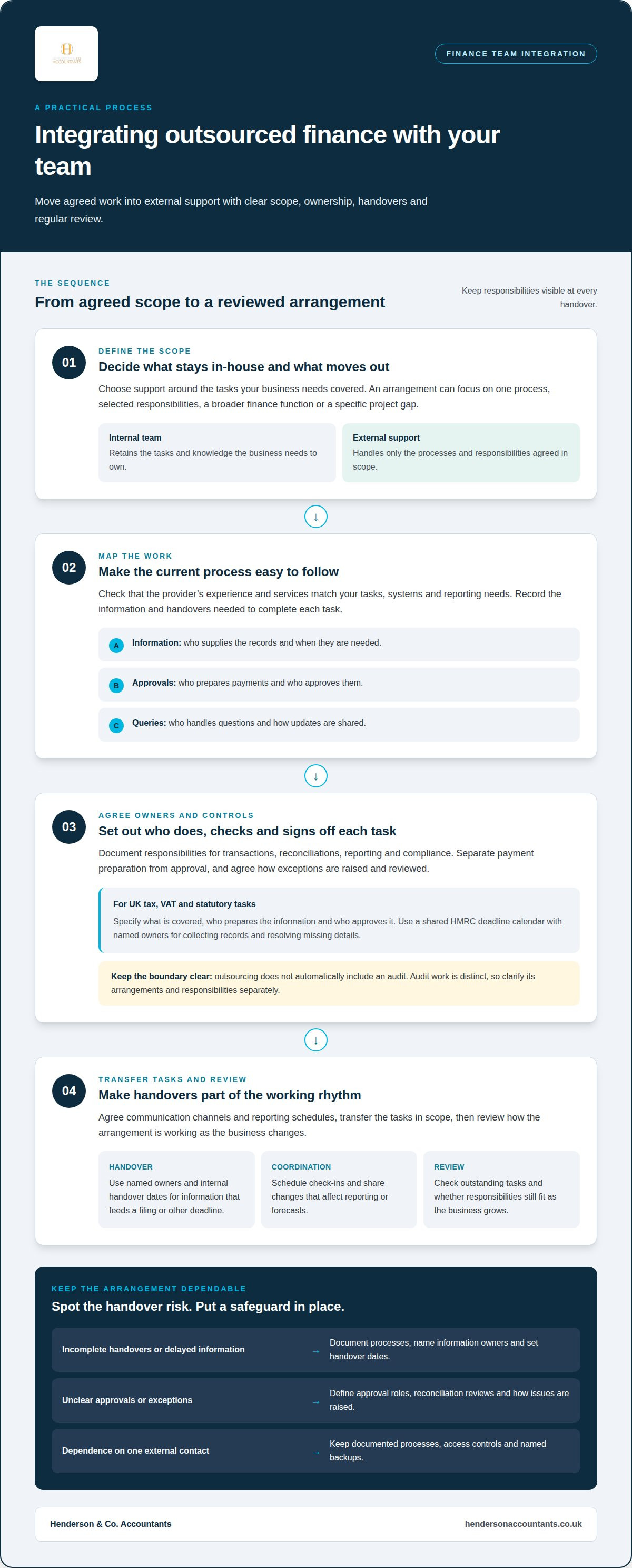
Integration starts with agreeing which finance tasks stay internal and which move to external support. Clear responsibilities, reporting schedules and communication channels help the arrangement fit your existing processes.
Flexible outsourcing arrangements
A flexible arrangement can cover one process, selected responsibilities or a broader finance function. For example, your internal team might retain supplier relationships while external specialists handle bookkeeping and payroll. Defined project support can also address a specific gap without transferring every task.
When choosing an outsourced finance provider in the UK, assess whether its experience and services match your tasks, systems and reporting needs. Agree who supplies records, approves payments and handles queries. Start by defining the scope, mapping current processes, agreeing responsibilities and communication, then transferring tasks and reviewing the arrangement.
Financial controls and statutory compliance
Accurate records depend on clear checks, not simply dividing work between teams. Agree how transactions are recorded, who reviews reconciliations and how exceptions are raised. For example, separating payment preparation from approval makes responsibilities visible and can help identify errors before processing.
Document which UK tax filings, VAT submissions and statutory tasks are covered, who prepares them and who approves the information. Set a shared calendar for HMRC deadlines, with named owners for gathering records and resolving missing details. Businesses expanding internationally may also need specialists familiar with the destination’s tax, employment and reporting rules.
Reporting responsibility and risk management
Set out responsibilities in the engagement: specify who prepares management reports, who reviews them and who provides information for tax compliance. Your team still needs to supply accurate records and make decisions; the external team handles only the tasks agreed in scope. Don’t assume finance outsourcing includes an audit. Audit work is distinct, so clarify arrangements and responsibilities separately.
Risks include incomplete handovers, unclear approvals, delayed information and dependence on one external contact. Manage them with documented processes, access controls, named backups and regular reviews of outstanding tasks. If a VAT submission depends on sales records, for instance, assign an owner and an internal handover date ahead of the filing deadline.
Outsourced and in-house finance teams
An in-house team works within the business every day and builds direct knowledge of its operations. An outsourced team can provide selected expertise or manage agreed processes without requiring every role to sit internally. The right balance depends on the work involved, the knowledge your team needs to retain and the support your operations require.
Outsourcing works best when communication is collaborative. Schedule regular check-ins, share changes that affect forecasts or reporting, and review whether responsibilities still fit as the business grows. A hybrid arrangement can keep financial decisions close to management while external specialists support defined processes.
Access to bookkeeping, payroll and accounting expertise
Outsourcing can bring practical accounting expertise into a growing business without recruiting for every finance role. Choose the processes that need support and keep the responsibilities that belong with your team.
Outsourcable accounting and payroll services
Bookkeeping, payroll, VAT returns, annual accounts and Construction Industry Scheme submissions are tasks businesses can outsource. Identify where work builds up, such as recording transactions or preparing payroll information, then define the scope. A clear handover explains which records are supplied, who approves outputs and how queries are resolved.
Payroll support can include processing employee pay and managing related information. A shared timetable helps your team pass on changes, such as a new starter or updated hours, before payroll is processed. Clear handovers make the process easier to coordinate with internal approvals.
Flexible outsourced accounting services
Service frequency can match the volume and pace of your transactions. Bookkeeping can be arranged daily, weekly or monthly, while other tasks can be assigned individually or combined into wider accounting support. This lets a business address a specific workload without transferring unrelated responsibilities.
As demand changes, the agreed level of support can be adjusted. For example, a growing business might begin with bookkeeping and add payroll as its needs develop. A useful arrangement sets out the tasks, information flow and review points so changes to scope don’t create confusion over ownership.
Accounts payable and receivable
Accounts payable covers amounts the business needs to pay suppliers; accounts receivable tracks money customers owe. Support may include organising invoices, recording due dates and following up outstanding balances. Agree who checks invoices and approves payments, because financial commitments still need clear internal oversight.
For example, a supplier invoice can be recorded, matched to the relevant purchase information and passed to an authorised approver. For customer balances, regular reviews of overdue invoices help identify which accounts need follow-up. These steps connect transaction processing with cash management without blurring approval responsibilities.
Digital tools can make these processes easier to coordinate. Cloud accounting software gives your team and external support a shared view of recorded transactions, with access arranged appropriately. Automated invoicing can reduce manual steps, while a consistent system keeps documents connected to entries. Xero Cloud Accounting Setup can help establish cloud accounting processes.
Before work begins, map each process from source document to completed task. For bookkeeping, agree how receipts and invoices arrive, who records them and how queries are flagged. For payroll, define how employee changes reach the processor and how outputs return for review. Clear steps let your team use specialist expertise while retaining visibility of operational decisions.
Forecasting, budgeting and cash flow planning
A budget sets out planned income and spending; a forecast tests those expectations against changing business conditions. Together, they give decision-makers useful insight before committing resources or changing plans.
Forecasting and budgeting
Build the budget from expected sales, operating costs, planned recruitment and investment. A forecast uses current information to show how actual trading may differ from that plan. For example, slower customer orders could reduce expected receipts while fixed costs remain unchanged. Comparing the two helps managers understand the gap and consider a response.
Use scenarios to test strategic choices before acting. A business planning a new product launch could model expected sales alongside production, marketing and staffing costs. Review the assumptions behind each scenario, including timing and customer demand. This makes the forecast a working decision tool, rather than a document prepared once and left unchanged.
Payment allocations and cash-flow forecasting
Payment allocation means matching money received or paid with the correct customer invoice, supplier bill or account. Accurate allocations show which invoices remain outstanding and which commitments have been settled. For example, assigning a customer payment to the wrong invoice can make an overdue balance appear unpaid, distorting information used for cash flow planning.
A cash flow forecast maps expected receipts and payments over time. Include invoice due dates, planned supplier payments, payroll and other known commitments. If a customer’s payment is delayed, update the expected receipt and review the effect on available cash. This gives managers a clearer view of timing, not just projected income and spending.
Cash-flow planning and credit control
Credit control supports cash flow planning by tracking customer balances and following up overdue invoices. A practical process records the invoice date, due date, payment received and next follow-up action. Reviewing outstanding customer accounts can highlight delayed receipts before managers approve discretionary spending.
Use the forecast to identify periods when expected payments may exceed receipts. Managers can then review payment timing, spending plans or the assumptions driving the shortfall. Keep forecast updates linked to current invoice information and known commitments. This creates a clearer basis for deciding whether to defer a planned purchase or revise the budget.
Assign ownership for updating assumptions, recording payment allocations and reviewing forecast changes. Share significant movements with decision-makers, such as a large customer delaying payment or an unexpected cost entering the plan. Regular reviews turn new information into actionable insight and keep budgeting connected to operational decisions.
What an outsourced finance function includes
The scope can range from transaction processing to senior financial guidance. A business may outsource individual tasks, such as bookkeeping, or use support across a wider finance department. Define each task, its owner and the output your team needs.
At the transactional level, support can include bookkeeping, supplier payments, credit control and payroll. These processes move records from source documents into organised financial information. For example, supplier invoices can be recorded for review while customer balances are tracked for follow-up. Payroll can also be included where the agreed scope covers employee pay processes.
Compliance work may include VAT returns, Construction Industry Scheme submissions, annual accounts and company secretarial services. Identify exactly which filings or records are handled, who supplies the information and who reviews it. A shared schedule can connect recurring tasks with the records and approvals needed to complete them.
Management accounts add a decision-making layer. They bring financial results together so managers can review performance, costs and the business’s position. Budgeting and cash flow forecasting help assess planned spending against expected receipts. Before committing to a new project, for instance, managers can consider its expected costs alongside the forecast and available resources.
A broader arrangement may also include senior financial guidance. An outsourced finance director can help interpret reporting, identify operational questions and support strategic decisions. The value comes from linking advice to the business’s priorities, such as reviewing margins before changing prices or assessing planned investment against cash flow expectations.
Technology can form part of the process too. Cloud accounting software and digital collaboration tools provide a shared place for financial records and support the flow of information between the business and its finance team. Implementing structured cloud solutions, such as those provided by Make It Mine, can help streamline everyday communication and document sharing across teams. Set out which system is used, who can access records and how documents or queries move through the process. Software supports the work, but agreed responsibilities still matter.
To define the scope, map finance work from the first transaction through to reporting and decision-making. Mark the tasks that need specialist input, the approvals your team retains and the outputs managers use. Then agree how responsibilities can change as the business grows. This turns a broad service description into a practical operating arrangement.
If you’re shaping support around your finance tasks, discuss your finance requirements and the responsibilities you want covered.
Henderson & Co. Accountants
Henderson & Co. Accountants can organise accounting support around the financial work your business needs. If you manage eCommerce transactions, want to set up accounting software or need a clearer process for compliance tasks, the right support can make these responsibilities easier to coordinate.
Services include eCommerce Accounting, Xero Cloud Accounting Setup, VAT Return Preparation and Corporation Tax Returns. They can support practical needs such as organising business records, using cloud accounting software and preparing tax returns. Identify which processes need attention and how they connect with your team’s day-to-day work.
To discuss your accounting needs, contact Henderson & Co. Accountants.
Shape finance support around your next stage of growth
Decide which finance responsibilities need more capacity now and which may change as your business grows. An outsourced finance function should fit the way your team works, with clear ownership and support that adapts as priorities shift. Start with the processes creating the greatest pressure to establish a practical scope.
Henderson & Co. Accountants supports businesses with eCommerce Accounting, Xero Cloud Accounting Setup and VAT Return Preparation. These services address distinct accounting needs as you organise your finance operations. Consider what you want your records, systems and reporting processes to make easier, then discuss how the support could fit your requirements.
Contact Henderson & Co. Accountants to discuss the finance support your business needs. A clear starting point can help you build a more confident path forward.
Frequently Asked Questions
Why is outsourcing so attractive to businesses?
Outsourcing appeals to businesses that need finance expertise without building every role internally. It can also help when workloads fluctuate, such as for a retailer moving from a busy sales period to quieter trading. You can assign defined tasks externally while keeping operational decisions in-house. This can give managers more time to focus on customers, products or growth rather than routine finance administration.
How do you ensure outsourcing is done in an MTD VAT compliant way?
Use digital records and an accounting process that supports your business’s VAT reporting. Keep invoices and transaction information organised, apply VAT treatment consistently, and reconcile the figures before preparing a return. Agree who checks the records and submits the return. Xero Cloud Accounting Setup and VAT Return Preparation can support these processes; accurate information and clear responsibilities remain essential.
How do you structure fees?
Fees are shaped by the agreed scope of work rather than a single standard package. Relevant factors include which tasks are included, transaction volumes, how often work is completed, and the reporting or specialist input required. A clear proposal separates recurring work from additional tasks and explains how changes to scope affect the fee. This gives you a defined basis for planning and reviewing the arrangement.
How much does outsourcing cost?
The cost depends on the work included, transaction volumes, service frequency and level of financial expertise required. A business outsourcing bookkeeping alone has a different scope from one needing payroll, compliance work and senior financial guidance. The price depends on the case and is given after a quote request. Set out the tasks and expected outputs so the proposed service can be scoped accurately.
What is an outsourced finance function?
An outsourced finance function is an arrangement where an external provider carries out agreed finance processes for a business. Its scope can range from a specific task to broader operational support. For example, a company might outsource transaction recording while keeping payment approvals and budgeting decisions with its managers. The agreement should define responsibilities, information handovers and the outputs the business needs.
Which finance tasks can UK businesses outsource?
UK businesses can outsource bookkeeping, payroll, VAT Return Preparation, annual accounts, Corporation Tax Returns and company secretarial work. They may also arrange support with management accounts, budgeting or forecasting. The right combination depends on workload and internal expertise. For example, a business with an experienced bookkeeper might outsource payroll or seek senior input on financial planning.
How much does finance function outsourcing cost in the UK?
There is no single UK price because the scope and workload vary between businesses. Costs depend on the processes covered, transaction volumes, reporting frequency, software requirements and level of specialist input. A focused bookkeeping arrangement differs from a broader finance department service. The price depends on the case and is given after a quote request, once the required work has been outlined.
What are the benefits and drawbacks of outsourcing finance?
Benefits can include access to specialist expertise, flexible support and less need to recruit for every finance task. Trade-offs can include reliance on timely information handovers and less immediate access to external staff than to internal colleagues. For example, delayed sales records can hold up reporting. Clear contacts, agreed response processes, secure access and documented responsibilities help manage these practical risks.