
Outsourced Finance for Growing UK Businesses

Growth can make the finance work behind your business harder to manage. Outsourced finance for growing businesses means transferring some or all finance responsibilities to an external team, which can handle tasks such as bookkeeping, payroll, tax returns and reporting, alongside ongoing financial support.
It’s understandable to think of an accountant mainly as someone who prepares annual accounts and tax returns. Outsourced finance can cover those compliance tasks, as well as regular management reporting, budgeting and cash flow support, helping you understand your finances and make informed decisions.
This guide explains what outsourced finance can include, how it differs from traditional accountancy and what affects its cost. You’ll also learn how timely reporting can make cash flow easier to monitor and help you stay on top of financial responsibilities. The right support depends on the work your business needs, so the focus is on understanding the options and how they fit as your business grows.
Key Takeaways
- Outsourced finance can take on selected finance tasks or provide broader ongoing support, allowing the arrangement to adapt as your business changes.
- Traditional accountancy often centres on compliance, while outsourced finance can also include management reporting, forecasting and financial guidance.
- Regular, clear reports can help you spot cash-flow pressures, understand performance and plan ahead with better information.
- Delayed invoicing, inconsistent supplier payments and unclear financial information can be early signs that reporting or cash-flow processes need attention.
- When comparing outsourced and in-house support, consider the full cost of staffing, recruitment, training and software alongside the services your business needs.
What is Outsourced Finance?
Outsourced finance transfers some or all finance responsibilities to an external team. It can complement an existing finance team or cover functions the business doesn’t manage internally. Outsourced finance for growing businesses can focus on immediate priorities and adapt as those priorities change.
Flexible finance support
Flexible finance support means matching outsourced tasks to a business’s changing needs. A growing company might begin with bookkeeping, then add payroll or financial reporting as transaction volumes and responsibilities increase.
This approach can free business owners and staff to focus on sales, operations and growth rather than finance administration. Outsourcing doesn’t necessarily reduce headcount; it can let existing employees focus on higher-value work. Support can also adapt as priorities shift, rather than requiring a new hire for every finance task. For example, a seasonal sales increase may create a short-term need for more transaction processing, while reporting remains part of the regular finance function.
Fractional finance leadership
An outsourced finance director provides ongoing financial leadership without working as a full-time member of the business. They can support decisions about budgets, forecasts, financial performance and growth plans.
This differs from hiring a specialist consultant for a defined project with a specific deliverable; while independent advisory firms such as Swiss Alpha Matrix provide focused due diligence and project management for complex financial programmes, an outsourced finance director works with the business over time, connecting financial information with operational choices. For example, a business considering a new sales channel can use financial insight to assess its effect on costs, cash flow and expected returns. Outsourced finance for growing businesses can therefore provide leadership alongside routine financial support.
Access to specialist expertise
Outsourced support gives a business access to finance expertise across tasks such as bookkeeping, payroll, reporting and forecasting. This can help when one employee would otherwise need to manage several different finance responsibilities.
For instance, a business may need accurate bookkeeping for regular reporting and specialist input to plan for growth. External support can address both needs, rather than relying on one generalist or building every capability in-house. Business owners can define the expertise needed for daily processes and the input required for planning and decisions.
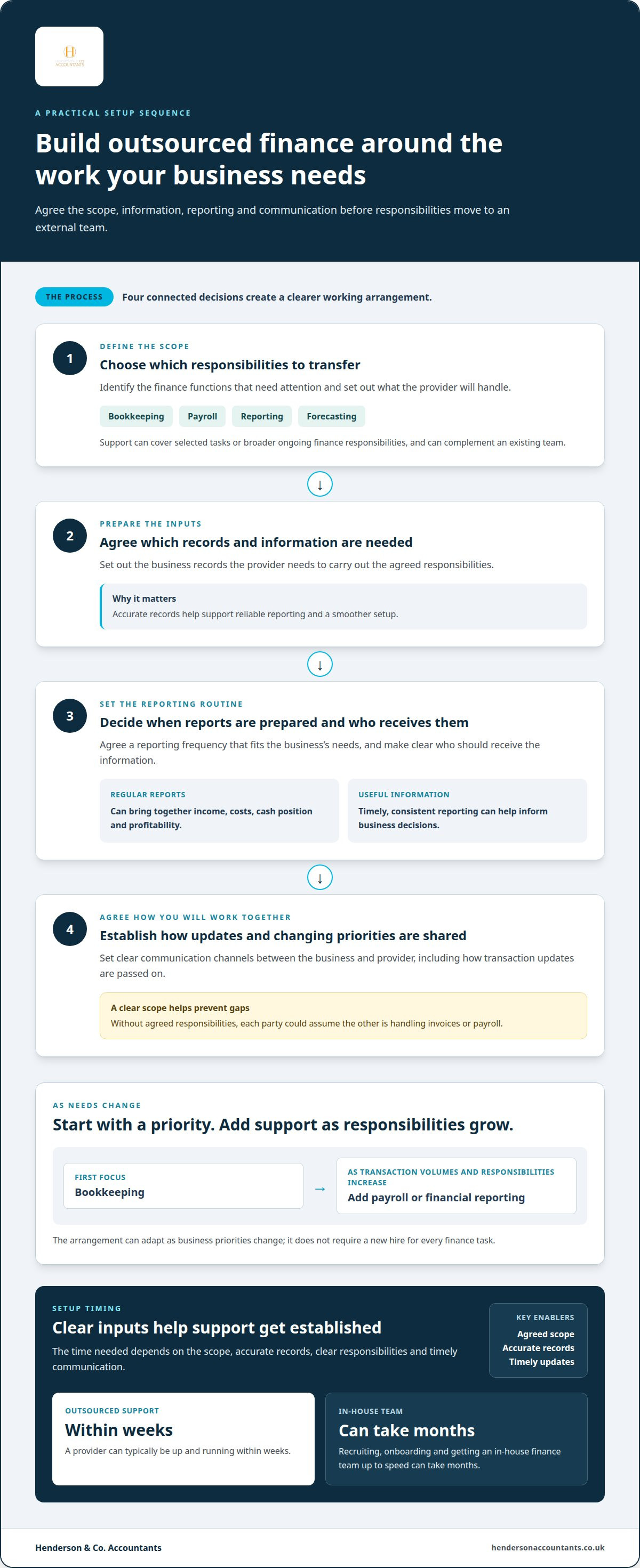
Setting up professional support starts with identifying which finance functions need attention. The provider and business then agree on responsibilities, required records, reporting needs and communication channels. A clear scope helps prevent gaps, such as each party assuming the other is handling invoices or payroll.
- Set out the responsibilities to transfer, such as bookkeeping, payroll or forecasting.
- Agree which business records and financial information the provider needs.
- Define how often reports are prepared and who receives them.
- Establish how the provider and business share updates about transactions or changing priorities.
An outsourced finance provider can typically be up and running within weeks. Recruiting, onboarding and getting an in-house finance team up to speed can take months. The time needed to establish support depends on the scope and the availability of accurate records, clear responsibilities and timely communication.
Financial outsourcing versus traditional accountancy
Growing UK businesses can outsource bookkeeping, VAT returns, annual accounts, payroll, reporting, forecasting and company secretarial work. Traditional accountancy often centres on compliance, while outsourced finance can extend to regular reporting and financial guidance. Outsourcing can free internal capacity and provide broader expertise, but unclear responsibilities or inconsistent communication can create gaps.
The main difference is the scope of the finance function. A traditional accountant may focus on annual accounts and tax returns, while an outsourced team can handle selected day-to-day tasks or provide ongoing financial oversight. A business can combine both approaches, using compliance support alongside strategic finance leadership.
For example, working with an established firm such as Stewart Accounting Services for outsourced bookkeeping can keep sales, purchases and payments organised, giving the finance team reliable records to work from. Support may also include VAT return preparation, payroll, annual accounts and company secretarial services. The right combination depends on the tasks the business needs handled and the capacity available internally.
Management accounts and performance reporting
Management accounts are regular internal reports that show how a business is performing financially. They can bring together income, costs, cash position and profitability, giving business owners insight beyond annual accounts.
For example, comparing sales and costs across business areas can show which products or activities contribute most to profit. Consistent reporting can also help identify changing trends and inform decisions using current financial information. Its value depends on accurate records and reports arriving in time to guide decisions.
Cash flow forecasting and month-end processes
Cash flow forecasting estimates expected money coming in and going out, while month-end processes organise transactions into a regular reporting cycle. Together, they help a business understand upcoming cash needs and review its financial position consistently.
A month-end process can include recording transactions, reconciling accounts and preparing management reports. Those reports can inform forecasts, such as whether expected customer receipts will cover planned supplier payments. Clear deadlines and assigned responsibilities help internal staff and external specialists work from consistent information.
Benefits and risks of outsourcing
Outsourcing can give a business specialist finance support without requiring it to build every capability in-house. It can also provide documented processes and consistent reporting standards, supporting financial oversight as the business grows.
Risks can arise when responsibilities, deadlines or communication channels are unclear. For instance, uncertainty about who handles an invoice or supplies payroll information can delay work or leave a task incomplete. A defined scope, agreed reporting schedule and regular communication help reduce these operational risks.
Outsourced finance can therefore extend beyond the compliance focus of traditional accountancy, adding management reporting, forecasting and ongoing oversight. A business that needs a broader function can consider outsourced finance department support alongside the compliance work it already uses.
Frequent financial reporting and cash flow visibility
Regular reporting turns bookkeeping records into timely information for business decisions. For outsourced finance for growing businesses, an agreed schedule, clear responsibilities and reliable communication help make reports useful to external specialists and internal managers alike.
Frequent financial reporting
Frequent financial reporting gives business owners an up-to-date view of performance and cash movements. It can reveal changes in sales, costs or outstanding invoices before they appear in annual accounts.
For example, a report showing rising costs alongside slower customer receipts can prompt an earlier review of spending and collections. The best reporting frequency depends on how quickly the business’s finances change and when managers need information to act. Internal ownership matters too: someone needs to review the figures, raise questions and connect them with operational decisions.
Cash flow forecasting
Cash flow forecasting estimates when money is expected to enter and leave the business. Used alongside current financial reports, it can show whether expected receipts are likely to cover planned payments.
A forecast might bring together customer payments, supplier invoices, payroll and upcoming tax or VAT commitments. Comparing expected movements with actual results helps reveal changes in timing. This can support proactive decisions, such as following up overdue invoices or reconsidering when to make a planned purchase. Regular updates based on current business activity make the forecast more useful.
Payroll and board reporting
Payroll reports summarise employee pay information and related costs, while board reports present financial insight for directors’ decisions. Accurate, timely payroll information supports employee payments and helps businesses manage payroll responsibilities.
A board report might bring together revenue, costs, cash position and forecast changes. Directors can use that shared view to discuss a specific decision, such as whether cash projections support recruitment. Clear commentary connects the figures with operational plans rather than presenting numbers without context.
Reporting and automation
Cloud accounting and automated data capture can reduce manual handling and make financial information easier to access. A dashboard, for example, can bring sales, expenses and cash information into one view for business owners and finance staff.
Outsourced finance for growing businesses can use these tools to make routine reporting more consistent, but automation still depends on accurate records. Consistent categorisation, account coding and reviews of unusual entries help keep reports meaningful. If a payment is assigned to the wrong category, even a frequently updated dashboard can give a misleading picture.
To make reporting practical, the business and finance provider agree on the schedule, report contents, responsibilities and communication channels. They also decide how payroll information and operational updates reach the finance team. Reviewing forecasts against actual cash movements helps keep information current and gives managers useful context for strategic decisions.
Warning signs in financial reporting, cash flow and compliance
Consider outsourcing when delayed reports, missed deadlines or limited internal capacity make finance tasks hard to manage. The work involved determines the relevant experience and controls to assess, along with who is responsible for each task.
Accuracy and financial controls
Financial controls are checks and processes that keep records accurate and reduce the risk of errors or fraud. For example, separating the responsibility for recording a supplier invoice from approving its payment creates a review point.
Warning signs include management accounts that don’t match underlying records, repeated corrections or unexplained changes in balances. Established processes and quality controls can help outsourced accounting professionals reduce errors. Clear records also give a director a stronger basis for decisions about spending, hiring and cash requirements.
Compliance deadlines
Compliance deadlines are dates by which a business must complete and submit required information, such as VAT returns or payroll records. A missed deadline can create avoidable pressure, especially when records or approvals arrive late.
A practical process assigns responsibility for each task, identifies the information needed and allows time for review before submission. For example, an upcoming VAT return depends on complete transaction records and timely clarification of unusual entries. A shared deadline calendar and regular updates help the business and finance professionals spot missing information early.
Compliance and risk reduction
Consistent compliance processes reduce the chance that an error, missed deadline or incomplete record becomes a larger financial problem. Documented procedures also clarify who handles each stage, from recording a transaction to reviewing a submission.
Weak credit control, delayed invoicing and poor visibility of future payments can put pressure on cash flow. Late or inconsistent supplier payments may strain relationships and affect service levels. Current reporting helps directors identify risks sooner, while regular reviews can bring tax or VAT commitments to light before they become unexpected demands.
Deciding when to outsource finance
Outsourcing makes sense when finance work exceeds internal capacity or the business needs specialist support. Expanding payroll, growing transaction volumes or recurring gaps in management accounts can make it harder for existing staff to keep records and deadlines under control.
It can also help when a director needs financial oversight for decisions but the business doesn’t need a full-time finance leader. Support may cover a specific gap or a wider finance function. Clear responsibilities matter: agree who prepares records, reviews reports and manages each deadline, so work doesn’t fall between internal staff and external professionals.
Look for practical evidence of how a provider manages the work, including documented processes, consistent reporting standards and clear communication channels. A defined monthly reporting schedule, for example, shows how financial information is prepared, reviewed and shared. These arrangements help directors understand accountability and decide what support their business needs.
What Do Different Finance Teams Cost?
Compare the full cost of an in-house finance department with the scope of outsourced support. The comparison should include salaries and employment overheads, as well as the processes and expertise your business needs.
Outsourced and in-house finance costs
Comparing finance costs means weighing staffing and operating expenses against the work an external team would handle. This helps owners assess the whole function rather than comparing a service fee with one employee’s salary.
An in-house team can involve salaries, pensions, recruitment, training, software licences and cover during absence. Outsourcing can reduce the need for some of these costs while giving the business access to specialist expertise. The balance depends on the support required, the complexity of the work and the capacity the business needs.
Costs of in-house finance teams
These estimates show why role mix and workload matter: adding credit control or senior oversight changes the resources involved.
For owners, the relevant comparison is not salary alone, but whether the business needs full-time leadership and the wider costs of employing that role.
Outsourcing costs and predictable fees
Outsourced finance costs depend on the work included, transaction volumes, reporting needs and level of expertise required. The price depends on the case and is given after a quote request, with the scope, workload and complexity shaping the cost.
An outsourced arrangement can make finance support easier to plan by setting out the services included and the agreed fee. Support can also adapt as circumstances change, without recruitment or restructuring. Agreeing which processes are covered helps owners understand what the fee includes and how additional requirements may affect the arrangement.
For a useful comparison, list the finance tasks required, the internal time they consume and the employment or software costs involved. Then match those needs against an outsourced scope, including bookkeeping, management reporting or financial leadership. Explore outsourced finance support when you’re assessing the right structure for your business.
Henderson & Co. Accountants
Henderson & Co. Accountants helps growing businesses organise finance support around their day-to-day needs and reporting priorities. If bookkeeping, tax preparation or financial oversight is becoming difficult to manage internally, its services include outsourced finance support, annual accounts, VAT return preparation and corporation tax returns.
For eCommerce businesses, specialist accounting can help bring sales and financial records together. Xero Cloud Accounting Setup can support a clearer accounting workflow, while finance leadership can help owners use financial information in business decisions. The right combination depends on the work you need handled and the insight you want from reporting.
If you’re considering support for your growing business, contact Henderson & Co. Accountants to discuss your finance needs.
Give your next stage a clearer financial foundation
As your business changes, your finance arrangements can change with it. Start by deciding which responsibilities need dependable ongoing support and which decisions would benefit from clearer financial insight. This gives you a practical basis for shaping support around your priorities, rather than adding processes without a clear purpose.
For growing businesses, outsourced finance can connect routine accounting work with better-informed decisions. Henderson & Co. Accountants offers eCommerce Accounting, Xero Cloud Accounting Setup and VAT return preparation, helping businesses address specific accounting needs alongside broader finance support.
Discuss the finance support that could fit your business with Contact Henderson & Co. Accountants. A clear view of your needs can help you take the next stage of growth with greater confidence.
How Henderson & Co. Accountants can support your growing business
Henderson & Co. Accountants provides outsourced finance support for growing businesses, including bookkeeping, an outsourced finance department and an outsourced finance director. It can be a natural next step when you need help managing finances alongside business growth.
Support can also include eCommerce accounting, Xero cloud accounting setup, VAT return preparation, corporation tax returns, payroll and CIS management, company secretarial services and annual accounts. Turn to Henderson & Co. Accountants for help managing these finance and accounting tasks.
Frequently Asked Questions
What Does In-House Really Cost?
The real cost includes more than an employee’s salary. A business may also need to account for employer costs, pensions, recruitment, training, software licences and cover during absence. For example, hiring a finance manager can address an oversight gap but still leave bookkeeping or payroll capacity uncovered. Map each role to its responsibilities, then consider whether the full team is needed throughout the year or only for specific finance tasks.
Why Is Outsourcing Your Accounting Function Important?
Outsourcing can give a business access to finance capacity and expertise without requiring internal staff to handle every task. It can be useful when growth creates more transactions, reporting needs or payroll administration than the current team can manage. For example, an owner can delegate bookkeeping while retaining responsibility for approving spending. The value comes from defining who does each task and how financial information reaches decision-makers.
How much does outsourced finance cost in the UK?
There’s no single UK fee for outsourced finance because the cost depends on the agreed scope and workload. A service covering bookkeeping alone differs from one that also includes payroll, reporting or financial leadership. Transaction volumes, the complexity of records and how often reports are required also affect the work involved. Henderson & Co. Accountants’ fees depend on the case and are provided after a quote request.
How do outsourced finance costs compare with hiring an in-house finance team?
Compare the outsourced fee with the full employment and operating costs of the roles needed, not just one salary. An internal team may involve recruitment, training, pensions, software licences and cover, while an outsourced arrangement is shaped by its agreed scope. For example, a business needing specialist planning input and routine bookkeeping support may not need to recruit several full-time employees.
How do UK outsourced finance providers support bookkeeping, payroll, VAT and management accounts?
Providers can take on defined tasks such as recording transactions, processing payroll information, preparing VAT returns and producing management accounts. The business supplies relevant records and operational updates, while responsibilities for review and submission are agreed. Henderson & Co. Accountants offers bookkeeping, payroll and CIS management, VAT return preparation and outsourced finance department support. This can connect routine records with the reporting information owners need.
How to choose an outsourced finance provider for a UK business?
Choose support by matching the provider’s services to the work your business needs handled. Clarify who prepares records, who reviews reports, how deadlines are managed and how often financial information is shared. For example, an online retailer may need eCommerce accounting and connected cloud accounting processes. Clear responsibilities and communication help prevent tasks being missed between your staff and the external finance team.
How does outsourced finance support cash-flow forecasting and business growth?
Outsourced finance can organise current financial information and use it to inform cash flow forecasts. For example, a forecast can compare expected customer receipts with planned supplier payments, payroll and tax commitments. Reviewing actual results against expectations can highlight timing changes and inform decisions about spending or expansion. This gives owners a clearer basis for planning, although a forecast’s usefulness depends on timely, accurate business records.
What steps does a provider take when switching a UK business to outsourced finance?
A provider typically agrees the scope, responsibilities, reporting arrangements and required records before taking on finance tasks. The transition may include reviewing bookkeeping records, identifying outstanding transactions and agreeing how payroll or VAT information will be shared. Henderson & Co. Accountants confirms that clients can switch accountants at any time of year with no tax implications. A clear handover helps maintain continuity across ongoing work and deadlines.