
Outsourced Finance Department in Northern Ireland

A 60-month contract is not a standard term for every business. A Department of Finance procurement notice listed a duration of 60 months, excluding extensions, for that specific contract. When setting up an outsourced finance department for your business, the right contract length depends on the support you need and the agreement you make with your provider.
It’s understandable to want clear financial oversight without taking on a commitment that doesn’t fit. Henderson & Co. Accountants can help bring budgeting and day-to-day financial management into a clearer routine, while the contract sets out how the arrangement will work over time.
This article explains what finance support can cover, how it can help with planning and control, and what to consider when agreeing a contract duration. You’ll also see how to think about the level of support your business needs as it grows or changes.
Key Takeaways
- Assess the finance tasks and level of guidance your business needs before agreeing a contract duration.
- Compare provider support by the practical work it covers, such as bookkeeping, budgeting and financial reporting.
- Weigh outsourced support against the ongoing responsibilities of employing an in-house finance team.
- Focus on your business’s complexity and changing workload, rather than size alone, when judging whether outsourced finance could help.
- Choose an arrangement with clear responsibilities, communication and scope so you know how the support fits your business.
Contract duration
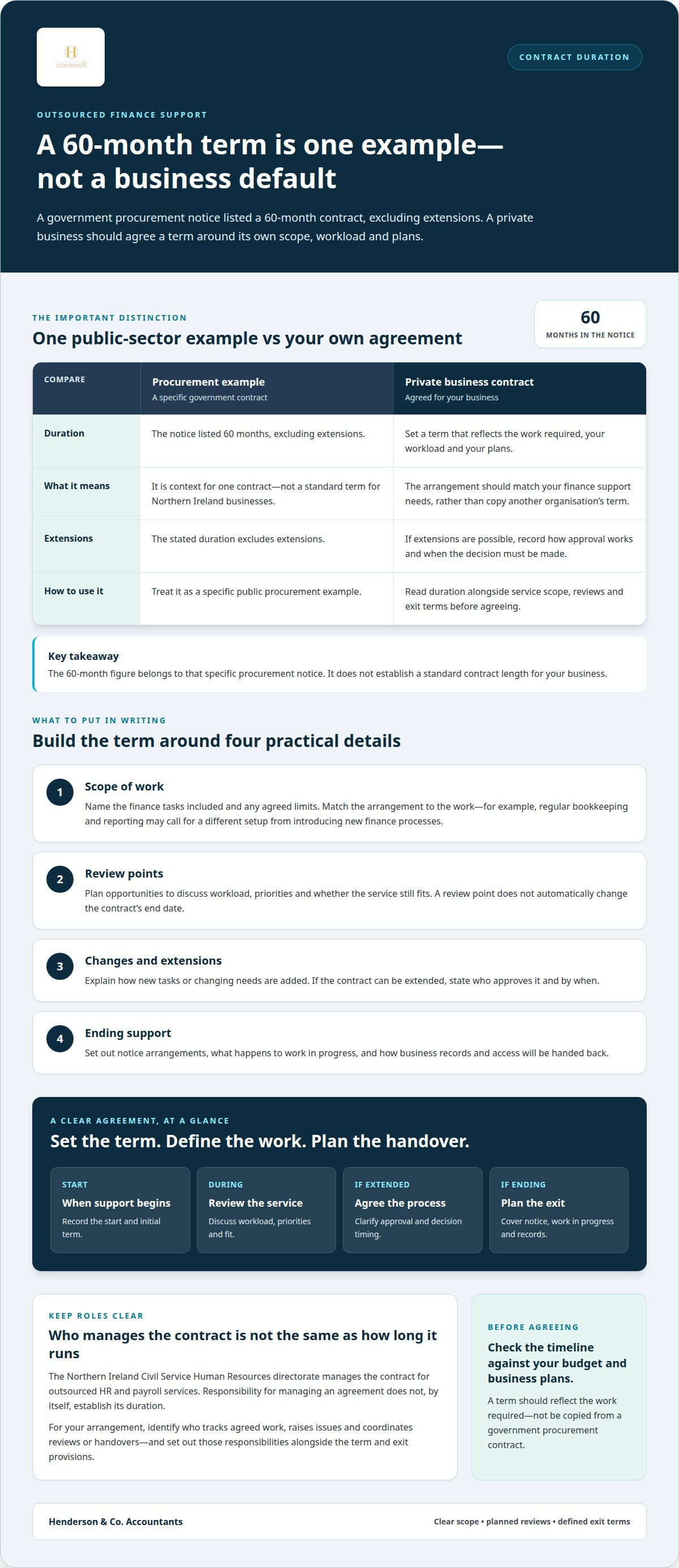
A Northern Ireland Department of Finance procurement notice listed a contract duration of 60 months, excluding extensions. That term applied to a specific government procurement, not every outsourced finance arrangement. A private business should agree a duration that reflects its own scope, workload and plans. The public-sector example provides context, but it isn’t a standard term for Northern Ireland businesses.
Start by separating the initial commitment from any extension period. A contract can state when support begins, how long the initial term lasts, and whether both parties can extend it. It should explain how an extension is approved and when that decision must be made. Clear dates help you plan your budget and avoid uncertainty about whether support will continue.
Next, match the term to the work involved. A business seeking regular bookkeeping and reporting may need a different arrangement from one setting up new finance processes. For example, moving records into a new system may require defined transition stages before routine support begins. The contract can describe those stages and specify when ongoing work takes over.
- Scope: name the finance tasks included and any agreed limits.
- Reviews: set review points to discuss workload, priorities and service fit.
- Changes: explain how new tasks or changing needs are added.
- Ending support: describe notice, handover steps and access to business records.
These details matter whether the proposed term is short or long. A review point doesn’t automatically change the end date; it gives both parties a planned opportunity to discuss whether the scope still fits. For instance, a growing business might review its reporting needs after launching a new sales channel.
Also consider what happens if you leave early. The written agreement should explain how notice works, what happens to work in progress, and how records are handed back. If the term includes extensions, the process should clarify who can approve them and by what date. These practical details help prevent an unexpected gap in financial administration.
Before signing, read the duration alongside the service scope, review process and exit terms. Ask how the proposed timeline supports your budgeting cycle and business plans. An outsourced finance department in Northern Ireland should be structured around the work required, rather than copied from a government procurement contract with a 60-month term.
The Northern Ireland Civil Service Human Resources directorate manages the contract for outsourced HR and payroll services. This is a reminder to distinguish who administers an agreement from how long it runs: responsibility for managing a contract does not, by itself, establish its duration. When reviewing an arrangement, identify the party responsible for contract management and ensure that role is clear alongside the term, review points and extension process.
That clarity can help keep discussions about service delivery separate from decisions about continuing the arrangement. Confirm who will track agreed work, raise issues and coordinate reviews or handovers. Record how these responsibilities fit with the contract’s duration and exit provisions. This makes the agreement easier to manage without treating another organisation’s arrangement as a template for your business.
Which outsourced finance providers operate in Northern Ireland?
Northern Ireland businesses can look at several provider models: accountancy practices, specialist finance teams and outsourced finance directors. These descriptions reflect different ways support is organised, rather than a ranking of named firms. The right fit depends on whether you need reliable transaction processing, regular management information or senior financial guidance.
An accountancy practice may combine bookkeeping with compliance work and routine financial reporting. This can suit a business wanting related finance tasks coordinated by one provider. For example, a retailer might need sales records organised alongside regular reports. Ask how the proposed service connects day-to-day records with the information you use to make decisions.
An outsourced finance team may focus on operational finance. Depending on the agreed scope, its work can include maintaining records, preparing reports and supporting budget tracking. This model may suit a business whose finance workload has outgrown occasional bookkeeping but does not yet require a full in-house department. Establish who handles each task and who provides oversight.
An outsourced finance director has a different focus. The role centres on financial planning and decision support, rather than simply processing transactions. A business considering expansion, for instance, may need help assessing cash-flow scenarios before committing to a plan. An outsourced finance director can be a good fit when strategic guidance matters more than additional routine processing capacity; similarly, for broader organisational transitions, exploring an interim CEO hire fractional executive model can provide flexible high-level leadership during periods of change.
Some providers work locally in Northern Ireland, while others support businesses across the United Kingdom. Location alone does not define the service. Consider how meetings, reporting and access to financial information will work for your team. A provider using cloud accounting may coordinate work remotely, while scheduled discussions can keep priorities clear.
Compare the proposed scope with your actual workload. Separate recurring tasks from decisions that need senior input. Then ask how the work will flow, who your main contact will be and what information you’ll receive. These points help distinguish a bookkeeping arrangement from broader finance support.
- Operational support: routine records, reconciliations and reporting.
- Planning support: budgets, cash flow discussions and financial decisions.
- Combined support: operational work alongside senior financial oversight.
For an integrated option, explore how outsourced finance department support could align day-to-day finance work with your management needs. The key is matching the provider’s responsibilities to the gaps you want to address, not choosing a label alone.
Outsourced vs in-house finance departments
The choice depends on how your business needs finance work delivered. An in-house team works within your organisation, while an outsourced arrangement assigns agreed tasks to an external team. For a Northern Ireland retailer, the decision may turn on whether daily access to finance staff matters more than flexible external support.
An in-house employee can build close knowledge of your products, customers and internal processes. They can speak directly with colleagues and respond to questions during the working day. For example, a manufacturer may value having finance staff involved in production meetings and purchasing decisions. That continuity can connect financial records with operational activity.
However, employing someone means managing recruitment, onboarding, workload and cover when they are unavailable. A sole finance employee may also have limited capacity to handle several tasks at once. If month-end reporting coincides with a budgeting project, priorities need careful management. A larger in-house team can share responsibilities, but the business must coordinate those roles.
Outsourced support gives a business access to agreed finance work without placing every task within its own organisation. A growing online retailer, for instance, may need regular transaction processing and clear reports, but not a full internal department. The arrangement can be shaped around defined responsibilities, reporting routines and management input.
It also changes how communication works. Internal staff may be easier to reach informally, whereas an external team needs agreed channels, deadlines and access to records. A weekly reporting schedule, for example, gives a business owner a regular opportunity to review cash movements and raise questions. The agreement should clarify who supplies information and who acts on it.
- Control: in-house staff are part of the organisation; outsourced work follows the agreed scope.
- Capacity: internal roles depend on the team employed; external support can cover specified tasks.
- Knowledge: employees learn the business directly; external teams need useful records and context.
- Continuity: plan how work continues during staff absence or changing requirements.
A blended approach is another option. A business might retain an internal administrator for invoices and use external support for reporting or financial planning. This can work when responsibilities are clearly separated. For example, one person can gather sales information while the external team prepares management reports for review.
To compare the models, list your recurring tasks, decision-making needs and preferred communication rhythm. Then identify which work requires daily internal involvement and which can follow a scheduled process. The best fit connects finance work to business decisions without leaving ownership of key information unclear.
What size and type of Northern Ireland business benefits from outsourced finance?
Business size alone doesn’t determine whether outsourced finance is useful. A stronger indicator is a gap between the financial work required and the capacity available internally. A small family-run shop may need regular reporting, while a larger firm may already have enough staff. Consider workload, complexity and the decisions that depend on timely financial information.
A start-up may have limited transaction volumes but need help understanding cash flow as sales develop. Its priorities could include organising records, tracking spending and planning for upcoming commitments. Outsourced support can suit this stage when the founder handles finance alongside sales, operations and customer service. The aim is to make financial information useful without building a full internal team.
A growing business may reach a different point. For example, a retailer adding online sales could face more payment channels, stock movements and reporting needs. If records take too long to reconcile, owners may struggle to see which activities affect cash flow. An external finance team can take on agreed work and prepare information to support management decisions.
Some businesses need more than routine processing. A construction company managing varied projects may want budgets and project results reviewed together. A seasonal tourism business may need planning that reflects uneven income across the year. In each case, fit depends on the complexity of the financial questions and how often leaders need guidance.
Consider these signs that external support may be relevant:
- Finance tasks compete with core work: owners spend time organising records instead of running operations.
- Reports arrive too late: decisions rely on outdated sales or cash information.
- Workload changes: busy periods create pressure, but quieter periods don’t justify permanent capacity.
- Growth adds complexity: new products, locations or sales channels make oversight harder.
Outsourcing may be less suitable when a business needs constant, immediate input from an employee embedded in daily operations. A manufacturing firm with frequent purchasing decisions, for instance, may value close internal coordination. A blended model can still work if staff handle daily information and external support provides defined reporting or planning.
Before deciding, map recurring tasks and the decisions they support. Note who currently prepares records, reviews results and responds to cash-flow changes. Then separate routine work from questions requiring management insight. This simple breakdown shows whether your needs are transactional, strategic or both.
An outsourced finance department in Northern Ireland can be considered by businesses at different stages, from a founder-led start-up to an established employer. The best indicator is whether the arrangement gives the business the financial capacity and insight its current operations require.
Choosing an outsourced finance provider in Northern Ireland
Choose a provider by matching its proposed work to your finance priorities. A Belfast retailer needing monthly reporting has different requirements from a construction firm tracking project budgets. Begin with the decisions you want better financial information to support, then identify the tasks needed to produce it.
Write a clear scope before comparing proposals. Include recurring work, expected reports and the level of management input required. For example, a growing online business might need transaction records organised alongside regular cash-flow updates. The proposal should distinguish routine processing from financial analysis, so responsibilities don’t blur.
Next, establish who will handle each part of the work. Ask how day-to-day queries are managed and who discusses reports with your leadership team. If one person gathers information and another prepares the analysis, make the handover process clear. A named contact and agreed communication rhythm help keep decisions moving.
Technology is another practical consideration. If your business uses cloud accounting, find out how the provider will work with your setup and receive the necessary records. For example, a hospitality business may need sales information from several channels brought together in useful reports. Agree how information is shared, who maintains records and how errors are raised.
Review the written proposal for these essentials:
- Scope: tasks included, exclusions and the reports you’ll receive.
- Responsibilities: information your team supplies and actions the provider handles.
- Communication: meeting arrangements, query routes and reporting dates.
- Changes: how new tasks or shifting workloads affect the arrangement.
- Handover: how records and unfinished work move if support ends.
Use a practical example to test the proposed process. Ask how the provider would turn late customer payments into a clear cash-flow report, or present results from a new sales channel. For businesses looking to minimise debtor administration, exploring dedicated accounts receivable solutions such as smartAR can illustrate how automated collection tools help reduce overhead alongside broader outsourced support. The answer should explain the steps, information needed and output you can expect. This reveals whether the approach fits your actual decisions.
Before appointing a provider, agree the scope and working arrangements in writing, then plan the transition. Identify existing records, outstanding tasks and the people who will provide information. A staged handover can help the provider understand your processes before taking responsibility for recurring work. Schedule an early review to discuss whether the reports and communication meet your agreed needs.
If you’re ready to discuss how outsourced finance support could fit your business, talk through your finance requirements and the work you want covered.
Henderson & Co. Accountants: Outsourced Finance Department
Henderson & Co. Accountants provides outsourced finance support for businesses that need clearer budgeting and financial management without building every finance role in-house. The work can be shaped around the tasks and insight your business needs, from ongoing finance support to guidance from an outsourced finance director.
For an eCommerce business, eCommerce Accounting can help bring financial activity into focus. Xero Cloud Accounting Setup and VAT Return Preparation can also help organise accounting processes and VAT work. The right starting point depends on your current workload and where you need practical support.
If you’d like to discuss your finance needs, contact Henderson & Co. Accountants.
Make your next finance decision with clarity
Use your next planning conversation to define what better financial visibility would help you decide. You might want to understand how a proposed investment affects cash flow or see which trading activities need closer attention. Write down the decision first, then identify the information and support that would help you assess it. This gives the discussion a practical starting point and keeps the focus on what your business needs next.
For a business considering an outsourced finance department in Northern Ireland, the next step is to connect those priorities with a workable scope of support. Henderson & Co. Accountants can discuss how its outsourced finance support may fit your organisation and financial management needs. Contact Henderson & Co. Accountants to start the conversation and explore a clear way forward for your business.
How Henderson & Co. Accountants can support your finance function
Henderson & Co. Accountants provides outsourced finance department services for businesses in Northern Ireland. If you need ongoing support with your finance function, the firm can help with bookkeeping, annual accounts, VAT return preparation and corporation tax returns.
You can also turn to Henderson & Co. Accountants for an outsourced finance director, payroll and CIS management, company secretarial services, eCommerce accounting or Xero cloud accounting setup. Choose support that fits the finance tasks you want to outsource.
Frequently Asked Questions
What services does an outsourced finance department provide in Northern Ireland?
An outsourced finance department can cover bookkeeping, payroll and CIS management, alongside financial oversight. The agreed scope may also include support from an outsourced finance director, depending on your business needs. For example, a construction business may need CIS administration, while an online retailer may prioritise bookkeeping and sales records. Henderson & Co. Accountants also offers VAT Return Preparation, Corporation Tax Returns and Annual Accounts as separate services.
How much does outsourced finance support cost in Northern Ireland?
The cost depends on the work involved and is provided after a quote request. Key factors include the tasks covered, the volume and condition of financial records, reporting requirements and the level of management support needed. For example, a business requiring regular bookkeeping has a different scope from one seeking bookkeeping plus financial planning. Setting out your priorities helps define the work behind the quote.
What financial reporting and management accounts should an outsourced finance department provide?
Agree on reports that help you make decisions, rather than relying on a generic pack. Useful management information can include income and spending against budget, cash-flow movements, outstanding customer payments and results by product or project. For example, a retailer could review sales and costs by channel to understand trading performance. Set the reporting frequency, format and review process around your planning cycle and the decisions you need to make.
How are confidentiality, data protection and financial access managed by outsourced finance providers?
Agree how the provider will access financial records, what information your team will supply, and the channels and deadlines for communication. The agreement should clarify responsibilities and the scope of the work.