
Monthly Management Accounts: Drive Smarter Business Growth

A set of accounts can be accurate and still arrive too late to guide a decision you need to make this month. Monthly management accounts give you a regular, internal view of your business’s finances, usually including profit and loss, cash flow and balance sheet information.
It’s understandable to rely on annual accounts to see how your business is doing, but they serve a different purpose. Statutory accounts are prepared annually to meet reporting obligations; monthly management accounts help you monitor performance and make decisions throughout the year.
This guide explains what management accounts show and how they differ from statutory accounts. You’ll learn how regular reporting can support cash-flow planning, cost control and decisions about pricing, hiring and investment. It also explains why up-to-date bookkeeping matters: reliable records make reports useful when you need to act.
Key Takeaways
- See how profit and loss, balance sheet and cash-flow reporting can give you a clearer picture of business performance.
- Understand why internal management reports serve a different purpose from annual statutory accounts.
- Use regular performance information to inform choices about costs, pricing, hiring and investment.
- Learn how cash-flow forecasts can help you plan for upcoming payments and funding needs.
- Find out why accurate, timely bookkeeping helps make management reports more useful for decisions.
What are monthly management accounts?
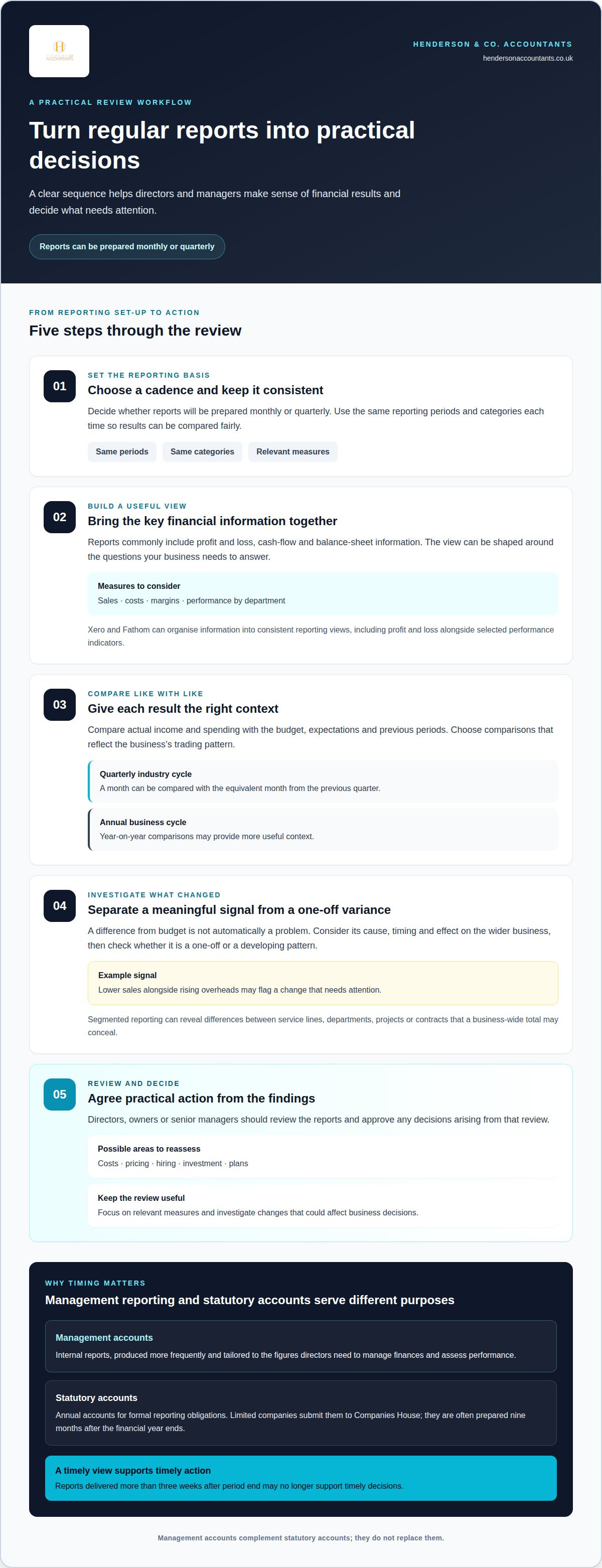
These internal reports help directors, owners and senior managers monitor finances and make business decisions. They are commonly prepared monthly or quarterly, with no prescribed format. Directors, owners or senior managers should review them, then approve any decisions arising from that review.
Profit and loss reporting
A profit and loss report summarises income and costs over a chosen period, showing whether the business made a profit. Monthly management accounts can compare results with expectations and previous periods. For example, lower sales alongside rising overheads may flag a change that needs attention. Read alongside cash-flow and balance-sheet information, the report gives a fuller picture than profit alone.
Accountant support for reporting
An accountant can shape reporting around the questions your business needs to answer. Agree which figures matter, such as sales, costs, margins or performance by department, and use consistent categories to make comparisons clearer. This can connect financial results with investment and strategic decisions. Owners and directors can review the same information and focus on practical actions, such as investigating a cost increase or reassessing a plan.
Setting up management reports in Xero and Fathom for clients
Setting up Xero and Fathom can organise financial information into reports that are easier to review. An accountant can align categories and reporting periods, then configure views around measures relevant to your business. For example, a report might show profit and loss information alongside selected performance indicators. A clear setup helps managers interpret results consistently, rather than spend review time working out how figures have been grouped.
Segmented reporting for profitability
Segmented reporting separates results by service line, department, project or contract. It can show which parts contribute profit, where costs are rising and where opportunities may exist. For example, an overall result could conceal weaker performance in one department and stronger results in another. An SME increased profitability through segmented reporting over a period of 9 months. This approach can help managers focus attention on specific areas for action.
Consistent segments and reporting periods make comparisons more useful. Reviewing the same service lines or departments each month can reveal changes hidden by a business-wide total. An accountant can help choose segments that support your decisions, keeping monthly management accounts focused on relevant measures and giving owners practical context for investment and planning.
Management accounts compared with statutory financial statements
Management accounts are not legally required in the UK, unlike statutory accounts, which limited companies submit to Companies House annually. Inaccurate or late reports can lead to decisions based on misleading figures. Reports delivered more than three weeks after period end may no longer support timely action.
Differences from statutory financial statements
Management accounts are internal reports for business decisions, while statutory financial statements meet formal reporting obligations to HMRC and Companies House. Statutory accounts are prepared annually and often nine months after the financial year ends, so they may not reflect current trading. Internal reports can be produced more frequently and tailored to the figures directors need to manage finances and assess performance.
For example, a director considering a new hire needs a current view of costs and results, rather than relying only on the previous year’s statutory figures. The two report types serve different purposes: management accounts complement, rather than replace, statutory accounts.
Consistent preparation over time
Consistent preparation means using the same reporting periods and categories so results can be compared fairly. If sales costs are grouped differently each month, a change in the total may reflect categorisation rather than business performance. A consistent approach gives directors a more dependable view of changes across periods and helps them decide whether a difference needs investigation.
The first set of management accounts can establish a benchmark. Later reports can show changes against that starting point, helping distinguish a one-off variance from a developing pattern.
Tracking trends in results
Comparing results across periods helps reveal trends that a single report can conceal. A business with a quarterly industry cycle might compare a month with the equivalent month from the previous quarter. A business with an annual cycle may find year-on-year comparisons more useful. These comparisons provide context for changes in revenue, costs or margins and show where closer review may be needed.
For example, a gradual fall in a department’s results across comparable periods may call for a closer look at its costs or sales. Comparing like with like makes the signal easier to spot.
Budget and actual comparisons
A budget-versus-actual comparison sets planned income and spending against the figures recorded for the same period. It helps managers see where results differ from expectations and decide whether to adjust spending, revise plans or investigate a variance. A higher cost is not automatically a problem: its cause, timing and effect on the wider business matter.
Reviewing a difference alongside previous periods adds context. A one-off expense, for instance, may explain a monthly variance, while repeated overspending could indicate that a budget needs revisiting.
When comparisons need to inform wider financial decisions, an outsourced finance director can help interpret reporting and support planning.
Business planning and decision-making benefits
Management accounts can help you connect financial results with the decisions facing your business. Turnover of roughly £500,000 is often a point to consider introducing them, but the practical need depends on how much visibility you need. For example, if annual figures leave you unsure whether the business can afford expansion, regular reporting can give you a more current basis for planning.
Use the reports to assess choices such as pricing, hiring and resource allocation. If a proposed hire would increase staff costs, the latest profit and loss report can show how those costs relate to current income. If sales are changing, reviewing the figures before adjusting prices can help you weigh the effect on profit. Management accounts support these decisions with financial information; they do not replace commercial judgement.
Growth brings more moving parts to monitor. ACCA describes regular management reporting, formal business planning and financially trained staff as prerequisites for rapid growth that does not jeopardise a business’s survival and longevity. Reports should do more than present totals: they should help managers understand performance, spot emerging pressures and connect financial results with a plan. For example, review a hiring plan alongside the costs and income it is expected to affect.
The gap between annual accounts and current business information can become problematic once turnover passes roughly £1 million. Annual figures provide a retrospective view, while a growing business may need information that reflects changing activity during the year. If new sales channels, costs or staffing needs are altering the picture, regular reporting can help you see those changes sooner and consider their effect on plans.
The format should suit the decisions you need to make. A useful report might include profit and loss information, cash position, balance-sheet figures and key performance indicators. Each has a different role: profit and loss helps assess trading results, cash information supports spending decisions, and indicators put changes in performance into context. An accountant can help select measures that answer your business questions, rather than add figures that do not inform action.
Clear, consistent financial reporting can also build credibility with lenders and investors. If you are preparing to discuss funding, well-organised reports can help explain business performance and support your plans with relevant figures. Less than half of small and medium-sized businesses prepare management accounts, so a regular reporting process can give you a clearer view of progress and a stronger basis for financial discussions. For owners aiming to use these performance insights to maximise company worth, strategic advisory firms like 41 Legacy can help protect and grow long-term enterprise value.
Cash position
A cash-flow report shows when money enters and leaves the business, helping you understand the cash available for upcoming commitments. It complements profit figures: a sale may appear in the accounts before the customer pays, while supplier costs may fall due sooner. Reviewing cash movements helps identify timing pressures and assess whether planned spending fits the money expected to be available.
A cash forecast commonly looks ahead 8 to 13 weeks. It brings expected receipts and payments into view, such as customer invoices, supplier bills, payroll and regular operating costs. For example, if several large customer payments are expected after a payroll date, the forecast can highlight a short-term squeeze. This visibility gives managers time to consider action, such as following up overdue invoices or rescheduling planned expenditure.
Cash-flow analysis is most useful when it reflects realistic payment timing. An invoice date alone does not show when cash will arrive, so expected customer payment dates matter. Similarly, a supplier bill affects the forecast when payment is due, not simply when the expense was recorded. Comparing expected receipts with actual cash movements shows whether assumptions remain useful and where a gap may be developing.
Reviewing cash at least monthly helps inform decisions about budgets, investment, funding or borrowing needs. A business considering equipment, for instance, can weigh the planned payment against forecast receipts and existing commitments. If the forecast shows limited headroom, managers may adjust the timing or review other spending. If receipts are stronger than expected, the business can assess whether investment is affordable while retaining cash for upcoming obligations.
Each updated report should clearly show opening cash, expected inflows, expected outflows and the resulting position. A month-end balance alone cannot explain how cash changed or what is due next. Showing expected and actual figures side by side makes differences easier to investigate. For example, slower customer payments may explain why the current balance falls below the earlier forecast.
Regular monitoring also helps identify patterns before they become harder to manage. If customer receipts repeatedly arrive later than expected, the timing may affect supplier payments or planned purchases. A seasonal business can build expected changes in receipts across the year into its forecast. Managers can then discuss practical action using the same cash information, rather than relying on a single balance or an outdated estimate.
Good forecasting depends on current bookkeeping and relevant information about upcoming payments and receipts. When records are maintained consistently, each new forecast can be compared with the last. This makes it easier to understand what changed, update expectations and base cash decisions on the business’s current position.
Bookkeeping and preparation of management accounts
Reliable management reports start with bookkeeping that accurately records the business’s financial activity. Sales invoices, supplier bills, receipts and bank transactions help explain the figures behind revenue, costs and cash. If a customer payment is recorded against the wrong invoice, the reported position may be misleading. Consistent records help an accountant prepare accounts that reflect the period under review and support decisions based on current information.
Timing matters too. Businesses should aim to receive monthly management accounts within 10 working days of the period end. With clean bookkeeping, producing them within five working days is described as achievable. Reports delivered more than three weeks after period end may no longer support timely decisions. For example, a late report could show a cost increase only after the business has already committed to further spending.
Before preparing a report, an accountant uses bookkeeping records to organise transactions into meaningful categories. Record sales under the right revenue headings, and describe and treat costs consistently. For a business selling through several channels, separating sales by channel can make changes easier to interpret. Accurate categorisation helps managers understand whether a shift in profit reflects revenue, direct costs or overheads.
Incomplete records can distort key measures. If a supplier bill arrives after month-end but relates to that period, leaving it out can make costs appear lower. This may overstate profit or margin and give managers an unreliable basis for action. The same problem arises when customer payments are missing or transactions are duplicated. An accountant’s review of unusual movements and supporting records can identify errors before they shape a decision.
Prepare management reports as soon as possible after each month ends, using information complete enough to explain performance. Typical reports include key performance indicators, a profit and loss statement, the cash position and the balance sheet. An accountant can tailor the format to the owner-manager’s priorities and explain significant movements. For example, a fall in margin alongside rising supplier costs points to a different issue than lower revenue alone.
Clean bookkeeping also makes it easier to compare reporting periods. When categories stay consistent, managers can see whether a change is a genuine trend or a recording difference. If transaction details are unclear, an accountant may need supporting invoices or explanations before presenting the figures. Well-organised records throughout the period therefore support accurate reporting and timely decisions.
If bookkeeping is delaying useful reports, get professional bookkeeping support to help keep records organised for management reporting.
Henderson & Co. Accountants: Payroll and CIS Management
Henderson & Co. Accountants helps businesses organise key financial processes through services such as Xero Cloud Accounting Setup, eCommerce Accounting and Annual Accounts. If payroll or Construction Industry Scheme administration adds complexity to your records, Payroll and CIS Management can support that part of your finance operations.
Turn to professional support when financial information is difficult to organise or your reporting needs to fit the way your business operates. A suitable accounting setup can help create clearer records for reviewing performance and planning decisions, while annual accounts address a separate reporting need.
For help with payroll, CIS or related accounting support, contact Henderson & Co. Accountants.
Make your next decision with greater clarity
Make financial reporting part of how you steer the business, not simply a record of what has already happened. Monthly management accounts can turn current figures into considered decisions, especially when your priorities or operations are changing. Start by deciding which information would make your planning clearer, then build reporting around those questions.
Henderson & Co. Accountants can support connected finance needs through eCommerce Accounting, Xero Cloud Accounting Setup and VAT Return Preparation. The right support can help keep reporting aligned with the way your business operates and the decisions you need to make.
Start a conversation about the accounting support that fits your business. Contact Henderson & Co. Accountants to discuss your next step and move forward with a clearer view of your finances.
Henderson & Co. Accountants and monthly management accounts
Henderson & Co. Accountants supports the financial processes behind monthly management accounts through bookkeeping, Xero Cloud Accounting Setup and outsourced finance services.
Turn to the firm when you need help maintaining financial records or managing finance in-house. Its services also include VAT Return Preparation, Corporation Tax Returns, payroll and CIS management, annual accounts and company secretarial services.
Frequently Asked Questions
When Does a Business Actually Need Them?
A business may need regular management reporting when annual figures no longer provide enough information for decisions during the year. This often happens as sales channels, staffing, costs or projects become harder to oversee together. For example, an owner planning a new product range may need to understand its costs separately. The right reporting frequency depends on how quickly the business changes and how often managers need current financial insight.
Who Prepares Them?
An accountant or finance professional commonly prepares management accounts using the business’s bookkeeping records and agreed reporting needs. They organise the figures, investigate unclear entries and present information in a format managers can use. Directors, owners or senior managers then review the reports and decide what to do. For example, a manager may ask for costs grouped by business area to identify which operations need closer attention.
What do these internal reports include?
Monthly management accounts are internal financial reports prepared for a regular period to help a business understand its position and performance. They may include profit and loss information, a balance sheet, cash-flow information and selected performance indicators. The mix depends on the decisions the reports need to support. For an online retailer, for example, showing sales channels separately can make changes in trading easier to interpret.
Why do UK businesses prepare monthly management accounts?
UK businesses prepare them to make informed decisions between annual reporting dates. Regular insight can help managers assess whether spending plans remain realistic, understand changes in performance and identify issues that need attention. For example, a business considering a new supplier can review current costs alongside its wider plans. Reports also give managers a shared set of figures for discussing priorities and deciding what needs further investigation.
What is the difference between management accounts and statutory accounts in the UK?
Management accounts are for internal business use, while statutory accounts meet formal annual reporting obligations. Internal reports can be shaped around the questions directors need to answer; statutory accounts follow applicable reporting requirements. A company might use internal figures to review a proposed expansion during the year, then prepare statutory accounts for its reporting obligations. Neither replaces the other, as each serves a distinct purpose.
What financial statements and key performance indicators should monthly management accounts include?
A useful set commonly includes a profit and loss statement, balance sheet and cash-flow information, alongside indicators chosen for the business. Relevant measures might include sales by channel, gross margin, overdue customer balances or staff costs, depending on the business model. A retailer and a consultancy may need different indicators. The aim is to present figures managers can act on, rather than add measures that do not inform decisions.
How to prepare monthly management accounts step by step
Keep bookkeeping clean and consistent, then choose reporting periods, categories and measures suited to the business. Prepare profit and loss, cash-flow and balance-sheet reports, compare results with budgets or previous periods, and review them to identify actions.
Which UK accounting software can automate monthly management accounts?
Xero and Fathom can be set up to organise financial information into reports, with categories, reporting periods and views tailored to the business.