
Management Accounts Northern Ireland: A Strategic Guide

Clear management accounts are more useful than a set of figures that arrives too late to guide a decision. For businesses operating across the UK, including regional enterprises in Northern Ireland, management accounts can bring together illustrative profit and loss, cash flow and balance sheet proformas, helping you see how the business is performing and where cash may be tied up. Prompt invoice payment matters because sales recorded on paper don’t put money in the bank until customers pay.
It’s understandable to want a clear view of what your numbers mean, especially when revenue, costs and cash don’t move in step. Here at Henderson & Co. Accountants, we know a well-prepared pack can help you spot changes, understand outstanding invoices and decide what action could support day-to-day decisions.
This guide explains what management account proformas can show, how reporting frequency can suit your business, and why timely invoicing and follow-up matter. You’ll also learn what information helps an accountant prepare useful accounts, so you can make financial decisions with greater clarity.
Key Takeaways
- Choose a reporting rhythm that gives you timely information for decisions, with monthly reports useful when you need a regular view of performance and cash.
- Management accounts support day-to-day planning, while statutory accounts serve a different reporting purpose. Knowing which is which helps you use each set of figures appropriately.
- Profit and loss, cash flow and balance sheet reports each show a different part of your business’s financial position; invoice payment information adds useful context about cash coming in.
- A clear preparation process depends on organised records and reconciled figures, so the reports give you a dependable basis for decisions.
- Accounting software such as Xero can support accessible financial records, while payroll and CIS management can help keep workforce-related processes organised.
How often should an accountant prepare management accounts for a Northern Ireland business?
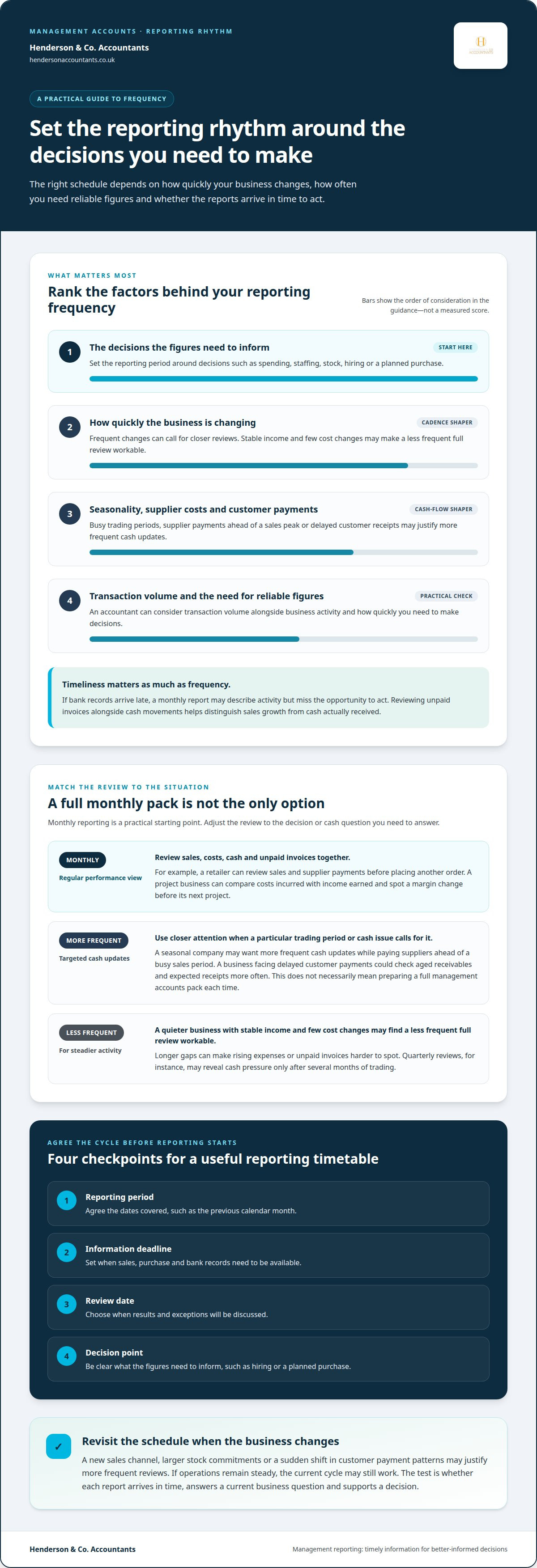
Set the reporting rhythm around the decisions you need to make. Monthly reporting is a practical starting point for reviewing sales, costs, cash and unpaid invoices together. Management accounts in Northern Ireland can give you a regular view of recent activity without waiting for year-end accounts. The right frequency depends on how quickly your business changes and how often you need reliable figures to act.
Use monthly reporting if regular changes could affect spending, staffing or stock. For example, a retailer can review sales and supplier payments each month before placing another order. A business with large projects can compare costs incurred with income earned, then spot a margin change before the next project begins. The reporting period should match the decisions you need to make.
Some businesses need closer attention during particular trading periods. A seasonal company may want more frequent cash updates while paying suppliers ahead of a busy sales period. A business facing delayed customer payments could review aged receivables and expected receipts more often. These targeted reviews don’t necessarily require a full management accounts pack each time.
A quieter business with stable income and few cost changes may find a less frequent full review workable. However, longer gaps can make it harder to spot rising expenses or unpaid invoices. For instance, quarterly reviews may reveal cash pressure only after several months of trading. An accountant can consider transaction volume, seasonality and how quickly the business needs to make decisions.
Agree the practical timetable with your accountant before reporting starts. The cycle should identify:
- Reporting period: the dates covered, such as the previous calendar month.
- Information deadline: when sales, purchase and bank records need to be available.
- Review date: when the accountant discusses results and exceptions with you.
- Decision point: what the figures need to inform, such as hiring or a planned purchase.
Timeliness matters as much as frequency. If bank records arrive late, a monthly report may describe activity but miss the opportunity to act. An accountant can establish a repeatable close process, reconcile the records and flag missing information before preparing the pack. For example, reviewing unpaid invoices alongside cash movements helps distinguish sales growth from cash actually received.
Revisit the schedule when the business changes. A new sales channel, larger stock commitments or a sudden shift in customer payment patterns may justify more frequent reviews. If operations remain steady, the current cycle may still work. For management accounts in Northern Ireland, ask whether each report arrives in time, answers a current business question and supports a decision. Management accounts should inform action, not simply create another reporting deadline.
What is the difference between management accounts and statutory accounts?
Management accounts help you understand current performance and make business decisions. Statutory accounts present a formal picture of a company’s financial activity for external reporting. The same sales and expense records may inform both, but the reports serve different purposes. For example, a monthly management report can help you assess a new product line, while year-end accounts summarise the company’s financial position over its reporting period.
Management accounts are decision-focused. An accountant can shape them around the questions you need answered, such as whether a product is profitable or overheads are rising. They may include budget comparisons, explanations of unusual movements and details by department or sales channel. If an online retailer sees higher sales but weaker margins, a breakdown by product can help pinpoint the change.
Statutory accounts are formal financial statements. Their purpose is not to provide a running commentary for weekly decisions. They present financial information in a structured form, using the company’s accounting records and relevant reporting basis. For instance, a director reviewing year-end results may use these statements to understand the overall position, rather than compare the latest month’s sales with a budget.
The reporting timetable and level of detail also differ. Management accounts can be prepared regularly during the year, with frequency shaped by business activity and decisions. Statutory accounts relate to a defined accounting period. A monthly pack might explain why staff costs changed, while annual statements show those costs within the wider results for the period.
Neither report replaces the other. Management accounts can be more useful for operational choices, but similar figures don’t make them statutory accounts. The formal statements require their own preparation and review. Likewise, statutory accounts alone may not provide the timely detail needed to manage cash, compare performance or respond to a sudden change in customer demand.
When both are prepared from consistent records, they provide complementary views. An accountant can use reconciled bookkeeping as the foundation, organise management information for decision-making and prepare formal year-end statements separately. Differences between a monthly report and annual figures may result from adjustments made during year-end preparation, so clear explanations help you understand what changed.
If you need the formal year-end statements as well as useful reporting during the year, annual accounts support can sit alongside management reporting. The key is to use each report for its purpose: management accounts to guide choices during trading, and statutory accounts for a structured view of the completed reporting period.
What financial reports should an accountant include in monthly management accounts?
A useful monthly pack combines reports that explain performance, financial position and cash movement. Each report answers a different question. A profit and loss report shows whether trading produced a surplus or loss; a balance sheet shows assets and liabilities at the period end. Together, they provide more context than a sales total alone.
An accountant can tailor the pack to your business model. A shop may need sales by product category, while a consultancy may focus on project income and staff costs. Reports should make changes visible, not bury them in account codes. Brief commentary can explain a movement, such as higher delivery costs reducing gross margin.
- Profit and loss report: compares income and expenses for the month. A separate view of gross profit can show whether rising sales are also producing stronger margins.
- Balance sheet: summarises assets, liabilities and reserves at the month end. Trade debtors, supplier balances and stock can help explain why reported profit differs from available cash.
- Cash flow report: tracks money received and paid, then shows the effect on cash. For example, strong invoiced sales alongside slow customer payments may leave less cash available for supplier bills.
- Budget-versus-actual report: compares results with the agreed plan. If marketing spend exceeds budget, the accountant can show the variance and help identify whether it reflects timing or a genuine overspend.
- Aged receivables report: groups unpaid customer invoices by how long they have remained outstanding. It helps you prioritise follow-up and understand which expected receipts have not reached the bank.
- Aged payables report: lists unpaid supplier invoices and their due dates. This supports payment planning, particularly when several large bills fall close together.
For an online seller, a sales breakdown by channel can add valuable detail. It can compare marketplace, website and in-person sales, then show related fees or refunds. A service business may benefit more from project or department reporting. The accountant should select breakdowns that connect directly to decisions, rather than add detail simply because the software can produce it.
Clear commentary ties the reports together. If the profit and loss report shows increased sales while cash flow falls, the receivables report may reveal delayed payments. That link explains the difference between earning revenue and receiving it. A monthly pack can also flag missing records or unusual balances for discussion, making the figures easier to interpret before decisions are made.
Ask for a consistent layout each month. Keeping report categories and comparison periods stable makes it easier to spot patterns, such as recurring cost increases or seasonal sales changes. The pack should provide both the figures and a concise explanation of what needs attention.
How does an accountant prepare management accounts for a small business step by step?
A clear process turns everyday bookkeeping records into useful business information. The accountant first agrees the reporting period and the questions the figures should answer. For a small business, that might mean tracking gross margin, cash available for supplier payments or revenue from a new sales channel. A consistent process also makes changes between reporting periods easier to understand.
- Agree the reporting purpose. The accountant establishes which decisions the reports need to support, such as reviewing overheads or planning a purchase. A café might want to compare food costs with sales, while a consultancy may need to understand income and costs by project. This shapes the level of detail and the comparisons included.
- Gather the records. The accountant brings together bookkeeping entries, bank transactions, sales invoices, purchase invoices and payroll information for the period. The business supplies relevant records and explains unusual transactions. For example, a one-off equipment purchase should be distinguishable from regular monthly costs.
- Reconcile balances. The accountant compares the records with bank statements and supporting documents, then investigates differences. A bank transaction missing from the bookkeeping, or a customer receipt allocated to the wrong invoice, can distort the reports. Reconciliation helps ensure that the figures reflect recorded activity rather than an incomplete snapshot.
- Review outstanding items. The accountant examines unpaid customer invoices, supplier bills and other balances. If an invoice remains unpaid, it may appear as income earned but not cash received. The accountant can present that distinction clearly, helping the business understand expected receipts and upcoming payments.
- Prepare and analyse the reports. Once the records are organised, the accountant prepares the agreed reports and compares results with a budget or earlier period. A fall in gross margin, for instance, may relate to higher purchase costs or a change in the sales mix. Commentary should explain the movement in terms the business can use.
- Discuss findings and follow-up. The accountant presents the figures, highlights unusual movements and answers questions about their meaning. If sales rose but cash fell, the discussion might focus on invoice timing, stock purchases or supplier payments. Any missing information or unresolved balance can be recorded for follow-up, rather than hidden within the totals.
Timing depends on how quickly complete records reach the accountant and how complex the activity is. Regular bookkeeping and clear records of sales, costs and payments make preparation more straightforward. A growing business may also need new reporting categories, such as separate results for an online shop and a physical outlet.
The finished pack should connect figures to decisions. It can show what changed, identify balances that need attention and give the business a clearer basis for its next planning conversation.
Common management accounting software in Northern Ireland
Xero is a cloud accounting platform that can support the bookkeeping records behind management accounts. It organises transactions and makes financial information accessible for review, but doesn’t decide what your reports should explain. An accountant still needs to reconcile the records, interpret movements and shape reports around business decisions.
For a business in Northern Ireland, the right setup depends on how transactions arise. An online retailer may need sales grouped by channel, while a consultancy may want costs linked to projects. The chart of accounts, tracking categories and reporting layout should reflect those needs. If everything is posted to broad categories, the figures may not show which part of the business changed.
A useful software setup supports a repeatable monthly process. The accountant can review transactions, reconcile bank balances and check that income and costs appear in appropriate categories. For example, separating delivery charges from product purchases can make gross margin easier to interpret. Clear records also help identify unmatched payments or invoices that need attention before reports are prepared.
- Bank transactions: reconciliation helps compare recorded entries with bank activity and identify missing or duplicated items.
- Sales records: consistent categories can distinguish income by channel, service or product group.
- Costs: appropriate coding can separate regular overheads from project or stock costs.
- Reporting: saved report layouts can make period comparisons easier to follow.
Software alone won’t make management accounts reliable. Incorrect coding can put a supplier bill in the wrong category, while unreconciled transactions can distort the cash position. The accountant’s review matters: they investigate unusual balances, ask about unclear entries and explain significant movements. For instance, rising sales alongside lower cash may prompt a closer look at unpaid customer invoices.
Choose a system based on the records your business needs to manage and the reports you need to discuss. A small service company may value straightforward bank reconciliation and project tracking. An eCommerce business may need sales and fee information clearly organised across its trading channels. The setup should make records consistent, without adding complexity that doesn’t support a decision.
Henderson & Co. Accountants provides Xero cloud accounting setup to help establish a system around your business records and reporting needs. If Xero is the platform you want to use, arrange a setup that supports clean bookkeeping and meaningful management reports.
Henderson & Co. Accountants: Payroll and CIS Management
Henderson & Co. Accountants provides Payroll and CIS Management to help businesses keep workforce records organised. Clear payroll information can make staff costs easier to review alongside other figures in a management accounts pack. The firm also prepares Annual Accounts. For online sellers, eCommerce Accounting supports accounting needs linked to their business model, while Xero Cloud Accounting Setup helps establish software for recording transactions.
These services can support your wider finance processes when payroll, CIS records, online sales or accounting setup are involved. The right support depends on your business needs. To discuss your accounting requirements, contact Henderson & Co. Accountants.
Make your next finance decision with clarity
Use your next reporting conversation to identify the decision you want your figures to support. That might mean planning a staffing change, reviewing a new sales channel or understanding how tax and cash commitments affect your options. For a business seeking management accounts in Northern Ireland, the value lies in turning financial information into a considered next step.
Henderson & Co. Accountants supports connected finance needs through eCommerce Accounting, Xero Cloud Accounting Setup and VAT Return Preparation. These services can help bring accounting records and reporting requirements into clearer view, so your financial processes keep pace with the decisions ahead.
Take the next step at a pace that suits your business. Talk to Henderson & Co. Accountants about the support that fits your needs, and move forward with greater confidence.
Henderson & Co. Accountants for management accounts support
Henderson & Co. Accountants provides bookkeeping, Annual Accounts and outsourced finance support for businesses seeking management accounts in Northern Ireland.
Turn to the team for support with ongoing financial records or a wider finance function. Services also include eCommerce Accounting, Xero Cloud Accounting Setup, VAT Return Preparation, Corporation Tax Returns, Payroll and CIS Management, and Company Secretarial Services.
Frequently Asked Questions
What are management accounts and what do they include?
Management accounts are internal financial reports that help owners assess how their business is performing. A pack can bring together financial statements and tailored analysis, such as sales by product, costs by project or performance against a budget. For example, a catering business could use event-level results to see which bookings contribute most to its income. The accountant shapes the information around the decisions the business needs to make.
Do Northern Ireland businesses have specific rules for management accounts?
Management accounts are generally prepared for internal use, rather than as a prescribed statutory filing. A business in Northern Ireland can agree a format and reporting cycle suited to its operations, while keeping management reporting distinct from formal statutory accounts. For example, an owner may request a report by department for planning, even if that breakdown isn’t part of the company’s year-end statements.
How can management accounts help with cash flow, budgeting and business decisions?
They can help you compare planned spending with actual results and see how timing affects available cash. For example, a business considering a new supplier arrangement can review expected costs alongside customer payment patterns before committing. A report may also help assess whether a proposed hire fits the current budget. The value lies in using relevant figures to weigh options, identify trade-offs and plan the next decision.
What should businesses check when choosing a Northern Ireland accountant for management accounts?
Look for support that explains how reporting will reflect your business model, records and decisions. A retailer may need useful sales breakdowns, while a contractor may prioritise clear project costs. Henderson & Co. Accountants offers bookkeeping and Outsourced Finance Director services to support financial record-keeping and strategic finance needs. Consider whether the reporting provides clear explanations, not just a collection of figures.
What are common management-accounting errors and risks for small businesses?
Common risks include relying on late or unreconciled records, which can make reports untimely or unreliable. Businesses may also mistake invoiced sales for cash received, overlook unpaid invoices or use management accounts as a substitute for statutory accounts.