
Filing Dormant Company Accounts: A Complete UK Guide

Dormant doesn’t mean paperwork-free. Dormant company accounts are still required each year, even when a company has had no significant transactions during its financial year. For a private company that qualifies as small and dormant, the filing can be simpler than full annual accounts, but the deadline still matters: according to Companies House, accounts are due nine months after the company’s year end.
It’s easy to assume that stopping trading makes a company dormant. The key is knowing which transactions affect its status, what the accounts must include and which filing duties continue.
This guide explains how dormancy works for Companies House and HMRC, what dormant accounts contain and what to consider when deciding whether to keep or close a company. It also sets out practical next steps based on the company’s circumstances.
Key Takeaways
- Understand which transactions can affect your company’s dormant status, including everyday bank activity.
- See why a dormant company still has annual filing duties and what a simplified set of accounts may contain.
- Learn how Companies House dormancy differs from dormancy for Corporation Tax purposes.
- Consider whether keeping the company dormant makes sense, or whether closing it is the more practical choice.
- Find out how Company Secretarial Services and Annual Accounts can help you manage ongoing company obligations.
Dormant company: What must a company do to stay dormant?
Companies House and HMRC use different tests for dormancy, so one status doesn’t automatically settle the other. Your transactions and any HMRC notice determine which filing duties apply.
Dormancy under HMRC and Companies House
In the UK, a dormant company has no significant transactions for Companies House, or no trading activity or other income for Corporation Tax purposes. Companies House assesses transactions during the financial year; HMRC focuses on activity relevant to Corporation Tax. A new company that hasn’t started trading may be dormant for HMRC, whilst Companies House applies its own test. The distinction matters because accounts and tax-return duties can differ.
What counts as a significant transaction?
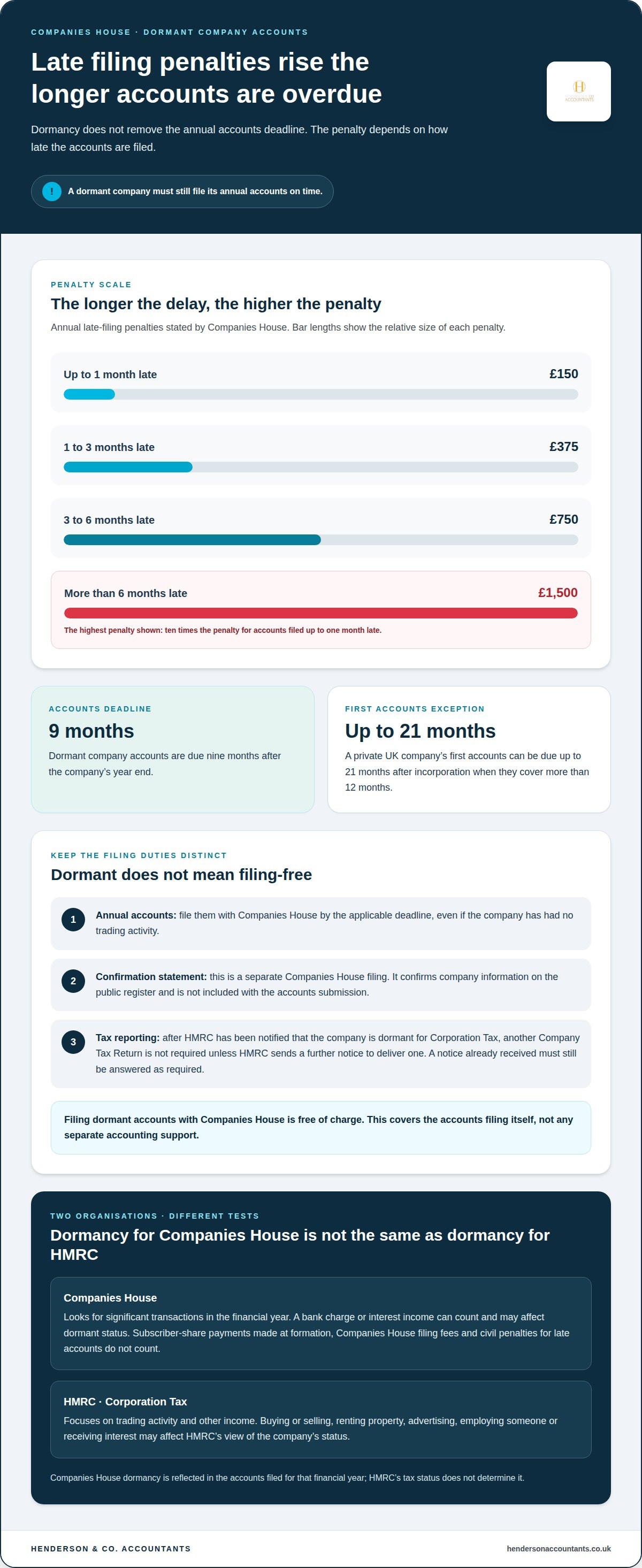
For Companies House, a significant transaction is generally a financial transaction recorded in the company’s accounting records. Payments for subscriber shares made at formation, Companies House filing fees and civil penalties for late accounts do not count. A bank charge or interest income can count, however, and may affect dormant status for that year. For example, a bank account fee could mean the company no longer meets Companies House’s dormancy test.
For Corporation Tax, buying or selling, renting property, advertising, employing someone or receiving interest may count as trading activity or income. These activities can affect HMRC’s view of the company’s status, even if Companies House treats it differently.
Notifying the relevant organisations
Notify HMRC when the company becomes dormant for Corporation Tax. After notification, HM Revenue & Customs says the company need not pay Corporation Tax or file another Company Tax Return unless HMRC sends a further notice to deliver one. If the company has already received a notice, it must respond as required: dormancy alone does not cancel it. Companies House dormancy is reflected in the accounts filed for the relevant financial year, rather than determined by HMRC’s tax status.
Accounts deadlines and the first filing
A UK dormant company’s annual accounts are due nine months after its year end, according to Companies House. Companies House says a private UK company’s first accounts can be due up to 21 months after incorporation when those accounts cover more than 12 months. Use the company’s accounting reference date to identify the relevant year end, then prepare and file the accounts by the applicable deadline.
Late filing penalties
Companies House applies penalties to late accounts, including dormant filings. The annual late-filing penalty is £150 for accounts filed up to one month late, according to Companies House. The penalty is £375 for accounts filed one to three months late, and £750 for accounts filed three to six months late, according to Companies House. For annual accounts filed more than six months late, the penalty is £1,500, according to Companies House. Keep the deadline in view even when the company has had no trading activity.
Why Does a Dormant Company Still Need to File Accounts?
Dormancy reduces some reporting requirements, but it does not remove a limited company’s Companies House duties. The company must keep its records current and meet the filing requirements that apply.
Dormant accounts and audit exemptions
A private company that qualifies as both small and dormant can submit an unaudited abbreviated balance sheet with prescribed notes. This streamlined filing provides Companies House with the required information without a full set of accounts.
A UK company that is dormant according to Companies House and qualifies as small does not have to include an auditor’s report with its accounts. This audit-related exemption does not remove the filing requirement. Directors remain responsible for ensuring accounts and reports are properly prepared and filed on time.
The balance sheet records the company’s financial position at the end of its financial year, and prescribed notes provide the required context. The accounts must reflect the company’s actual records for the period. If its activity means it no longer meets the dormancy test, simplified dormant accounts may not be appropriate.
Companies House filing rules
A limited company must file annual accounts and a confirmation statement with Companies House, even if it has no trading income. The filings have different purposes: accounts report financial information, while the confirmation statement confirms company information on the public register.
Dormant accounts are suitable only when the company meets Companies House’s dormancy test and qualifies for the relevant small-company treatment. A private company that does not meet those conditions may need to prepare and file different accounts. The filing must reflect the company’s circumstances for that financial year, not simply its intention to remain inactive.
Tax reporting is separate. A dormant company may not need to file another tax return after notifying HMRC, unless HMRC issues a notice requiring one. Filing accounts with Companies House does not replace a tax return required by HMRC.
Filing deadlines
Companies House sets the deadline for dormant accounts according to the company’s year end. Accounts are due nine months after that date. This deadline still applies when the company has no activity to report, so directors need to arrange preparation and submission on time.
Filing dormant accounts with Companies House is free of charge. This covers the accounts filing itself, not any separate accounting support the company chooses to use. A confirmation statement is a separate filing and is not included in the accounts submission. Keeping these obligations distinct helps prevent a dormant company from overlooking a filing simply because it has no income or Corporation Tax to pay.
What’s the difference between a dormant and a non-trading company?
A limited company can stop trading without meeting Companies House’s definition of dormant. The distinction matters because “non-trading” describes what the company does, while dormancy depends on specific tests for company accounts and Corporation Tax.
For Companies House, the test is whether the company had any significant transactions during its financial year. For Corporation Tax, HMRC generally treats a company as dormant if it has stopped trading and has no other income, or has not started trading. A company can therefore be dormant for Corporation Tax but fail Companies House’s dormancy test.
“Dormant company accounts” and micro-entity accounts describe different things. Dormancy concerns the company’s activity; micro-entity status is a reporting category available to companies that meet the relevant conditions. A company may be both dormant and a micro-entity, but one status does not automatically establish the other. The accounts must reflect the company’s circumstances and applicable filing requirements.
Non-trading does not always mean dormant
A non-trading company may still receive income or carry out activity relevant to Corporation Tax. HMRC treats buying or selling, renting property, advertising, employing someone or receiving interest as activity that can affect tax dormancy. For example, a company that has stopped selling products but earns interest may not be dormant for Corporation Tax.
Companies House applies a separate test based on the company’s financial transactions. Certain transactions, including filing fees, do not prevent dormant accounts. Other transactions can count even when the company has no sales or customer activity. So “no trading” alone does not prove that the company had no significant transactions.
Pre-trading and restarting
A newly formed limited company that has issued shares may still be dormant. Payment for subscriber shares at formation does not count as a significant transaction for Companies House. If the company has not started trading and has no other income, it may also be dormant for Corporation Tax.
Preparations for trading can change the company’s tax position. Advertising, buying stock or arranging employment may count as trading activity for Corporation Tax, even before the first sale. When deciding which accounts and tax filings apply, consider the company’s actual activity and records.
When a dormant company resumes trading, it does not need to notify Companies House separately. Its next set of non-dormant accounts shows the change in status. HMRC requires the company to register for Corporation Tax again when it starts trading. If HMRC issues a notice to deliver a Company Tax Return, the company must respond for the period covered, even if it considers itself dormant.
Keeping a company dormant or closing it
A company can remain dormant throughout its lifetime; there is no set time limit. Consider whether keeping the limited company available for future use is worth its continuing filing responsibilities. Directors must continue to meet Companies House filing requirements and any HMRC requirements while it remains dormant.
Keeping the company dormant
A small company that meets Companies House’s dormancy test can file dormant accounts instead of other annual accounts. It must also file a confirmation statement at least once every 12 months. That statement keeps the company’s details on the register current, even when there have been no significant transactions.
Check how the company’s other obligations fit its plans. A company registered for VAT that plans to restart trading must submit nil VAT returns whilst dormant. If it won’t restart, it must deregister for VAT within 30 days of becoming dormant. Dormant status alone doesn’t cancel VAT obligations.
Closing a PAYE scheme
A company that has stopped trading should review whether its PAYE scheme still needs to remain open. This is separate from filing dormant accounts. For example, a company with staff on its payroll may still need to address those obligations, even if it has stopped selling or providing services.
Review Corporation Tax separately. A dormant company may still need to file a Company Tax Return if HMRC has issued a notice requiring one. If the company previously traded, becoming inactive does not make its tax position or outstanding filing duties disappear.
Closing a company that’s no longer needed
If there’s no plan to trade again, directors can apply to strike off and dissolve the company through the Companies House online service. The digital strike-off fee is £13. Dissolution ends the company’s existence, unlike dormancy, which leaves it on the register and able to resume trading.
Before choosing strike-off, consider whether the company has outstanding affairs to resolve. A company with ongoing transactions, VAT responsibilities or an HMRC notice may have obligations to address before closure. Directors remain responsible for company filings. Failure to meet them can result in a fine or, in serious cases, the company being struck off the register.
Whether it’s a trading company, property company or flat management company, the right choice depends on its purpose. A flat management company is usually dormant for Corporation Tax, but must still meet Companies House filing requirements. Keeping it dormant may suit a planned pause; strike-off may suit a company the directors no longer need.
Contents of dormant company accounts
Dormant accounts are a simplified form of annual accounts, not a sign that the company has no filing duties. For a private company that qualifies as small and dormant, the Companies House submission can consist of an unaudited abbreviated balance sheet and prescribed notes.
The balance sheet and notes form the core of the filing. They must reflect the company’s position for the relevant accounting period, rather than simply state that it did not trade. Directors are responsible for ensuring the accounts are properly prepared and filed. The information should agree with the company’s records, including transactions that could affect its dormant status.
A dormant company that qualifies as small does not have to include an auditor’s report with its accounts. This exemption reduces what must accompany the filing, but does not remove the requirement to submit accounts. Dormancy and audit exemption are separate questions: the company must meet Companies House’s dormancy test and qualify as small to use this simplified approach.
To prepare the filing, keep the key components distinct:
- Balance sheet: the abbreviated statement included in the eligible company’s accounts.
- Prescribed notes: information required alongside that balance sheet.
- Audit material: an auditor’s report isn’t required where the company meets the small and dormant conditions.
- Confirmation statement: this is a separate Companies House filing, not part of the annual accounts.
Online filing depends on the company’s circumstances. Companies House provides an electronic dormant-accounts template for companies that have never traded. It is available to companies limited by shares and companies limited by guarantee. A company that traded previously should not assume this template suits its accounts. Its past activity may mean it needs a different filing, even if it is now inactive.
Prepare the accounts using the company’s records, then choose the Companies House filing route that matches its history and eligibility. The submission does not replace the separate confirmation statement, and an HMRC notice to file a tax return remains a distinct obligation. Allow enough time to complete the filing before the accounts deadline: late-filing rules apply to dormant accounts too.
If you need support putting the accounts together, get help preparing company accounts with the relevant information presented clearly for filing.
Henderson & Co. Accountants: Company Secretarial Services
Henderson & Co. Accountants can support you with company administration and accounts during dormancy. Company Secretarial Services help manage ongoing filing responsibilities, while Annual Accounts support can help prepare the accounts required by Companies House.
This support can be useful if you are unsure whether the company’s activity qualifies for dormant filing, have previously traded or want to keep the company ready to restart. Clear accounting records also make it easier to identify transactions that could affect its status. For eCommerce businesses, eCommerce Accounting can help keep financial records organised as activity changes.
For support with your company’s accounts or ongoing obligations, contact Henderson & Co. Accountants.
Choose the next step for your company
A dormant company can preserve the option to trade again, but keeping it on the register means maintaining records and meeting continuing obligations. Consider what you want the business to do next. If you plan to restart, organise its finances so renewed activity is recorded clearly from the outset. If you no longer need the company, consider whether closure better suits your plans.
Accurate records can make changes easier to manage. Henderson & Co. Accountants offers eCommerce Accounting, Xero Cloud Accounting Setup and VAT Return Preparation to support businesses as their activity develops. The right support depends on what the company needs, whether that is staying organised during a pause or preparing to trade again.
For help deciding how to manage your company’s accounts and obligations, contact Henderson & Co. Accountants. With a clear plan, you can move forward with greater confidence.
Henderson & Co. Accountants can help with dormant company accounts
Henderson & Co. Accountants provides Annual Accounts and Corporation Tax Returns, alongside Company Secretarial Services. If you are preparing dormant company accounts and need support with these responsibilities, the firm can help.
For related accounting needs, Henderson & Co. Accountants also offers Bookkeeping, Xero Cloud Accounting Setup and an Outsourced Finance Department.
Frequently Asked Questions
Should You Keep a Company Dormant or Close It?
Keep the company dormant if you may use it again and are prepared to maintain its filings. A company can remain dormant for its entire lifetime, so there is no set time limit. If it has no future purpose, directors can apply to strike it off and dissolve it. Consider any outstanding tax, VAT or payroll matters before deciding, as dormancy does not resolve those obligations.
Can a Company That Previously Traded Become Dormant?
Yes. A company that traded previously can become dormant after it stops trading, provided it meets the relevant dormancy tests. Past sales do not automatically prevent dormant status in a later accounting period. For example, a retailer that stops selling may qualify if its subsequent activity meets the Companies House and HMRC tests. Earlier trading records still matter when preparing accounts for the period in which trading stopped.
Do Dormant Companies Need to Register for or Deregister From VAT?
A company’s VAT position doesn’t change automatically when it becomes dormant. If it remains VAT-registered and plans to restart, it must submit nil VAT returns while inactive. If it doesn’t plan to trade again, it must deregister for VAT within 30 days of becoming dormant. For example, a company pausing sales temporarily should consider whether it intends to resume before deciding whether to deregister.
Do penalties still apply to a dormant company?
Yes. Dormant status does not remove filing duties or late-filing penalties. Companies House applies the same late-filing rules to dormant accounts as to other company accounts. Missing the deadline can therefore lead to a penalty, and repeated late filing can increase the consequences. Directors should take filing failures seriously: non-compliance can result in a fine and, in serious cases, the company being struck off the register.
Does advertising end a company’s dormant status?
Advertising can affect dormancy for Corporation Tax because HMRC treats it as trading activity. It may mean the company is not dormant for tax purposes, even if it has not made a sale. Companies House applies a separate test based on significant transactions. If the company is planning a relaunch, consider when advertising began and how related activity appears in its records before deciding which filings apply.
What Are the Most Common Dormant Company Mistakes?
Common oversights include assuming that no sales means no significant transactions, forgetting the confirmation statement and missing an HMRC notice to file a tax return. VAT can also cause confusion: a dormant company that remains registered may still need to submit nil returns. Bank charges and interest can affect the company’s status too. Review activity across Companies House, HMRC and VAT to identify the separate responsibilities.
What information must be included in dormant company accounts?
For a private company that qualifies as small and dormant, its Companies House accounts can include an unaudited abbreviated balance sheet and prescribed notes. The balance sheet reports the company’s financial position, while the notes provide required accompanying information. The accounts must reflect the relevant period and the company’s records. If it traded previously or had activity during the period, the filing may need to differ from dormant accounts.
What are the penalties for filing dormant company accounts late?
Late-filing penalties apply to dormant accounts, with the amount increasing according to how late the accounts arrive. Companies House’s penalty bands distinguish between shorter and longer delays, and the penalty doubles if accounts are filed late two years in a row. Dormant companies are not exempt. Directors can reduce the risk of missing a deadline by planning around the company’s year end and allowing time to prepare the accounts.