
Director Trivial Benefits: UK Tax-Free Perks Guide

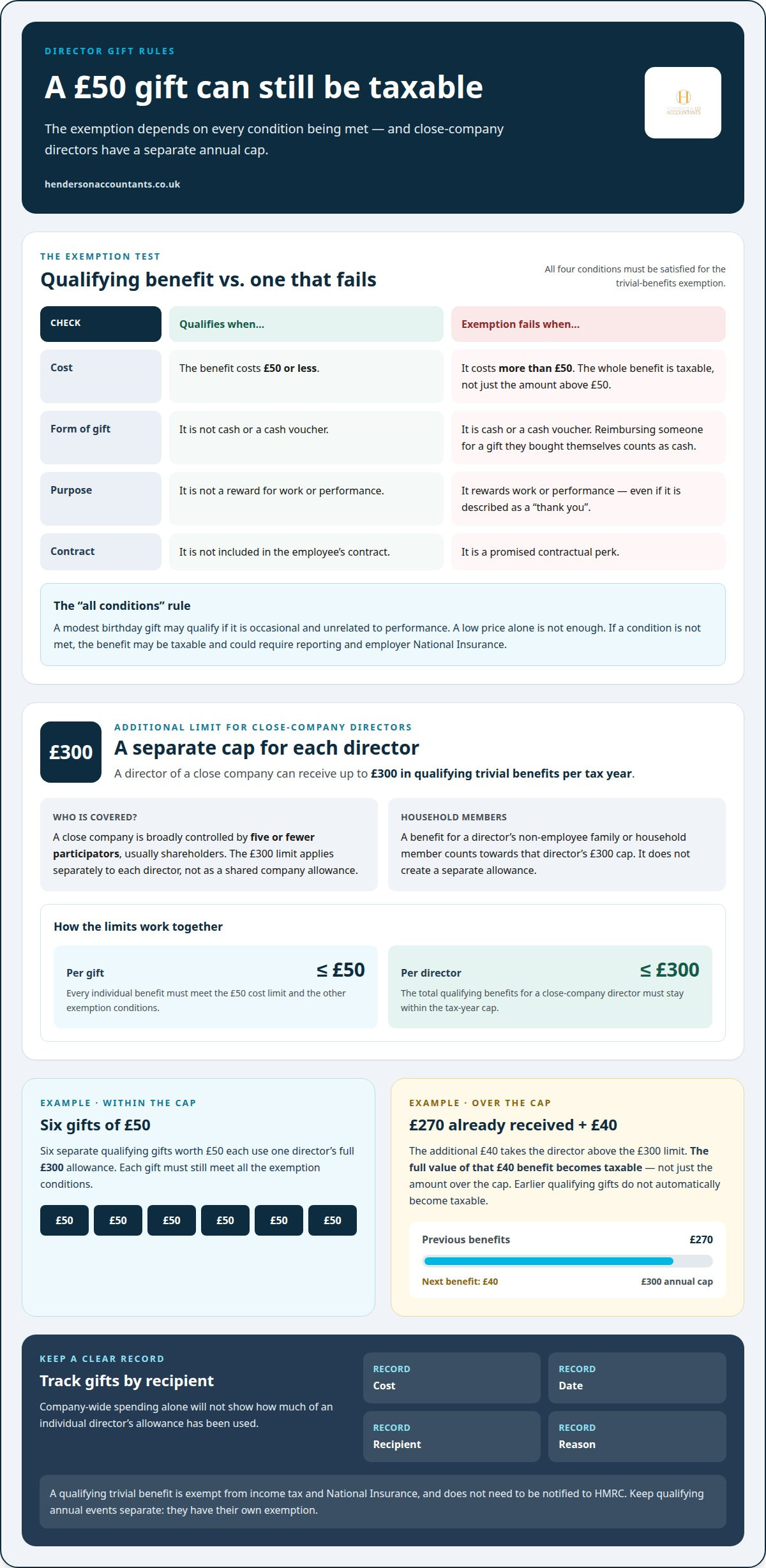
A £50 gift isn’t automatically tax-free. Trivial benefits for directors must meet several conditions: according to HM Revenue & Customs, each benefit must cost £50 or less, must not be cash or a cash voucher, must not reward work or performance, and must not be included in the employment contract. A director of a close company cannot receive trivial benefits worth more than £300.
It’s easy to confuse an occasional gift with a benefit that counts as part of pay. For directors, the distinction matters: a perk that fails even one condition may not qualify for the exemption, while a qualifying benefit can be provided without income tax or National Insurance for the employer or recipient.
This guide explains the rules in practical terms, including which gifts may qualify, how the per-benefit and annual limits work, and what to consider when providing perks more than once. It also compares trivial benefits with benefits in kind, so you can work out when a gift falls under the exemption and when it may need different tax treatment.
Key Takeaways
- Assess whether a perk meets every condition for the exemption; a low price alone isn’t enough.
- Keep the close-company director’s separate annual limit in mind when planning occasional gifts.
- Work out the cost of each benefit carefully, including how shared expenses are allocated.
- Consider whether a gift is genuinely occasional and unrelated to work before treating it as tax-free.
- Understand how perks differ from benefits in kind, and when an outsourced finance director can help you manage the wider picture.
What Are Trivial Benefits?
A trivial benefit is a small perk an employer gives an employee, rather than cash pay or a contractual reward. The exemption depends on the gift’s cost, purpose and terms, not simply what it is called. A gift described as a “thank you” may still be taxable if it rewards work or performance.
HM Revenue & Customs says a benefit can qualify only if it costs £50 or less, is not cash or a cash voucher, is not a reward for work or performance, and is not included in the employee’s contract. All four conditions must be met. For example, a modest birthday gift may qualify if it is occasional and unrelated to performance; a promised contract perk does not.
Which trivial benefits are exempt from income tax and National Insurance? A benefit that meets every condition is exempt from income tax and National Insurance. The employer does not have to pay tax or National Insurance or notify HMRC about it. Reimbursing an employee for a gift they bought themselves counts as cash, so it does not qualify.
Timing matters when reviewing benefits. HM Revenue & Customs states that the UK tax year runs from 6 April to 5 April. Salary sacrifice arrangements made on or after 6 April 2017 do not qualify for the trivial-benefits rules. For context, HM Revenue & Customs sets the Class 1A National Insurance rate at 15% for the period from 6 April 2025 to 5 April 2026.
Don’t confuse a small staff meal with an annual event. HM Revenue & Customs allows an annual staff entertaining exemption of up to £150 per attendee. That is a separate exemption, so the event’s purpose and cost per attendee matter when deciding which treatment applies.
If a condition is not met, the benefit may be taxable and could require reporting and employer National Insurance. Qualifying trivial benefits can receive Corporation Tax relief. Record each benefit’s cost, date and reason, then assess whether it meets the exemption before deciding how to treat it for tax purposes.
Can employers claim Corporation Tax relief on trivial benefits? Yes, a company can claim Corporation Tax relief on the cost of qualifying trivial benefits. Do not treat an expense as qualifying simply because it was given as a gift if it fails the conditions.
How should employers record and report trivial benefits to HMRC? Keep a record of each benefit’s cost, date and reason. A qualifying trivial benefit does not need to be notified to HMRC. A taxable benefit may need separate reporting and treatment.
The £300 annual cap for directors of close companies
Trivial benefits for directors of close companies have an additional cap to track. HM Revenue & Customs says a director of a close company cannot receive trivial benefits worth more than £300 in a tax year. A close company is broadly one controlled by five or fewer participators, usually shareholders. This ownership test matters: a limited company’s structure determines whether the director is subject to this separate ceiling.
The allowance applies separately to each director, rather than being shared across the company. If a close company has two directors, each can receive qualifying benefits up to their own £300 limit. Together, they may receive £600, provided each director’s gifts qualify individually. The cap is not permission to provide one gift worth £300: every benefit must still meet the per-benefit cost limit and the other qualifying conditions.
For example, six separate qualifying gifts worth £50 each would use one director’s full £300 allowance. A director could receive fewer gifts at different values, provided each remains eligible and their total stays within the cap. Track gifts by recipient and tax year. The company’s total spending alone won’t show how much of an individual director’s allowance has been used.
Benefits given to family or household members can also count. If a director’s family or household member receives a benefit and isn’t an employee, its value counts towards that director’s £300 limit. A gift for a non-employee spouse therefore doesn’t create a separate allowance. Regular employees, by contrast, aren’t subject to the directors’ £300 cap.
Take care when the total approaches the limit. If a director has received £270 in qualifying benefits, a further £40 benefit takes the total above £300. The full value of the benefit that takes the total over the limit becomes taxable, not just the amount above the cap. Earlier qualifying gifts don’t automatically become taxable because of that later benefit.
Keep a record for each director with the date, recipient, reason and cost of each perk. These records make it easier to track remaining headroom and distinguish individual benefits from the company-wide total. Trivial benefits for directors should also be kept separate from qualifying annual events, which have their own exemption. For help aligning company records and accounts, consider company secretarial support.
The £50 per-benefit cost limit
Each gift or perk is assessed against its own cost, not against the director’s total spending. HM Revenue & Customs states that if a UK company provides a trivial benefit costing more than £50, the entire benefit is taxable, rather than only the amount above £50. A small excess therefore changes the treatment of the whole gift. Staying within the limit is only one requirement: the benefit must also meet the other qualifying conditions.
Work out the cost of the benefit the company actually provides. For a hamper, for example, consider both the hamper and any delivery charge, rather than relying only on its advertised price. Keep the supplier’s invoice, which records the purchase and any VAT charged. VAT treatment can affect the company’s recorded cost, so use the accounting treatment for that purchase rather than assuming the displayed net price is the relevant figure.
A shared expense can be assessed per person where the cost is apportioned fairly. For example, a £180 lunch for five people works out at £36 per person. If calculating each attendee’s exact share is impractical, an average cost per employee may be used, provided the average does not exceed £50. Keep the calculation with the expense record so the cost per recipient is clear.
Repeated payments need careful handling. Repeated top-ups may be assessed together, so splitting a gift card into smaller payments may not keep the benefit within the limit. Splitting a reward into smaller payments does not necessarily make each instalment a separate benefit. Similarly, two £50 gifts given for the same reason or occasion may be treated together as one £100 benefit and become taxable.
That distinction matters for gifts linked to salary or performance. A hamper costing £50 or less may still fail if it rewards a sales target; a benefit above the limit is taxable even if it is unrelated to work. Think about what the employee receives, why it is given and whether separate purchases are genuinely separate occasions. A label such as “gift” does not determine the tax treatment.
For a practical cost check, retain the invoice and note the recipient, purpose and date. Record how shared costs were divided, including any average used. Then assess the complete benefit, not just its headline price or one part of a combined gift. This helps distinguish a qualifying perk from a taxable reward and account for its cost correctly.
Examples of qualifying gifts
Start with the reason for the gift, then consider its form and total cost. A £25 bottle of wine given at Christmas may qualify when it’s a goodwill gesture, rather than a reward for work. A gift voucher can also qualify if it cannot be exchanged for cash. For example, a £30 store voucher unrelated to performance may meet the conditions.
A meal for a special occasion may qualify if its cost per person stays within the applicable limit and it isn’t contractual or performance-related. A modest team-building activity could also fit where it’s a genuine occasional gesture, not a work target incentive. A flu jab or basic medical check-up costing £50 or less is another possible example. In each case, consider the recipient, purpose and full cost.
Not every staff gift is a trivial benefit. A £65 hamper after an employee reaches a sales goal fails because it exceeds the cost limit and rewards performance. A long-service or thank-you gift tied to meeting performance targets also fails the purpose test. An employer can call something a gift, but the reason for providing it still matters.
Are trivial benefits different from staff gifts, annual parties or long-service awards? Yes. A staff gift qualifies only if it meets the trivial-benefit conditions; an annual party is considered under a separate staff-entertaining exemption. A long-service award linked to performance targets does not qualify as a trivial benefit.
The occasion can affect how multiple gifts are assessed. Two gifts provided for the same reason may be treated as one benefit, so consider their combined value rather than viewing each item in isolation. A Christmas gift and a separate birthday gift relate to distinct occasions, but each still needs to meet the qualifying conditions. Record the purpose and date alongside the cost.
The form of the benefit matters too. If an employee buys their own present and the employer reimburses them, the payment is treated as cash and does not qualify. A salary sacrifice arrangement is also different from a separate, employer-funded goodwill gift. The label, timing and funding method matter alongside the item itself.
For each proposed perk, note who receives it, what occasion it recognises, why it is given and its total cost. Then consider whether it rewards work, forms part of an agreement or has been combined with another gift. This simple record helps distinguish qualifying Christmas gifts and occasional gestures from taxable rewards or benefits that need different treatment.
Trivial benefits compared with benefits-in-kind
The key difference is the tax treatment, not whether a perk is called a gift. A qualifying trivial benefit is exempt from tax and National Insurance. A benefit that fails the conditions may instead be taxable and require separate reporting. For company directors, assess each item’s purpose, terms and cost before deciding how to record it.
A birthday gift is a useful example. Flowers given as an occasional goodwill gesture may qualify if they meet the conditions. Flowers promised under an employment contract are different because the employee is entitled to receive them. A birthday gift that rewards a sales target also falls outside the exemption. The occasion alone does not determine the tax treatment.
A gift card shows why the form of a perk matters. A voucher that cannot be exchanged for cash may qualify if it meets the other conditions. Cash, or a cash voucher, cannot qualify as a trivial benefit. If an employer tops up the same £10 gift card on seven further occasions, the total cost is £80, exceeding the per-benefit limit. Repeated top-ups shouldn’t be treated as unrelated gifts without considering what the employee receives overall.
Benefits in kind are not automatically tax-free just because they are not salary. If a perk does not qualify for the trivial-benefit exemption, its value may be taxable and subject to relevant reporting and National Insurance treatment. Cost is only one part of the decision. The connection to duties, contract terms and repeated provision can also affect the outcome.
Separate exemptions may apply to different arrangements. For example, an annual staff event is considered under the staff-entertaining exemption, not automatically as a trivial benefit. Keeping the event and individual gifts distinct in the company’s records helps show which treatment applies. Do not assume a long-service award linked to performance qualifies as a trivial benefit just because it is presented as a gift.
For each perk, record what was provided, who received it, why it was given and whether it forms part of a pattern. Then distinguish a qualifying occasional gift from a contractual or taxable benefit. If you want support bringing these decisions into wider financial planning, an outsourced finance director can help you assess how they fit your company’s finances.
Henderson & Co. Accountants: Outsourced Finance Director
Henderson & Co. Accountants provides outsourced finance director support to help you connect decisions about staff benefits with wider financial planning. This can be useful when weighing discretionary perks, reviewing company costs or seeking clearer financial oversight.
For businesses selling online, eCommerce Accounting can help bring financial records into focus. Xero Cloud Accounting Setup and VAT Return Preparation can support your wider accounting processes. The right support depends on your business’s needs and the questions you are working through.
For support with financial planning alongside your accounting, contact Henderson & Co. Accountants to discuss your needs.
Build a clearer approach to staff benefits
Use your understanding of trivial benefits for directors to build a consistent approach to staff perks. A clear process helps you make considered decisions, keep useful records and include benefit costs in the company’s wider financial picture. It also provides a practical basis for reviewing how employee perks fit with other business priorities.
Henderson & Co. Accountants supports businesses with eCommerce Accounting, Xero Cloud Accounting Setup and VAT Return Preparation. If you want to connect day-to-day accounting with broader financial planning, this support can help organise the information behind business decisions.
Talk through the support that fits your priorities. Contact Henderson & Co. Accountants to discuss your business’s accounting needs and take a confident next step.
Henderson & Co. Accountants can support your business
Henderson & Co. Accountants provides accounting and tax services, including corporation tax returns, annual accounts, bookkeeping and VAT Return Preparation. If you are reviewing trivial benefits for directors and need support with related business records or accounts, these services can help.
For broader financial support, Henderson & Co. Accountants also offers an outsourced finance director and outsourced finance department, alongside payroll and CIS management, company secretarial services, eCommerce Accounting and Xero Cloud Accounting Setup.
Frequently Asked Questions
Are gift vouchers considered non-cash?
A gift voucher counts as non-cash only if it cannot be exchanged for cash. That distinction matters: a shop voucher with no cash redemption option may qualify if the other conditions are met, while a cash voucher cannot. Check the voucher’s terms and keep evidence of its restrictions with the purchase record. Its format alone does not make a gift tax-free; its purpose and cost still matter.
Does the £50 limit include VAT?
Assess the cost of providing the benefit rather than assuming the invoice’s net amount is decisive. VAT shown separately on an invoice can affect the company’s actual cost, depending on its accounting treatment. Include delivery charges in the calculation. Keep the invoice and record how you worked out the total, so you can explain the amount used for the limit if queried.
How does the £50 threshold work in practice?
Apply the threshold to each benefit, using its full cost to the company. A benefit costing £50 or less can pass the cost test, but it still needs to meet the other conditions. If the cost is more than £50, HM Revenue & Customs says the whole benefit is taxable, not just the excess. Don’t split one gift artificially into smaller items to make it appear within the limit.
What if HMRC challenges a benefit?
Gather the purchase invoice, payment record and a note explaining the benefit’s recipient, date and purpose. These records help show how the company reached its tax treatment and whether the gift was linked to performance or contractual pay. Compare the evidence with the qualifying conditions, and correct the company’s records if they do not support exemption. Keep the explanation factual and consistent with the original business records.
What counts as a trivial benefit for UK tax purposes?
A trivial benefit is an occasional perk that meets the required cost, form, purpose and contract tests. For example, a modest birthday present could qualify if it is not cash, is not connected to work performance and is not promised under employment terms. A recurring benefit employees come to expect can be harder to distinguish from pay. Consider the overall arrangement, not just the item’s description.
What is the £50 limit for trivial benefits in kind?
The £50 threshold is the maximum cost for an individual benefit to pass the cost condition. It isn’t a tax-free allowance that can be applied to the first part of a more expensive perk. For example, if a single benefit costs more than £50, the whole benefit is taxable under the rule, rather than only the amount above the threshold.
Can cash or cash vouchers qualify as trivial benefits?
No. Cash and cash vouchers are excluded, even if the amount is small or the payment marks a birthday or another personal occasion. Reimbursing an employee for a gift they bought themselves is also treated as a cash payment. If the employer wants to provide a gift, a non-cash item or a voucher that cannot be exchanged for cash is a different starting point.
What are the annual trivial benefits limits for directors of close companies?
HM Revenue & Customs sets the limit at £300 in a tax year for a director of a close company. It applies separately to each director, but gifts to a director’s non-employee family or household members count towards that director’s total. Each benefit must also meet the individual qualifying conditions. Keep recipient-level records so the company can track the director’s cumulative benefits accurately.