
Accurate VAT Return Preparation for UK Businesses

Accurate VAT return preparation means reconciling your sales and purchases, calculating VAT due and reclaimable, and filing through compatible software. Making Tax Digital requires UK VAT-registered businesses to keep digital records and submit returns using compatible software. Most businesses submit returns every three months, and you must file even when there’s no VAT to pay or reclaim. If you miss a deadline, reaching the applicable late-return penalty-point threshold results in a £200 penalty, according to HMRC.
A VAT return deadline can feel like one more pressure when you’re already managing cash flow, invoices and day-to-day operations. Understanding what goes into a return, and what to do if something goes wrong, makes the process more manageable.
This guide explains how to reconcile VAT against your records, account for import VAT, meet Making Tax Digital requirements and respond to missed deadlines. It also covers when outsourcing VAT return preparation may help you keep reporting organised and on track.
Key Takeaways
- Know what digital record-keeping and compatible software mean for your VAT reporting.
- Distinguish import VAT from customs duty, and understand how postponed VAT accounting affects your return.
- Reconcile VAT figures with ledger entries and supporting documents to help spot errors and eligible relief.
- Understand the steps to take when a filing or payment deadline is missed, including how payment timing can affect your next move.
- Consider whether outsourcing return preparation could make recurring VAT work easier to manage.
Do you handle Making Tax Digital for VAT?
Making Tax Digital shapes how VAT records are kept, checked and submitted. It also affects what you need to do when a return or payment is late.
Making Tax Digital records and submissions
Making Tax Digital requires VAT-registered UK businesses to keep digital records and use compatible software to file returns. The digital records support the figures reported to HMRC, including sales, purchases and VAT amounts. If you expect to exceed the VAT registration threshold within the next 30 days, you must register for VAT, according to HM Revenue & Customs.
Record transactions consistently in a digital system so each return figure can be traced to its entries. For example, support a sales total with the relevant transaction records rather than entering an unconnected figure at filing time.
Electronic VAT return submissions
Electronic submission means sending the completed VAT Return to HMRC online through compatible software. UK businesses must submit returns electronically unless an exception applies and HMRC has given prior approval.
Before submitting, reconcile the return totals to your digital records and review unusual movements, such as a purchase correction. Submit only when the figures are accurate, then keep the submission confirmation with the records for that period. Digital filing connects the submitted figures with the records used to prepare them.
Preparing a final VAT return
The final return is used to report VAT for the business’s last reporting period while it is registered. It brings together the transactions belonging in the final reporting period, so the figures still need to be complete and supported by records.
Prepare the return by recording sales and purchases up to the relevant end date, calculating output and reclaimable input VAT, and reconciling those totals to the ledger. Submit through the required filing route and account for any balance shown. Keep the return, supporting records and submission confirmation together so the final figures remain traceable.
VAT rates and return preparation
UK VAT rates depend on the goods or services supplied, so apply the correct treatment to each transaction. The rate affects the output VAT recorded on sales and the figures included in the return.
To calculate VAT due, compare output VAT on sales with eligible input VAT on business purchases. The difference determines the net position. Claim input VAT only when the purchase and supporting records qualify. Check each transaction’s VAT treatment before transferring totals: the wrong rate can make otherwise accurate arithmetic produce an inaccurate return.
Late submission and late payment are separate issues: record the filing date and payment date independently. For return periods starting on or after 1 January 2023, the points-based late-return regime applies. Reaching the applicable penalty-point threshold results in a financial penalty of £200, according to HM Revenue & Customs.
Pay attention to late payment interest if a VAT balance remains unpaid. Track the amount due, payment date and any interest shown on your HMRC account. A late return does not remove the need to settle the balance. If you miss a deadline, submit the outstanding return and arrange payment promptly, then review your records to find the cause of the delay.
Can I claim import duty on my VAT return?
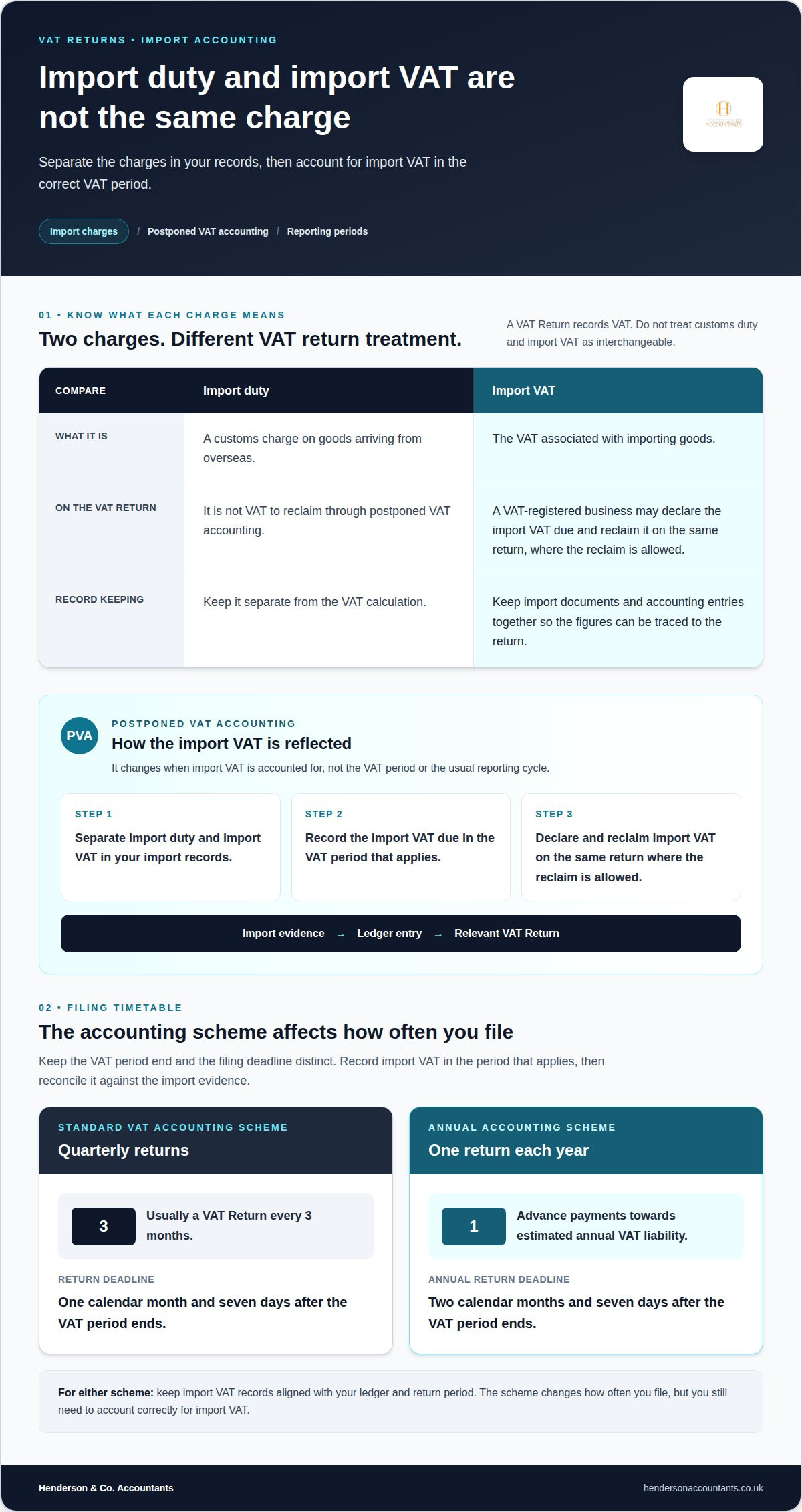
Import duty and import VAT are different charges. This VAT Return guidance concerns import VAT: a VAT-registered business can use postponed VAT accounting, declaring and reclaiming import VAT on the same return where the reclaim is allowed.
The distinction matters when goods arrive from overseas. Import duty is a customs charge; import VAT is the VAT associated with importing goods. A VAT Return records VAT, so don’t treat the two amounts as interchangeable. Separate each charge in your import records before deciding what belongs in the return.
With postponed VAT accounting, the business records the import VAT due and the corresponding reclaim on the same VAT Return. This affects when import VAT is accounted for, not the VAT period or the return’s usual reporting cycle. Keep import documents and accounting entries together so you can trace the figures from the import to the return.
For example, if an import record shows both import duty and import VAT, separate the amounts in your bookkeeping. You may declare and reclaim the import VAT on the return using postponed VAT accounting; the duty itself is not VAT to reclaim through this mechanism. Separating the charges helps prevent a customs charge being included in the VAT calculation by mistake.
Accounting periods determine which return includes the import VAT. In the UK, VAT-registered businesses usually need to send a VAT Return every 3 months, an interval known as an accounting period, according to HM Revenue & Customs. Record the transaction in the period that applies to it, then reconcile the entry against the relevant import evidence.
Under the Standard VAT Accounting Scheme, quarterly returns are due one calendar month and seven days after the VAT period ends, according to HM Revenue & Customs. The period end and filing deadline are separate dates. The deadline falls after the reporting period closes, leaving time to complete the accounting and submit the figures.
The Annual Accounting Scheme works differently. Businesses make advance payments towards their estimated annual VAT liability and file one VAT return each year. The annual return is due two calendar months and seven days after the VAT period ends. The scheme changes how often you file, but you still need to account correctly for import VAT.
Whether you use standard or annual accounting, keep import VAT records aligned with your ledger and return period. If imported goods are part of regular trading, VAT Return Preparation support can help bring import transactions into the wider return reconciliation.
Reconciling VAT transactions against ledger records
Reconciliation connects the VAT figures in your return to individual entries in your bookkeeping records. It helps you find missing invoices, duplicated transactions and coding errors before completing the return.
Start with the VAT account for the relevant period. Compare its sales and purchase totals with the corresponding ledger entries, investigating differences rather than adjusting totals without evidence. For example, a supplier invoice entered in the ledger but omitted from the VAT account could change the input VAT claimed. A sales credit note recorded in one place but not the other can also leave the return out of step.
For each purchase included in a reclaim, match the ledger entry to a valid VAT invoice or other accepted commercial documentation. Check that the document relates to the business and supports the VAT amount claimed. If a document is missing, flag the transaction for review rather than treating an unsupported figure as reclaimable input VAT.
Making Tax Digital requires VAT-registered businesses to keep digital records and submit returns using compatible software. Digital records make it easier to trace a return figure to its transaction, invoice and accounting entry. Keep source documents connected to digital records, especially when bookkeeping software imports transactions from separate sales or payment systems.
A practical reconciliation groups transactions by VAT treatment, then compares each group with the ledger. Review unusual balances, corrections and transactions posted near the period boundary. For example, check that a credit note reduces the correct sales account and that its VAT treatment appears in the same return period. Record every adjustment with an explanation and supporting document.
Bad debt relief also needs evidence. HM Revenue & Customs states that a bad debt must be older than 6 months to qualify for VAT relief. Keep records identifying the customer, supply, unpaid amount and steps taken to account for the debt. Submit a qualifying refund claim in a VAT Return, with the supporting records retained alongside the accounting entries.
The claim deadline is 4 years and 6 months from the date payment was due or the date of supply, whichever was later. Relief is unavailable if the business sold the debt or charged more than the normal price for the item. These conditions make the original invoice, payment terms and debt history important when reviewing a claim.
Before submitting, resolve differences between the VAT account and ledger, document corrections, and keep the reconciliation with the return records. This creates a clear trail from the HMRC filing back to the invoice or transaction supporting each figure.
What happens if I miss a VAT return deadline?
Missing a VAT deadline can affect both the return and the payment, so treat them as separate obligations. Submit any outstanding return and deal with the balance due promptly. Filing alone doesn’t settle the payment.
Most UK businesses file quarterly. Under the Standard VAT Accounting Scheme, the return and payment deadline is one calendar month and seven days after the VAT period ends, according to HM Revenue & Customs. Work from the end date shown for your accounting period, then use the applicable deadline for both filing and payment.
The deadline does not move if it falls on a weekend or bank holiday. Submit your VAT Return by that date, and make sure payment reaches HMRC by then too. If the deadline falls on a weekend or bank holiday, cleared funds must reach HMRC’s bank account on the last working day before it is due.
Allow time for your chosen payment method to clear. The key test is when funds reach HMRC, not simply when you initiate a payment. Check your accounting records for the amount due, submit the return electronically and arrange payment early enough to meet the same deadline. Keep the payment confirmation with the return records.
Annual Accounting has a different filing cycle. Businesses on this scheme file one VAT Return each year, due two calendar months and seven days after the VAT period ends. They make advance payments towards their estimated annual VAT liability, with a balancing payment or refund due alongside the return. The scheme changes filing frequency, but any final balance still has a deadline.
For return periods starting on or after 1 January 2023, late submissions fall under a points-based penalty system. Points can accumulate when returns are late, and reaching the applicable threshold triggers a financial penalty. A late return can therefore matter even when the figures show no VAT to pay.
Late payment is separate from late filing. Interest may apply to overdue VAT, so submitting the return does not resolve the payment issue. Check the amount shown on your HMRC account and arrange payment as soon as possible. The interest calculation depends on the overdue balance and how long it remains unpaid.
If you’ve missed the deadline, submit the outstanding return and address the payment without waiting for the next accounting period. Reconcile the figures first, keep the submission and payment confirmations, then review what caused the delay. A calendar reminder for each VAT period can help prevent a repeat.
Outsourcing VAT return services
Outsourcing VAT return preparation means appointing an accountant to organise records, reconcile VAT transactions and prepare figures for submission. It can suit a business whose sales, purchases or import records have become harder to manage internally. Even when preparation is outsourced, the business needs to provide complete records and meet the filing deadline.
A clear workflow starts with an agreed handover of bookkeeping records, sales data, purchase invoices and relevant adjustments. The accountant can compare the VAT account with the ledger, investigate discrepancies and identify transactions that need clarification. For example, resolve a supplier invoice entered without its VAT treatment before including its amount in a reclaim.
Digital systems matter too. VAT-registered businesses must keep digital records and use compatible software to submit returns under Making Tax Digital. An outsourced process can use these records to trace return figures back to their source transactions. Agree how sales platforms, payment records and bookkeeping entries will be shared to reduce gaps between business data and the VAT return.
Accurate information remains essential throughout the process. The business needs to supply complete records and explain unusual items, such as a credit note or a purchase used for more than one purpose. The preparer can review the evidence, apply the appropriate VAT treatment and raise questions before finalising the return. Clear communication helps prevent assumptions from becoming reported figures.
Outsourcing can also establish a repeatable routine for each accounting period. A useful cycle is to provide records, resolve queries, review the prepared return, submit it through compatible software and arrange payment by the deadline. Keep a copy of the submitted return and payment confirmation with the accounting records. This makes it easier to trace figures when reviewing a later period.
Before deciding whether to outsource, identify what is causing the pressure. If the main issue is late transaction coding, improving bookkeeping may be the first priority. If transactions are recorded but VAT treatment and reconciliation take too much time, a dedicated preparation service may be a better fit. For online sellers, consistent sales-platform records are especially important when reconciling orders, refunds and fees.
To move this work out of your day-to-day workload, arrange outsourced VAT return preparation with a clear handover of your records and reporting process.
Henderson & Co. Accountants: VAT Return Preparation
Henderson & Co. Accountants provides VAT Return Preparation for UK businesses needing support to organise records, reconcile VAT figures and prepare returns for submission. This can help when sales-platform, supplier or import transactions make reporting harder to manage, or when you want a consistent process for each accounting period.
For online sellers, eCommerce Accounting can support the wider bookkeeping behind VAT reporting. Xero Cloud Accounting Setup can help establish a digital system for managing business records. These services complement VAT support, while Corporation Tax Returns meet a separate reporting requirement.
For support with your VAT returns, contact Henderson & Co. Accountants to discuss your requirements.
Build a steadier finance routine
Make VAT return preparation part of your regular finance routine, rather than a task that begins when filing is due. Decide who is responsible for handing over records, how to note unresolved bookkeeping questions and when figures are ready for review. A consistent process makes it clearer what needs attention before submission.
Use the next reporting cycle to identify where information tends to arrive late or needs repeated clarification. Agree practical responsibilities across your team, and record process changes so they carry forward. This can make financial planning more deliberate and help you focus on business decisions, not just the next filing task.
If you’d like to discuss support for your VAT reporting, contact Henderson & Co. Accountants. A conversation can help you consider how outsourced support fits your records and working arrangements, so you can choose a clear next step for your business.
Henderson & Co. Accountants and VAT return preparation
Henderson & Co. Accountants provides VAT Return Preparation, supporting you from understanding your VAT obligations through to preparing your return. Turn to the firm when you need help with the preparation process.
For connected finance support, Henderson & Co. Accountants also offers Bookkeeping, eCommerce Accounting and Xero Cloud Accounting Setup. Its services include Annual Accounts, Corporation Tax Returns, Payroll and CIS Management, Company Secretarial Services, an Outsourced Finance Director and an Outsourced Finance Department.
Frequently Asked Questions
Can you help me choose the right VAT scheme?
The right scheme depends on how your business handles sales, purchases and payments. Standard VAT accounting records VAT on sales and eligible purchase reclaims; Cash Accounting follows payments received and made. The Flat Rate Scheme applies a fixed percentage of turnover, while Annual Accounting uses advance payments and one annual return. Consider your transaction patterns and bookkeeping arrangements before deciding. A scheme that suits one business may not suit another with different cash flow or trading activity.
How often do I need to submit a VAT return?
Most VAT-registered businesses submit a return every three months, but the accounting scheme can change the filing pattern. Under Annual Accounting, a business files one return each year and makes advance payments towards its estimated VAT liability. You must still submit a return for a period with no VAT to pay or reclaim. Check the periods assigned to your VAT account: those dates determine which transactions belong in each submission.
Made a mistake on your VAT Return?
Correct the error using the route that matches its net value and size. An error of £10,000 or less can be corrected on the face of a return. Errors between £10,000 and £50,000 can be included there if they’re less than 1% of total sales value. An error exceeding £50,000 requires a voluntary disclosure to HMRC using form VAT652. Keep an explanation and evidence for the adjustment in your records.
What is VAT?
VAT is a tax charged on many goods and services sold by VAT-registered businesses. Those businesses record VAT charged on sales and, where eligible, reclaim VAT paid on business purchases. They account for the difference through the VAT Return. For example, a retailer records VAT on a taxable sale and separately records supported VAT on a business purchase. The product or service’s VAT treatment determines how the transaction is reported.
What is the VAT Returns Process?
The process brings together transactions for a VAT period, checks their VAT treatment, reconciles totals to accounting records and submits the completed return. For example, record a sales refund’s credit note against the original transaction, then ensure the adjustment appears in the correct return figures. After submission, keep the return and its confirmation with the supporting records. Any VAT payment due is separate from filing.
What information and records are needed to prepare a UK VAT return?
Gather sales and purchase records, VAT invoices, credit notes, import documentation and ledger entries for the relevant period. These support the sales and purchase totals, VAT charged and input VAT claimed. For an online business, include records that reconcile orders, refunds and payment-platform activity. Link documents to the corresponding digital transactions so each return figure can be traced to its source if questions arise later.
What are the steps to file a VAT return using Making Tax Digital software?
Use compatible software to organise the period’s digital records, reconcile totals, review VAT treatment and submit the return electronically. Save the submission confirmation with the records and arrange any payment due. For example, resolve a mismatch between a sales-platform report and the ledger before submitting, rather than carrying an unexplained difference into the return. Digital records connect submitted figures with their underlying transactions.
What are the UK VAT return deadlines and payment deadlines?
For quarterly returns under Standard VAT Accounting, the return and payment are due one calendar month and seven days after the VAT period ends, according to HM Revenue & Customs. Annual Accounting returns are due two calendar months and seven days after the period ends. Payment must reach HMRC by the online submission deadline. If the date falls on a weekend or bank holiday, cleared funds must arrive on the preceding working day.