
Ecommerce VAT registration threshold and when to register

The UK ecommerce VAT registration threshold is £90,000 of taxable turnover in a rolling 12-month period, according to HMRC. You must also register if you expect your taxable turnover to exceed £90,000 in the next 30 days. You can choose to register below the threshold, but it’s important to understand what that means for your business.
It’s easy to focus on total sales and overlook that the ecommerce VAT registration threshold is based on taxable turnover, not every payment your shop receives. This guide explains which sales count, how to assess sales across marketplaces and channels, and when you may need to register. It also covers voluntary registration, so you can weigh up whether registering early makes sense for your business.
Key Takeaways
- Measure taxable turnover across a rolling 12-month period, rather than relying only on your calendar or financial year.
- According to HM Revenue & Customs, you must register if taxable turnover for the previous 12 months exceeds £90,000.
- Plan for the registration deadline: after exceeding the threshold, HM Revenue & Customs requires registration within 30 days of the end of that month.
- Review each sales channel separately. Marketplace rules can affect who accounts for VAT on certain transactions.
- Voluntary registration below the threshold may suit some businesses, but weigh the practical effects on pricing, customers and VAT administration.
VAT registration threshold 2026: When to register for VAT?
For UK ecommerce, the domestic VAT registration threshold is separate from EU cross-border distance-selling rules. The EU changed those rules on 1 July 2021, so the country-by-country thresholds below are historical.
The EU-Wide Distance-Sales Threshold
From 1 July 2021, the EU replaced national distance-selling thresholds with one €10,000 threshold for qualifying cross-border sales. This threshold can affect where VAT is due when an eligible seller supplies consumers in other EU countries.
The €10,000 limit applies to qualifying intra-EU distance sales of goods and certain telecommunications, broadcasting and electronic services. Below it, those sales may remain subject to VAT in the seller’s Member State of establishment. A seller can use this treatment only when established, permanently addressed or usually resident in one EU country, with goods dispatched from its country of establishment.
For UK businesses, the EU distance-selling threshold does not replace the UK domestic threshold. The former EU distance-selling thresholds no longer apply to the United Kingdom. Sales to UK customers and cross-border sales to EU customers must therefore be assessed under the rules relevant to each market.
Distance Selling and VAT Registration
Distance selling means supplying goods across borders to consumers. VAT treatment depends in part on where the goods are dispatched from and where the customer is located. The former EU system used separate country thresholds, so ecommerce businesses had to track sales by destination.
Before 1 July 2021, the former rules generally required registration in a customer’s country when annual sales there exceeded €35,000. Some countries used a €100,000 threshold, including Germany and the Netherlands. The former UK distance-selling threshold was £70,000, but it no longer applies to the United Kingdom.
For example, under the former rules, a German company with €30,000 in sales to French consumers from January to 30 June 2021 did not have to register for French VAT. At €36,000 in those sales, it had to register and regularise them. These examples concern the rules before 1 July 2021, not current UK ecommerce registration.
Older thresholds may matter when reviewing historical transactions. For current sales, separate UK taxable turnover from sales to consumers in EU countries. A threshold in one country cannot determine the VAT treatment that applies in another market.
Registering an Ecommerce Business with HMRC
To register an ecommerce business, submit a VAT registration application to HMRC when a UK registration trigger applies. The relevant trigger may be taxable turnover exceeding the UK threshold over the previous 12 months, or an expectation that taxable turnover will exceed it in the next 30 days.
Before applying, organise sales records by date, channel and transaction type. Include orders from your own shop and marketplaces, then distinguish UK sales from cross-border EU orders. This makes it easier to identify which transactions contribute to UK taxable turnover and which may fall under another country’s VAT rules.
For historic EU sales, use the dates and destination countries to distinguish transactions before and after 1 July 2021. The former €35,000 and €100,000 country thresholds applied before that change; the EU-wide €10,000 threshold followed it. Keeping these periods separate helps you assess the right registration position for each sale.
Once the UK registration requirement applies, EU sales thresholds are not a reason to delay an HMRC application. The ecommerce VAT registration threshold concerns UK taxable turnover, while cross-border sales may create separate VAT obligations in the destination country.
Do marketplace and multi-channel sales count towards the £90,000 threshold?
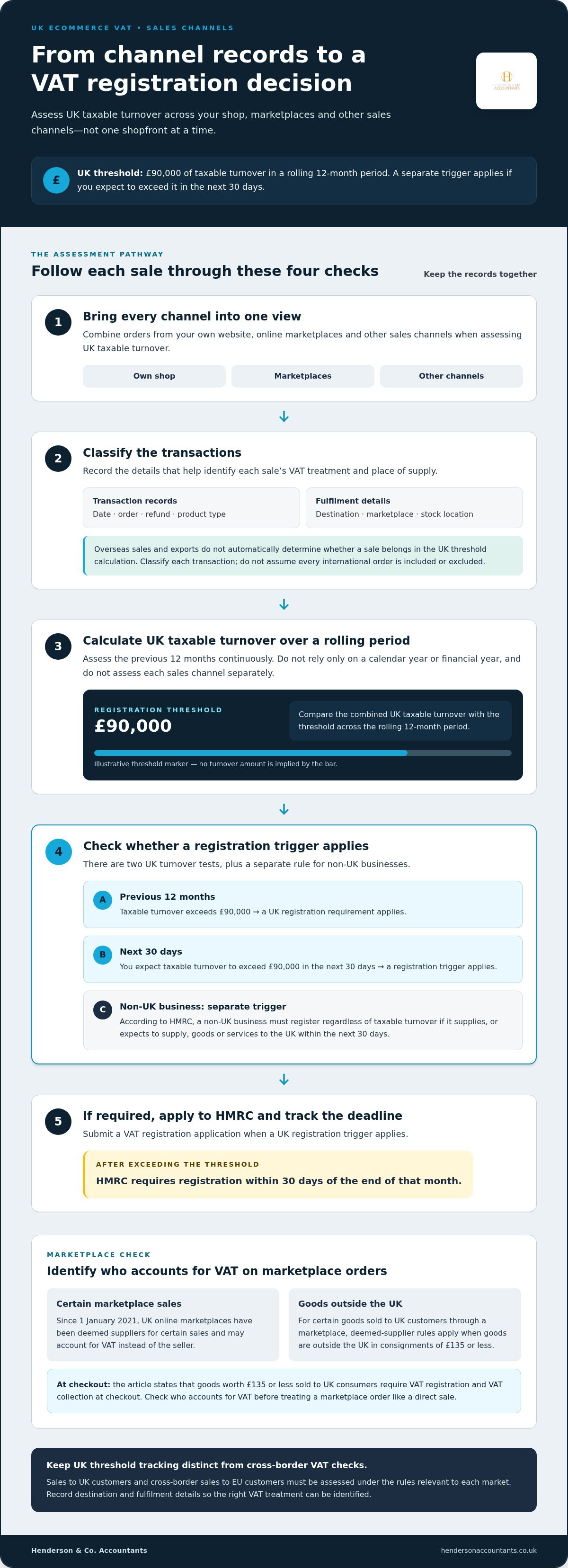
Review sales through your website, marketplaces and other channels together when assessing UK taxable turnover. Cross-border transactions may follow different VAT rules, so record each sale’s destination and how the order was fulfilled.
Sales Counted Towards the VAT Threshold
Sales count towards the threshold if they form part of your UK taxable turnover, whether customers buy through your website or another channel. Combining channel records gives you the overall picture instead of assessing each shopfront separately.
Record orders, refunds, product type, delivery destination and the marketplace involved. An online marketplace sale may be treated differently from a direct sale, so note whether the goods were in the UK or overseas when sold.
Overseas sales and exports do not automatically determine whether a transaction belongs in the UK threshold calculation. Classify each sale by its VAT treatment and place of supply, then separate UK taxable turnover from transactions treated differently. This avoids assuming that every international order is either included or excluded.
Marketplace and Multi-Channel Sales
Marketplace sales can involve different VAT responsibilities from direct ecommerce orders. Since 1 January 2021, UK online marketplaces have been deemed suppliers for certain sales. That means the marketplace, rather than the seller, may account for VAT on qualifying transactions.
For certain goods sold to UK customers through a marketplace, deemed-supplier rules apply when goods are outside the UK in consignments of £135 or less. For goods worth £135 or less sold to UK consumers, the stated rules require VAT registration and VAT collection at checkout. Identify who accounts for VAT before treating the transaction like a direct sale.
Stock location matters too. A non-UK business must register regardless of taxable turnover if it supplies, or expects to supply, goods or services to the UK within the next 30 days, according to HM Revenue & Customs. UK-held stock and goods shipped from overseas should therefore be recorded separately, especially where a marketplace handles the sale.
Cross-Border EU Sales
Some cross-border sales involving EU-held stock have a separate threshold. For certain non-excise goods sold from stock in an EU Member State to non-VAT-registered customers in another EU country or Northern Ireland, the threshold is 10,000 Euros. This is distinct from the UK domestic threshold.
EU VAT treatment depends on where stock is held and where the consumer receives the goods. If you hold stock in another EU country, you must register for VAT there. EU One Stop Shop schemes can cover eligible cross-border sales, but do not remove the need to consider local registration where stock is stored.
After UK registration, charge VAT on qualifying sales from your effective registration date and keep accurate records. VAT returns are usually filed quarterly under Making Tax Digital. Clear ecommerce transaction records help you reconcile marketplace statements with direct orders and prepare consistent returns.
What transactions are covered?
The timing of VAT registration depends on how your taxable turnover crosses the UK threshold. Keep the rolling-turnover test separate from the expected-turnover test, as they have different effective dates.
Registration deadlines and effective dates
If your previous 12 months’ turnover exceeds the threshold, HM Revenue & Customs says you must register within 30 days of the end of the month in which you exceeded it. Your effective registration date is the first day of the second month after that month.
For example, if you first exceed the threshold on 15 July, the GOV.UK example gives 30 August as the application deadline and 1 September as the effective date. Keep the date your turnover crossed the threshold in your records, as it determines both dates.
The expected-turnover test works differently. If you realise on 1 May that taxable turnover will exceed the threshold within the next 30 days, HMRC’s example gives 30 May as the application deadline and 1 May as the effective registration date. The date you recognise the expected increase matters.
Late registration and VAT due
Late registration can leave you owing VAT on sales from the date you should have registered. This may affect cash flow, especially if you set prices without adding VAT. The amount due depends on the qualifying sales and the correct effective date, not simply the day you submit your application.
Check past orders against the date your registration should have taken effect, then identify the sales on which VAT is due. The amount of any penalty is not established here. Do not confuse the date your VAT number is issued with your effective registration date.
Voluntary registration and EU changes
You can register voluntarily while below the UK threshold. This may suit sellers whose customers are VAT-registered businesses, as those customers may be able to reclaim the VAT charged. Before choosing this route, consider consumer prices, record-keeping and the need to submit VAT returns.
EU rules changed on 1 July 2021 for cross-border business-to-consumer ecommerce. The EU introduced a €10,000 threshold for qualifying intra-EU distance sales, replacing the former country-specific thresholds. The UK’s former £70,000 distance-selling threshold no longer applies to the United Kingdom.
For eligible EU cross-border sales, the One Stop Shop scheme can let sellers declare and pay VAT through one EU Member State. It doesn’t determine your UK registration date. A business established outside the UK must register regardless of taxable turnover if it supplies, or expects to supply, goods or services to the UK within the next 30 days, according to HM Revenue & Customs.
UK VAT registration threshold
The UK VAT registration threshold is £90,000 of taxable turnover. It has been at this level since 1 April 2024. HM Revenue & Customs requires a business to register if its taxable turnover for the previous 12 months exceeds £90,000. This is a rolling test, not a check made only at the end of your financial or calendar year.
Taxable turnover is the value of sales that count for VAT purposes. It is not profit, cash received or total business revenue by itself. Review the VAT status of each product or service, then total qualifying sales across your channels. If you sell goods online, include relevant orders from your own site and marketplaces when assessing your position.
Some sales need different treatment. VAT-exempt sales are not the same as taxable sales, while zero-rated sales are taxable at 0%. A business whose taxable turnover is mostly zero-rated may ask HMRC for exemption from registration. A business that only sells VAT-exempt goods and services cannot register for VAT.
Use a consistent record of sales dates and values to track each rolling 12-month period. A calendar-year report alone can miss turnover that crosses the threshold part-way through the year. As a practical planning measure, businesses can monitor their taxable turnover regularly to prepare for possible VAT registration. That leaves time to review sales trends and prepare for the registration process before a threshold test is met.
HM Revenue & Customs says a business that exceeds the threshold based on its previous 12 months’ turnover must register within 30 days of the end of the month in which it exceeded the threshold. For example, if the rolling total first passes the limit during May, calculate the deadline from the end of May. Keep the figures supporting that calculation, including sales records and adjustments.
A separate test applies if you expect taxable turnover to exceed £90,000 in the next 30 days. In that case, the registration obligation is based on what you expect to happen, rather than waiting for the previous-12-month total to cross the limit. A large confirmed order or planned sale may change your forecast, so update it when business plans change.
If turnover later falls, the UK VAT deregistration threshold is £88,000. That figure is relevant to leaving VAT registration, not to deciding whether a business must register initially. Keep the two thresholds distinct when reviewing sales forecasts and planning annual accounts.
United Kingdom VAT registration threshold
For UK sellers, HM Revenue & Customs requires VAT registration if taxable turnover for the previous 12 months exceeds £90,000. This is a rolling test, so review each new month alongside the preceding 11 months. Don’t rely only on annual accounts or a calendar-year total: either can hide the point when turnover first passed the threshold.
A separate forecast test applies when you realise taxable turnover will exceed the threshold in the next 30 days. HM Revenue & Customs says you must register by the end of that 30-day period. For example, if you recognise on 1 May that the limit will be exceeded within 30 days, the GOV.UK example sets 30 May as the application deadline and 1 May as the effective registration date.
For the previous-12-month test, HM Revenue & Customs sets the effective registration date as the first day of the second month after the month turnover exceeds the threshold. In its example, a business first exceeding the threshold on 15 July must register by 30 August, with registration effective from 1 September. The application deadline and effective date are different, so record both.
Include qualifying sales of goods and services in your turnover review, and classify transactions by VAT treatment. Imports, exports and distance sales can involve separate rules, so record where goods are held and dispatched, as well as where the customer is based. A UK business whose taxable turnover is mostly zero-rated may ask HMRC for exemption from registration. A business selling only VAT-exempt goods and services cannot register.
Northern Ireland has a specific rule for businesses selling only VAT-exempt or out-of-scope goods and services. It must register if it buys more than £90,000 of goods in any 12-month period from EU VAT-registered suppliers for its business. This purchase test is distinct from the usual taxable-turnover test, so keep EU supplier invoices separate in your records.
After registration, charge VAT on qualifying sales from the effective date, not simply from the day the VAT number arrives. A worked example uses the 20% rate, but the applicable VAT treatment depends on the goods or services sold. VAT returns are usually filed quarterly under Making Tax Digital, and registered businesses must keep digital VAT records for at least 6 years.
To keep deadlines, sales treatment and returns aligned, plan your VAT return process around the effective registration date and your ecommerce records.
Henderson & Co. Accountants: eCommerce Accounting
Henderson & Co. Accountants supports ecommerce finances with eCommerce Accounting, particularly when multi-channel sales make turnover and VAT records harder to manage. If you’re approaching the registration threshold or need ongoing compliance support after registering, the service can include VAT Return Preparation.
Accurate bookkeeping helps you monitor sales, reconcile transactions and keep financial information organised. Xero Cloud Accounting Setup can establish a cloud accounting system for your business, while Corporation Tax Returns address a separate part of your company’s reporting responsibilities.
Choose support that fits the point you’ve reached, whether you’re reviewing turnover or preparing VAT returns. Contact Henderson & Co. Accountants to discuss your ecommerce accounting needs.
Make VAT readiness part of your next growth step
As your online business grows, build regular VAT reviews into your sales and financial processes. This makes the ecommerce VAT registration threshold part of your planning, rather than a last-minute administrative concern. Clear records and a reliable accounting process also help you make considered decisions as your products, channels and customer base develop. For merchants operating in specialised retail sectors, industry publications such as jewelryecommerce.com explore the digital commerce technologies, platform strategies and operational practices that support sustainable growth.
Henderson & Co. Accountants provides eCommerce Accounting for online businesses, alongside Xero Cloud Accounting Setup and VAT Return Preparation. These services help you organise your accounting workflow and manage VAT responsibilities as your business develops.
Take the next step when you’re ready to strengthen your ecommerce accounting process. Contact Henderson & Co. Accountants to discuss the support that fits your business. With a clear view of your finances, you can focus on growing your shop with greater confidence.
Frequently Asked Questions
Should You Register Voluntarily?
Voluntary registration may suit you if reclaiming eligible VAT on business costs would help, or if your customers are mainly VAT-registered businesses. Consider whether adding VAT could affect consumer prices, as well as the records and returns involved. For example, an online shop investing in stock may value reclaiming eligible VAT, but should also consider how its prices fit customer expectations. A business selling only VAT-exempt goods and services cannot register.
When does an ecommerce business need to register for VAT?
An ecommerce business needs to register when a UK registration trigger applies, including the taxable-turnover test or the expected-turnover test. A business based outside the UK has a separate rule: it must register regardless of taxable turnover if it supplies, or expects to supply, goods or services to the UK within the next 30 days, according to HM Revenue & Customs. The location of the seller and the nature of its sales matter.
How do I avoid VAT threshold?
You cannot avoid a registration requirement by relabelling sales or splitting activity on paper. Instead, track taxable sales accurately, forecast orders and make informed commercial decisions. Check whether your products are taxable, zero-rated or exempt, as these categories are treated differently. A business whose taxable turnover is mostly zero-rated may ask HMRC for exemption from registration; a business selling only VAT-exempt goods and services cannot register.
What is the UK VAT registration threshold for ecommerce businesses in 2026?
For UK ecommerce, the registration threshold is £90,000. HM Revenue & Customs says a business must register if its taxable turnover for the previous 12 months exceeds £90,000. The test applies to taxable turnover, not profit or simply the amount paid into your bank account. Review orders across your sales channels and classify them correctly, so a busy period or marketplace growth doesn’t go unnoticed.
How is UK VAT taxable turnover calculated for the registration threshold?
Calculate taxable turnover by adding the value of relevant taxable sales in the previous 12 months, then reassessing the period as time moves on. Include sales from the channels your business uses, such as its own online shop and marketplace orders. Zero-rated sales are taxable at 0%, while exempt sales are treated differently. Keep transaction records by product and VAT treatment, so you can explain how you reached your total.
When must an ecommerce business register for VAT after exceeding the threshold?
HM Revenue & Customs requires registration within 30 days of the end of the month in which your previous-12-month turnover exceeded the threshold. The effective registration date isn’t necessarily your application date. For the rolling-turnover test, it is the first day of the second month after the month you exceeded the threshold. If you register late, VAT may be due on sales from the date registration should have taken effect.
Can an ecommerce business register voluntarily for UK VAT below the threshold?
Yes. An ecommerce business making taxable sales can choose to register below the threshold. Voluntary registration may be useful if reclaiming eligible VAT on costs matters to your business, or if customers can reclaim the VAT they are charged. Consider the effect on consumer prices and the work involved in keeping records and submitting returns. If you sell only VAT-exempt goods and services, you cannot register voluntarily.
Do online marketplace sales count towards the UK VAT registration threshold?
Marketplace orders need to be included in your turnover review, but VAT responsibility can vary by transaction. UK online marketplaces have been deemed suppliers for certain sales since 1 January 2021. For example, special rules apply to certain goods outside the UK, sold to UK customers in consignments of £135 or less. Record the marketplace, stock location and transaction details, then identify who accounts for VAT rather than treating every order identically.