
5 Ways eCommerce Directors Can Extract Company Profits

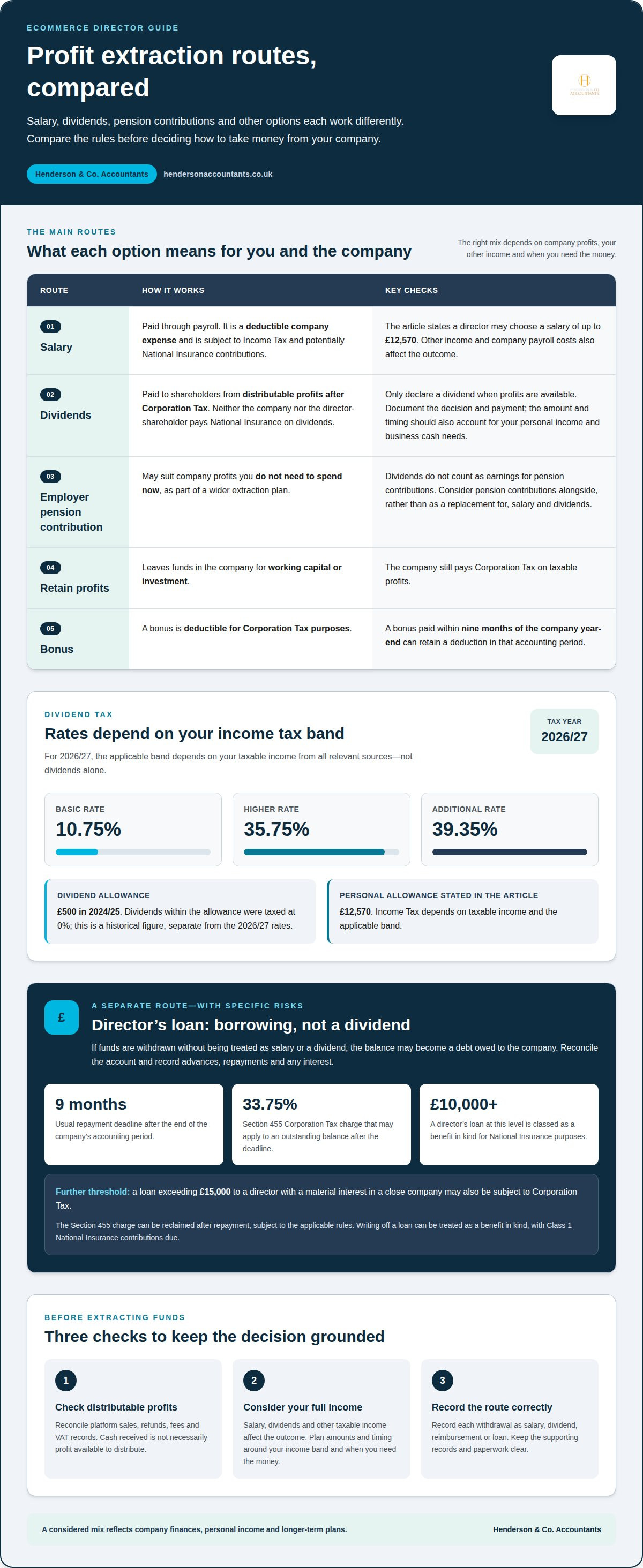
Tax-efficient profit extraction for eCommerce directors usually means balancing salary, dividends and employer pension contributions rather than relying on one route. Salary is a company expense, dividends can only come from distributable profits after Corporation Tax, and dividends don’t attract National Insurance contributions. From 6 April 2026, dividend tax rates are 10.75% for basic-rate taxpayers, 35.75% for higher-rate taxpayers and 39.35% for additional-rate taxpayers.
It’s understandable to focus on how much cash you can take home, but the right mix also depends on company profits, your other income and when you need the money. This guide to tax efficient profit extraction for ecommerce directors explains how salary, dividends and pension contributions can serve different needs.
Learn how dividend tax and National Insurance work, compare the main options, and see when professional advice can help you plan tax efficient profit extraction for ecommerce directors with greater confidence.
Key Takeaways
- Compare salary, dividends and pension contributions against your income needs, company profits and longer-term plans.
- Understand how dividend tax rates and the Dividend Allowance can affect what you take home.
- Factor in National Insurance when setting director pay, and weigh salary’s tax-deductible status against its payroll costs.
- Treat a director’s loan as borrowing that can create a Corporation Tax charge if it remains unpaid beyond the relevant deadline.
- Professional advice can help align your extraction strategy with pension allowances, company finances and your personal circumstances.
1. Dividend tax rates and allowance
Dividends can provide income without National Insurance contributions, but they are not automatically tax-free. The dividend tax you pay depends on your total taxable income, your tax band and the allowance for the relevant tax year. For eCommerce directors, the timing and amount of dividends are therefore important.
HM Revenue & Customs states that the UK Dividend Allowance was £500 in the 2024/25 tax year. Dividends within the allowance were taxed at 0%, but the allowance did not remove the need to consider other taxable income. Once your dividends exceed it, the applicable dividend tax rate depends on your income tax band.
For 2026/27, the dividend tax rates are 10.75% for basic-rate taxpayers, 35.75% for higher-rate taxpayers and 39.35% for additional-rate taxpayers. The basic and higher rates rose from 6 April 2026, whilst the additional rate remains unchanged. Your band depends on your taxable income from all relevant sources, not dividends alone.
Salary and dividends have different tax treatment. Salary is a deductible company expense and is subject to Income Tax and potentially National Insurance contributions. Dividends are paid to shareholders from distributable profits after Corporation Tax. Neither the company nor the director-shareholder pays National Insurance on dividends. The company must have sufficient distributable profits before paying one.
How should you manage business expenses and director reimbursements? The company can reimburse legitimate costs a director incurs on its behalf, while valid business expenses reduce taxable profits. Keep a clear record of each cost’s business purpose and amount, and separate company spending from personal spending.
For 2026/27, dividend tax rates are 10.75%, 35.75% and 39.35% across the basic, higher and additional bands. The stated Personal Allowance is £12,570; income tax depends on taxable income and the applicable band. The Dividend Allowance was £500 in 2024/25, so treat that historical figure separately from the 2026/27 rates.
A practical approach is to plan salary and dividends together, then consider whether an employer pension contribution suits profits you do not need to spend now. Dividends do not count as earnings for pension contributions, so a pension contribution may complement, rather than replace, salary and dividends.
Before declaring a dividend, review the company’s available profits and your personal income. Record the decision and payment in the company’s accounts. This helps you align the amount and timing with business cash needs, your tax bands and any pension planning.
2. Profit extraction for director-shareholders: Salary, dividends or alternatives?
A director’s loan account records money moving between you and your company. If you withdraw funds without treating them as salary or a dividend, the balance may become a debt you owe the company. Reconcile the account and clearly record advances, repayments and any interest.
HM Revenue & Customs says a director’s loan is usually due to be repaid within nine months of the end of the company’s accounting period. If it remains unpaid after that deadline, the company may face a Section 455 Corporation Tax charge of 33.75% on the outstanding balance. The charge can be reclaimed after repayment, subject to the applicable rules.
Other tax risks can arise before that deadline. A director’s loan of £10,000 or more is classed as a benefit in kind for National Insurance purposes. A loan exceeding £15,000 to a director with a material interest in a close company may also be subject to Corporation Tax. If a company writes off a loan, the amount can be treated as a benefit in kind, with Class 1 National Insurance contributions due.
How can you use dividends legally? Pay them only from distributable profits and document the decision with appropriate paperwork, such as minutes and a dividend voucher. A dividend cannot simply clear an overdrawn loan account: the company must have sufficient distributable profits and record the payment properly.
VAT, eCommerce platform sales and cross-border transactions all affect the profit figures used for extraction decisions. Reconcile platform payouts with sales, refunds, fees and VAT records so you do not mistake cash received for profit available to distribute. Cross-border sales can add VAT accounting considerations, making accurate transaction records important when calculating distributable profits.
Retaining profits leaves funds in the company for working capital or investment, but the company still pays Corporation Tax on taxable profits. Bonuses are deductible for Corporation Tax purposes; a bonus paid within nine months of the company year-end can retain a deduction in that accounting period. Selling a business involves separate tax considerations, so do not treat sale proceeds as ordinary trading profit.
Record the reason for each withdrawal and use the correct route: salary, dividend, reimbursement or loan. Interest on a director’s loan may also affect the company’s profit calculations. The outcome depends on the loan terms and accounting treatment, so keep those details with the loan account.
Clear eCommerce accounting records help connect platform activity, VAT and director balances, making it easier to assess the company’s true position before extracting funds.
3. Director salary and National Insurance
HM Revenue & Customs states that a UK company director may choose a salary of up to £12,570, the Personal Allowance stated on the page. This can make salary a useful part of an extraction plan, but the allowance is not the only factor. Your other income and the company’s payroll costs also affect the outcome.
Salary is paid through payroll and is subject to Income Tax and National Insurance contributions where applicable. It is a deductible business expense, reducing profits for Corporation Tax purposes. The company must weigh that deduction against employer National Insurance costs, while you consider employee contributions and your overall income tax position.
For directors in 2026-27, employee National Insurance is 8% on weekly earnings from £242 to £967, then 2% on earnings above £967. Employer National Insurance is 15% on weekly earnings above £481. These rates mean that increasing salary can create costs for both the company and the director, even when the company gains a Corporation Tax deduction.
Employer and employee National Insurance affect salary differently. Employee contributions reduce your take-home pay, while employer contributions increase the company’s payroll costs. Employer pension contributions for a director-shareholder do not incur National Insurance for the director and can save the company National Insurance, subject to pension and tax rules.
Salary can also matter when a company makes a research and development claim. Salaries are considered for UK R&D claims, whereas dividends are not. If your role involves qualifying development work, the difference between payroll payments and shareholder distributions may affect the figures included in the claim.
Set salary by considering the director’s other income, the company’s available cash and employer contribution costs. Then assess whether dividends or pension contributions suit any remaining extraction needs. For example, a higher-rate taxpayer should consider how salary adds to total taxable income, rather than looking at the Personal Allowance in isolation.
Keep payroll records aligned with payments made and the company’s accounts. Review salary before processing changes, especially if the business has several directors or employees. Consistent records help distinguish remuneration from dividends and support accurate reporting of income, National Insurance and company expenses.
4. Why are pension contributions so efficient?
An employer pension contribution moves company funds into a director’s pension, rather than their personal bank account. It may suit a director whose company has spare profits and who does not need those funds for immediate living costs. Unlike a dividend, the contribution is not personal income paid directly to the director.
For a director-shareholder, an employer pension contribution is a benefit free of tax and National Insurance contributions. The company may also receive Corporation Tax relief, and employer contributions can save it National Insurance. Company-paid contributions count as an allowable business cost, so they affect taxable profits as well as the director’s pension savings.
This route has a different purpose from salary or dividends. Salary and dividends can provide spendable income now, while pension contributions are intended for later life. Pension savings are intended for later life, so money committed this way may not be available for everyday household or business costs when needed.
A limited company can contribute to a pension for a director who is also a shareholder. The company pays into the pension arrangement, rather than paying the money to the director first. This distinction matters: dividends are not classed as earnings for pension contributions, while company-paid employer contributions count towards the recipient’s annual allowance.
Consider an eCommerce director whose business has funds beyond its working-capital needs. The company could compare a pension contribution with taking the same value as a dividend. A pension contribution may avoid personal Income Tax and National Insurance at the point of contribution, while a dividend provides accessible cash but is subject to dividend tax above the available allowance. The right comparison depends on access needs, company taxable profits and the director’s pension position.
Timing matters for the company’s accounts. For a pension contribution to receive a tax deduction in an accounting period, it must be paid before that period ends. A planned payment made after year-end will not be a cost paid within the earlier period, so coordinate the contribution date with the company’s accounting timetable.
Record the payment clearly as an employer contribution and include it in the company’s accounts and pension records. Check the recipient’s available annual allowance before deciding the amount, because employer contributions count towards it. A contribution that works for company tax purposes still needs to fit the director’s wider pension position.
Pension contributions are most useful when the company can afford to set money aside and the director can wait to access it. They are not a substitute for cash needed for living costs, stock purchases or other near-term commitments. Compare the company’s cash requirements with the director’s longer-term savings goals before choosing this approach.
5. Professional advice on extraction strategies
A sound plan for tax efficient profit extraction for ecommerce directors starts with three figures: the company’s available profits, your personal income and the cash the business needs to operate. An eCommerce company may need funds for stock, VAT payments, platform fees or planned investment. An adviser can weigh these factors before you choose between salary, dividends, pension contributions or retaining profits.
HM Revenue & Customs says most directors can contribute up to £60,000 per year to a pension and may carry forward unused allowances. Carry-forward planning can involve unused allowances from the preceding three years, where the director was a member of a qualifying pension scheme. The contribution still needs to fit the director’s circumstances and the company’s cash position.
Professional advice is especially useful when several tax rules interact. For example, a director with other income may face a different dividend tax result from one relying mainly on company income. A pension contribution could suit profits not needed immediately, while a dividend may better meet personal spending needs. Compare the company’s Corporation Tax position, available profits and accounting period.
For tax efficient profit extraction for ecommerce directors, seek a strategy that connects decisions with records and dates, rather than treating each payment separately. A practical review can bring together:
- Current and forecast company profits, cash requirements and planned investment.
- Your salary, dividends, other income and pension contributions.
- Available pension allowances, including any eligible unused allowance carried forward.
- Dividend paperwork, payroll records and the company’s accounting deadlines.
This process can also show when retaining profits may be beneficial. Keeping funds in the company can support stock purchases or growth, but it does not remove tax on the company’s taxable profits. Bonuses, dividends and employer pension contributions affect company accounts and personal tax differently, so timing and purpose matter.
Get advice before making a large or unusual payment, changing a regular salary, using a director’s loan account or approaching a company year-end. These decisions can affect Corporation Tax, personal income tax, dividend tax and pension allowances at once. Bringing accurate accounts and forecasts to the discussion helps make the comparison specific to your business.
For a clear, joined-up review of company figures and extraction choices, discuss your extraction strategy with an accounting professional.
Henderson & Co. Accountants: eCommerce Accounting
Henderson & Co. Accountants can help connect eCommerce sales records with company accounts and profit extraction decisions. Its eCommerce Accounting helps you see platform income, costs and cash flow more clearly, so you can assess what the business can retain or distribute.
Turn to the team when you’re weighing salary, dividends and pension contributions, or when platform records make the company’s position difficult to see. Xero Cloud Accounting Setup can organise your bookkeeping data, while VAT Return Preparation supports accurate VAT reporting. An Outsourced Finance Director can help you plan your finances and consider how extraction choices affect business decisions.
For accounting support tailored to your eCommerce business and profit extraction plans, contact Henderson & Co. Accountants.
Make your next extraction decision with a plan
Set a regular time to review how business performance translates into personal income. For eCommerce directors, a tax efficient profit extraction plan should reflect upcoming stock commitments, cash flow, personal needs and longer-term priorities. Treat it as part of financial planning, not a decision made only when cash builds up in the company.
Before changing your approach, bring together current accounts, forecasts and your personal income picture. This gives you a clearer basis for discussing the trade-offs and timing, and helps ensure your plans work alongside the company’s day-to-day needs. Asking the right questions can make complex choices more manageable.
Henderson & Co. Accountants can help you turn those figures into a considered next step. Arrange a conversation about your profit extraction plans and move forward with a clearer view of your options.
Henderson & Co. Accountants for eCommerce Profit Extraction
Henderson & Co. Accountants supports eCommerce directors with eCommerce Accounting, bookkeeping and outsourced finance services. This can bring together the financial information behind profit extraction as you consider how to take profits from your business.
Turn to Henderson & Co. Accountants for support with the wider accounting and compliance work involved, including VAT Return Preparation, Corporation Tax Returns, Annual Accounts and Company Secretarial Services.
Frequently Asked Questions
Profit extraction for director-shareholders: salary, dividends or alternatives?
Many directors consider a mix of salary, dividends and employer pension contributions rather than relying on one type of payment. Salary can provide regular income, dividends can be considered when the company has distributable profits, and pension contributions may suit funds you can leave invested. The right combination depends on your personal income, company cash flow and future plans. Record each payment under the correct category.
What is the best way to take money out of my limited company?
There is no single best method for every director. Choose an approach that fits your cash needs and the company’s position. A director drawing regular household income may need a different mix from one who can leave funds in the business or pension. Before paying yourself, review cash-flow forecasts, planned costs and other personal income. Keep company and personal transactions separate, and document each payment clearly.
How can a company director reduce their tax bill?
A director can plan payments around their total income, claim legitimate business expenses and consider employer pension contributions where suitable. For example, a company contribution may be relevant if you don’t need those funds for immediate spending. HM Revenue & Customs says most directors can contribute up to £60,000 per year to a pension and may carry forward unused allowances. The contribution must also fit the director’s pension position and company finances.
How does corporation tax affect profit extraction?
Corporation Tax affects the profit left in the company before dividends are considered. Dividends are paid from profits after Corporation Tax and only when distributable profits are available. Salary and employer pension contributions have different accounting and tax treatment, so they can affect the company’s taxable profit differently. For planning, distinguish cash in the bank from profits available for distribution, especially while sales, VAT liabilities or supplier payments are still being reconciled.
How does profit extraction appear in the company accounts?
The accounts record payments according to their purpose. Salary and employer pension contributions are recorded as company costs, while dividends are recorded as shareholder distributions, not ordinary trading expenses. A director’s loan account records money owed between the director and company. Clear records, payroll entries, dividend paperwork and evidence of pension payments help explain how each withdrawal was treated and support accurate year-end accounts.
How much dividend can I take tax-free from my company?
The amount you can take as a dividend is limited by the company’s distributable profits, while the tax-free Dividend Allowance applies to your personal dividend income. HM Revenue & Customs states that the allowance was £500 in the 2024/25 tax year. That is a tax-year-specific figure, so don’t assume it applies unchanged to another year. Your other income and tax band also affect tax on dividends above the allowance.
Why are pension contributions so efficient?
Employer pension contributions can move company funds into long-term savings without first paying them to you as personal income. They may also receive Corporation Tax relief and save employer National Insurance, subject to the relevant rules. The trade-off is access: pension money is not available for everyday spending, and contributions count towards the recipient’s allowance. Consider the company’s cash requirements and your retirement plans before deciding on an amount.
What UK tax-efficient ways can eCommerce company directors extract profits?
Common options include salary, dividends from distributable profits, employer pension contributions and reimbursement for legitimate business expenses. Each serves a different purpose: salary can provide regular pay, dividends distribute available profits, and pension contributions support longer-term saving. A director’s loan is borrowing, not a substitute for a properly planned payment, and can create tax charges if left outstanding. Compare the company’s records, cash needs and your personal income before choosing.