
UK Benefits in Kind: Tax Guide for Employers

For UK employers, the key test is whether a benefit has a value, is not normal pay and is not specifically exempt from tax. Benefits in kind include goods or services provided to an employee free or at a greatly reduced cost. They can create an income tax charge for the employee and National Insurance costs for the employer.
It is easy to focus on the tax due and overlook the wider picture. Some staff benefits are taxable, while others are exempt, and the way you report benefits and collect tax is changing. The cost of providing employee benefits may also qualify for Corporation Tax relief.
This guide explains how to identify a benefit in kind, with examples of taxable and exempt benefits. It also covers how employers report benefits and collect employees’ tax, what to know about payrolling, and when Corporation Tax relief may apply. Understanding the rules can help you assess the likely tax and reporting responsibilities before deciding how to provide a benefit to your team.
Key Takeaways
- Learn how to recognise a benefit in kind and why its tax treatment depends on its value and whether an exemption applies.
- See which common staff benefits may be taxable and which can be exempt, so you can assess what your package could mean for employees.
- Understand the year-end reporting process up to the 2025/26 tax year and how the move to payrolling changes what employers need to plan for.
- Find out how tax on employee benefits is collected and what National Insurance responsibilities may sit with the employer.
- Explore when the cost of providing employee benefits may qualify for Corporation Tax relief, and how accounting support can help with related returns.
What is a benefit in kind?
Benefits in kind are goods or services an employer provides to an employee free or at a greatly reduced cost. A company car, a phone for private use or a medical benefit can have tax consequences for both the employee and employer.
Benefits compared with cash pay
A benefit in kind is a non-cash reward, such as the use of a company car, rather than money added to an employee’s wages. Cash payments are treated as earnings and subject to tax and National Insurance through payroll. Non-cash rewards have separate valuation and reporting rules.
The distinction matters when you design a staff package and calculate deductions. An employee may owe income tax on a taxable benefit, while the employer may owe Class 1A National Insurance contributions. HM Revenue & Customs sets the Class 1A National Insurance rate on taxable benefits at 15% for the 2026/27 tax year.
Valuing cars and other benefits
Taxable value depends on the type of benefit. Most other employee benefits are valued by what they cost the employer to provide. For an asset loaned for an employee’s private use, the taxable value is 20% of the asset’s value when first provided for use.
Company car calculations use the car’s list price, CO₂ emissions, fuel type and registration date. These details affect the taxable value, so two cars with different specifications can lead to different tax outcomes. Keep accurate records of the vehicle and benefit for reporting.
Fuel can create a separate charge. Free fuel for an employee’s private use of a company car is an additional taxable benefit. Electricity is not treated as fuel for company-car fuel-benefit purposes, so electric vehicles do not incur that separate charge.
Personal use of cars and vans
Private use is a key distinction for vehicles. A company van is generally taxable when the employee uses it for private journeys beyond travel between home and work. The taxable benefit for private use of a company van is £4,170 for 2026/27. Free or subsidised fuel for private van journeys can create a further taxable benefit.
A fully electric company van has no taxable benefit from 6 April 2021, whether or not it is used privately. From 6 April 2025, most UK double cab pickups are treated as company cars rather than vans for benefit-in-kind purposes. That classification can change which vehicle rules apply.
For tax purposes, directors and employees are generally assessed under the same benefit rules. One specific distinction applies to qualifying trivial benefits provided to directors of close companies, which have a £300 annual cap according to HM Revenue & Customs. This makes the recipient’s role and the company’s status relevant when recording the benefit.
Employer-provided medical benefits also have tax and reporting implications. Mandatory payrolling of company cars, car fuel, vans, van fuel and employer-provided medical benefits is due to apply from 6 April 2027. Classifying benefits in kind correctly helps employers prepare records for payroll reporting.
P11D reporting up to the 2025/26 tax year
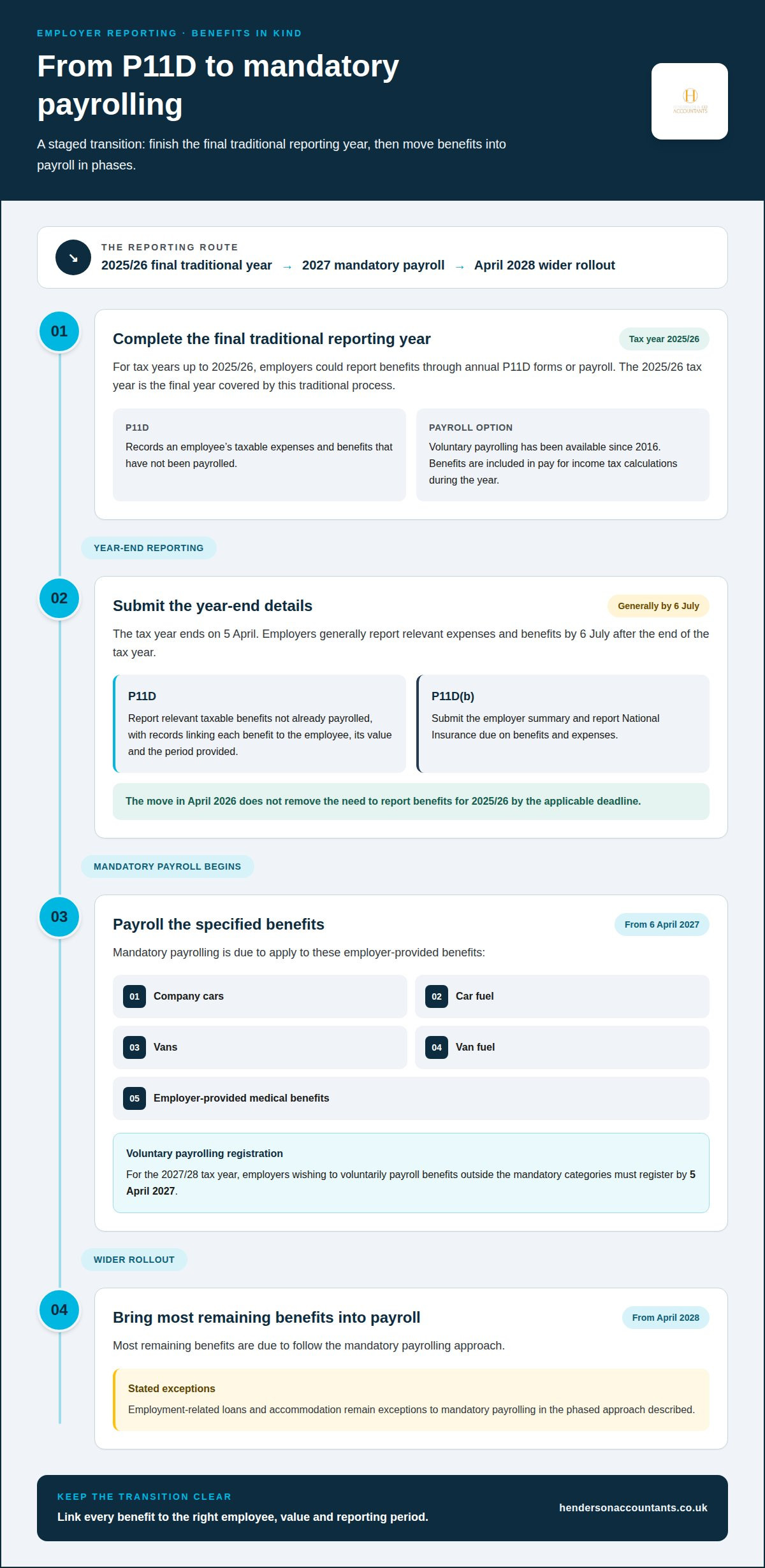
For tax years up to 2025/26, employers could report benefits through annual P11D forms or payroll. The year-end process required records for each employee and a separate employer submission.
Reporting benefits on P11D forms
A P11D form records an employee’s taxable expenses and benefits for a tax year. Employers used it to report items that had not been payrolled, so HMRC could calculate the employee’s tax through their tax code.
HM Revenue & Customs says employers generally must report relevant expenses and benefits under the year-end system by 6 July after the end of the tax year. The tax year covered by a P11D ends on 5 April. Employers also submit a P11D(b), which summarises employees’ P11D information and reports the National Insurance due on benefits and expenses.
Employees must receive details of their relevant benefits for the tax year. Keep a practical record linking each benefit to the employee, its value and the period it was provided. For example, record a company car benefit separately from an expense if they require different reporting treatment.
For the 2025/26 tax year, the final year covered by this traditional process, employers still need to complete the relevant year-end reporting. The shift in April 2026 does not remove the need to submit information for that earlier tax year by its applicable deadline.
Reporting benefits through payroll
Payrolling means adding a taxable benefit’s value to an employee’s pay for income tax calculations. Employers report it through payroll submissions during the year, rather than relying only on an end-of-year P11D to adjust the employee’s tax code.
Voluntary payrolling has been available to employers since 2016. Under the previous approach, employers registered with HMRC before including benefits in payroll. They still had to submit a P11D(b) to report employer National Insurance due, even where the employee’s benefit was payrolled.
The phased change separates the final P11D year from the new reporting system. Most benefits are due to be reported through payroll from 6 April 2027. Company cars, car fuel, vans, van fuel and employer-provided medical benefits enter mandatory payrolling from that date; most remaining benefits follow from April 2028. Employment-related loans and accommodation remain exceptions to mandatory payrolling in the stated phased approach.
For the 2027/28 tax year, employers wishing to voluntarily payroll benefits outside mandatory categories must register by 5 April 2027. Accurate payroll records help connect each benefit with the correct employee and submission. Payroll and CIS Management can support businesses organising payroll reporting alongside their wider payroll responsibilities.
Examples of taxable and exempt staff benefits
Whether a workplace benefit is taxable depends on what the employer provides, how it is used and whether an exemption applies. The examples below show why similar-looking staff perks can receive different tax treatment.
Taxable staff benefit examples
A taxable staff benefit can include a company payment for an employee’s personal costs, a loan or a voucher. For example, paying an employee’s Self Assessment fees can create a taxable benefit. If an employer writes off a staff loan, the amount written off is taxable and Class 1 National Insurance contributions apply.
Vouchers also need careful classification. Cash vouchers, or vouchers readily convertible into cash, are treated as normal pay and subject to tax and Class 1 National Insurance through PAYE. A non-cash voucher is generally taxable based on the amount the employer paid, with Class 1 National Insurance contributions handled through PAYE.
An interest-free loan for a travel season ticket is treated as a benefit in kind. The small-loan exemption normally applies only if qualifying beneficial loans do not exceed £10,000 in combined outstanding balance at any point in the tax year. This limit helps determine whether the loan creates a taxable benefit.
Benefits that may not be taxed
Some benefits can be exempt when they meet specific conditions. HM Revenue & Customs says a trivial benefit can be tax-free if it costs £50 or less and meets the other qualifying conditions. The exemption does not apply simply because an employer describes a payment or gift as a staff treat.
Potentially exempt support includes work-provided mobile phones, training and retraining costs, some childcare support, and staff welfare or counselling services. Employer-provided office equipment used only for business purposes generally does not create a taxable benefit. Cycles and cycle safety equipment may also be exempt when the relevant conditions are met.
The tax treatment of meals and expenses depends on their purpose and arrangement. Canteen meals can be tax-free, while reimbursing an employee for business expenses is not a benefit when the expenses are not personal. Record the reason for each payment clearly, especially when a claim includes both business travel and private spending.
Specific exemptions also apply to particular work arrangements. Board and lodging provided in the home of the person receiving care is exempt from income tax for carers, and the employer is exempt from National Insurance contributions on that benefit. Recording what was provided and how it was used helps you assess each employee’s package correctly.
How benefit tax is collected through payrolling
Payrolling adds taxable benefits to an employee’s pay records so income tax can be collected during the tax year. The phased move makes coordination between payroll, HR and finance important before each benefit category enters mandatory reporting.
Loans and accommodation in payrolling
Employment-related loans and employer-provided accommodation remain outside mandatory payrolling under the phased approach. Employers can choose to payroll these benefits voluntarily from April 2027, provided they register to do so.
For voluntary payrolling outside the mandatory categories in the 2027/28 tax year, registration must be completed by 5 April 2027. This gives payroll teams a clear decision point: include loans or accommodation in real-time calculations, or continue with the applicable reporting arrangements.
Effects on contributions and take-home pay
Payrolled benefits affect an employee’s taxable income and can reduce take-home pay because PAYE collects the income tax through wages. When benefits are reported outside payroll, employers should coordinate reporting and payroll records to help ensure tax is collected correctly.
Employers may owe Class 1A National Insurance on taxable benefits. Under mandatory payrolling, employer National Insurance on payrolled benefits will be collected monthly, alongside payroll processing.
From 6 April 2027, company cars, car fuel, vans, van fuel and employer-provided medical benefits are due to enter mandatory payrolling. Most remaining benefits are due to follow from April 2028. Employers should map each benefit to the correct start date, rather than treating all taxable benefits as one group.
Collecting income tax in real time spreads it across pay periods instead of leaving it to a later tax-code adjustment. For example, a recurring medical benefit can be included in payroll calculations as it is provided. Update payroll records when circumstances change, such as when an employee starts or stops receiving the benefit.
Prepare by matching benefit records with payroll data and agreeing how HR will report changes to finance. For example, payroll needs an update when a company car or its user changes. Clear handovers help prevent incorrect deductions and incomplete submissions.
Cash-flow planning matters too. Monthly collection of employer National Insurance changes the timing of payments compared with settling the year’s liability later. Finance teams can include this regular outflow in payroll forecasts, while payroll teams check that benefit values appear in the correct pay period. Clear processes for expenses and benefits also help prevent personal costs being treated as business items or taxable benefits being missed.
Corporation Tax relief for benefits
Providing a staff benefit can have a tax cost, but it may also reduce a company’s Corporation Tax bill. UK employers can claim Corporation Tax relief on the cost of providing benefits to employees and directors. The business’s relief and the recipient’s tax treatment are separate questions.
For example, if a business provides an employee with a taxable company benefit, the employer records the cost of providing it. That cost may qualify for Corporation Tax relief, even though the employee may still owe income tax on the benefit. The employer may also have National Insurance responsibilities. Relief does not make the benefit tax-free for the employee or remove those separate obligations.
Assess benefits as part of the full remuneration package. A cash salary, a company car and employer-provided medical cover can have different tax and payroll consequences. Compare the recorded cost of each option with its treatment for the employee and the business. This gives directors a clearer view of the package’s overall financial effect, rather than focusing only on its Corporation Tax treatment.
Keep a clear record for each benefit. Note what the business provided, which employee or director received it, the cost to the employer and the relevant accounting period. For a company car, record its purchase or provision cost in the business accounts, while handling the employee’s taxable benefit separately. Matching these records helps keep the Corporation Tax calculation distinct from payroll reporting.
Class 1A National Insurance is another separate cost to consider. For the 2026/27 tax year, its rate on taxable benefits is 15%, according to HM Revenue & Customs. Include that employer liability in the wider cost review, rather than treating Corporation Tax relief as a reduction in the National Insurance due. A benefit can affect the employee’s income tax, employer National Insurance and company tax calculation in distinct ways.
When preparing year-end figures, bring benefit records together with the company’s accounts and tax workings. Check that the costs recorded for employees and directors match the benefits provided, and that payroll information supports the relevant liabilities. This gives the Corporation Tax return a consistent basis and makes the treatment easier to explain if the figures are queried.
Corporation Tax relief can make benefits a more considered part of staff reward planning, but it is only one part of the calculation. Get support with Corporation Tax Returns to account for employee benefit costs alongside the company’s wider tax position.
Henderson & Co. Accountants
Henderson & Co. Accountants can help bring staff benefit costs, payroll records and company tax reporting into a clearer accounting process. If you are reviewing a benefits package, preparing year-end figures or adapting to payrolling changes, accurate records help connect what the business provides with its tax and reporting responsibilities.
Support can include Corporation Tax Returns, Annual Accounts and Payroll and CIS Management, alongside broader finance support to help you understand how benefits fit your business’s finances. Xero Cloud Accounting Setup can also help organise accounting information in one system. The right support depends on the accounting tasks you need and how your business handles benefits.
For a practical discussion about your employee benefits and accounting needs, contact Henderson & Co. Accountants.
Make benefit decisions part of your wider finance plan
Staff rewards work best when they suit the business’s finances as well as employees’ needs. Treat benefits in kind as part of your wider planning, so decisions about new benefits align with your accounting and reporting processes. Clear, consistent records can also help you understand the financial impact as your business changes.
Henderson & Co. Accountants supports businesses with eCommerce Accounting, Xero Cloud Accounting Setup and VAT Return Preparation. These services can help organise financial information for wider business decisions, including how staff benefits fit into your plans.
If you’re ready to discuss your accounting needs and how employee benefits fit into them, contact Henderson & Co. Accountants. A clear conversation can help you decide on a practical next step for your business.
Frequently Asked Questions
Has mandatory payrolling of benefits been delayed?
Yes. The planned start in April 2026 was delayed and replaced with a phased introduction. Benefits in kind such as company cars, car fuel, vans, van fuel and employer-provided medical benefits are due to enter mandatory payrolling from 6 April 2027. Most other benefits are due to follow from April 2028. Employment-related loans and accommodation remain outside mandatory payrolling, although employers can choose to payroll them voluntarily from April 2027.
How does BIK work?
An employer records a non-cash reward provided to an employee, then applies the tax treatment relevant to that benefit. If it is taxable, its value is included in the employee’s tax calculation, either through payroll or the relevant reporting process. For example, a company providing private medical cover needs to account for the benefit as well as the employee’s salary. Employer National Insurance may also be due.
How is electric car BIK calculated?
The taxable value of an electric company car depends on its list price, CO₂ emissions, fuel type and registration date. These details determine the company-car calculation, so the amount can differ between electric models. Electricity is not treated as fuel for company-car fuel-benefit purposes, meaning an electric vehicle does not incur that separate charge. The car benefit itself may still be taxable.
Will P11Ds disappear from April 2027?
For most benefits, employers are due to move from P11D reporting to mandatory payrolling from April 2027. Employment-related loans and accommodation are exceptions, and P11D forms will remain for those benefits under the stated approach. The change is phased: company vehicles and employer-provided medical benefits enter mandatory payrolling from 6 April 2027, while most remaining benefits follow from April 2028.
What are benefits in kind in the UK?
Benefits in kind are goods or services an employer provides to an employee instead of paying them as ordinary wages. Examples include access to a company vehicle, private medical cover or an asset for personal use. The tax question is whether the item has a taxable value and qualifies for an exemption. Its use and circumstances matter, so its label alone does not determine its treatment.
Which benefits in kind are taxable in the UK?
Taxable examples can include private use of a company vehicle, employer-paid personal expenses, and certain loans or vouchers. For instance, a company paying an employee’s Self Assessment fees can create a taxable benefit. By contrast, some work-provided mobile phones, training and counselling services can be exempt when conditions are met. Classify each item by its actual purpose and use rather than assuming all staff perks receive the same treatment.
How are benefits in kind valued for tax purposes?
Valuation depends on the type of benefit. Most other employee benefits are based on what they cost the employer to provide. For an asset loaned for private use, the taxable value is 20% of its value when first provided for use. Company-car calculations use different factors, including list price and emissions. Keeping original cost and provision details helps support the figure used for tax reporting.
What are the UK tax rules for company cars and fuel benefits?
A company car can create a taxable benefit, with the calculation affected by its list price, CO₂ emissions, fuel type and registration date. Free fuel for an employee’s private use creates an additional taxable benefit. Electricity is not treated as fuel for this company-car charge, so electric vehicles do not incur it. Assess company car and fuel benefits separately. HMRC publishes advisory fuel rates for company cars.