
Tax Planning for Company Directors: UK Guide

Tax planning for company directors starts with reviewing how you take money from your company and when. For 2026/27, the standard Personal Allowance is £12,570, according to HM Revenue & Customs, while the Dividend Allowance is £500 and dividend tax rates are 10.75%, 35.75% and 39.35%, depending on your tax band, according to HM Revenue & Customs. The right balance of salary, dividends and pension contributions depends on your income and the company’s position.
It can feel as though your company’s year-end is the natural point to make every tax decision. But personal tax planning also needs to account for the tax year ending on 5 April, so timing can matter as much as the payment method.
This guide explains how salary and dividends affect your tax, how pension contributions may fit into a director’s remuneration plan, and how to manage director’s loan accounts and tax deadlines. Planning ahead for both company year-end and personal tax-year dates can help you make informed decisions and avoid last-minute surprises.
Key Takeaways
- Compare salary and dividends in light of your income and your company’s profits before deciding how to take money out.
- Understand how company pension contributions can fit into your remuneration and tax planning.
- Keep director’s loan account balances in view to avoid unexpected tax consequences.
- Know how tax paid on your behalf can be treated as a benefit, with related reporting and National Insurance responsibilities.
- Plan around both your company year-end and the 5 April personal tax year-end, as well as the Corporation Tax rates that may apply to your profits.
1. Should I pay myself a salary or dividends?
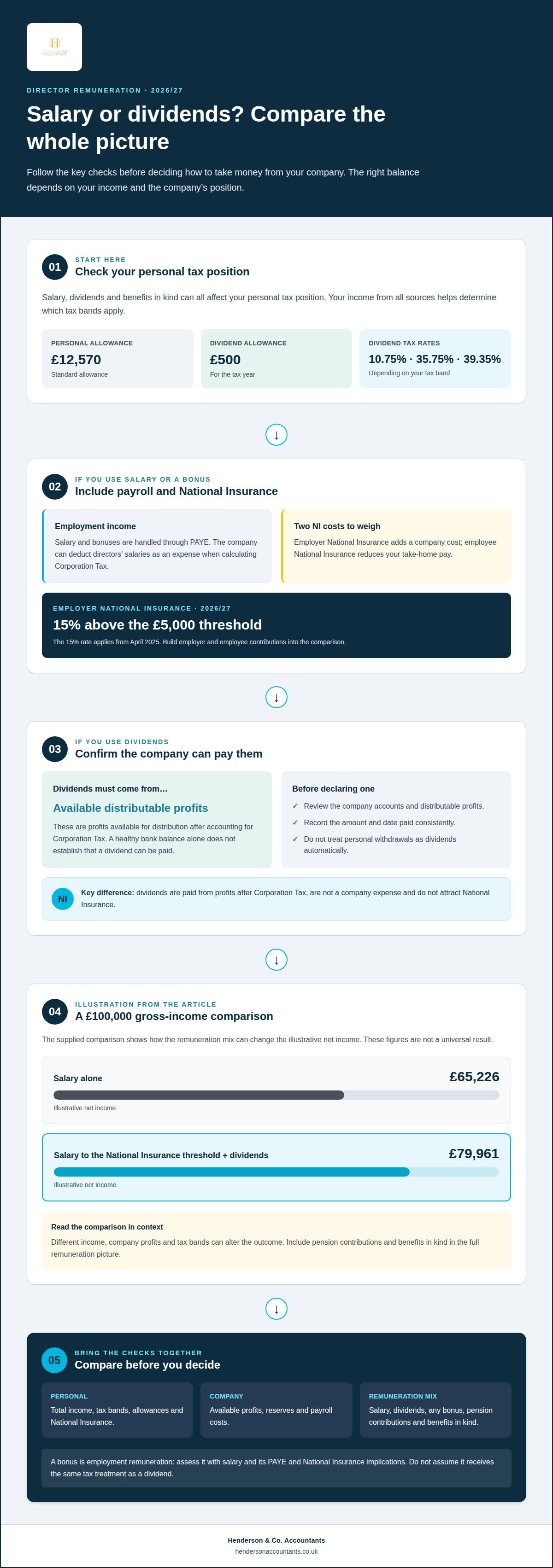
Compare salary, dividends and any bonus by considering your personal tax, National Insurance and the company’s available profits together. Salary and bonuses are employment income handled through PAYE, while dividends are paid from profits after Corporation Tax and do not attract National Insurance. Your income from all sources also affects the tax bands that apply.
For 2026/27, the standard UK Personal Allowance is £12,570, according to HM Revenue & Customs. For the same tax year, UK dividend tax rates are 10.75%, 35.75% and 39.35%, depending on the tax band, according to HM Revenue & Customs. The Dividend Allowance is £500. These thresholds make your other income relevant: salary, dividends and benefits in kind can all affect your personal tax position.
A salary can use some or all of your Personal Allowance, and the company can deduct directors’ salaries as an expense when calculating Corporation Tax. But salary also brings employer and employee National Insurance into the calculation. From April 2025, employer National Insurance is 15% above the £5,000 secondary threshold. Dividends avoid National Insurance, but they aren’t a company expense and can only come from available distributable reserves.
A healthy bank balance alone does not mean the company can pay a dividend. Dividends must come from profits available for distribution after accounting for Corporation Tax. Before declaring one, review the company’s accounts and distributable profits. Keep the dividend records consistent with the amount and date paid, rather than treating personal withdrawals as dividends automatically.
For a like-for-like illustration, one supplied comparison considers £100,000 gross income. Salary alone produces illustrative net income of £65,226; salary to the National Insurance threshold plus dividends produces £79,961. These figures illustrate how the mix can change the outcome, not a universal result. Different income, company profits and tax bands can alter the comparison, so include any pension contributions and benefits in kind in the full remuneration picture.
To choose between salary, dividends and a bonus, compare their effect on your total income, the company’s available reserves and its payroll costs. A bonus is employment remuneration, so assess it with salary and its PAYE and National Insurance implications. Do not assume it receives the same tax treatment as a dividend.
Employer National Insurance adds a company cost to salary, while employee National Insurance reduces the director’s take-home pay. For 2026/27, the employer rate is 15% above the £5,000 threshold. Build both contributions into the comparison before settling on a remuneration mix.
2. Pension contributions and tax relief
A company pension contribution can build retirement savings while affecting the company’s taxable profits. Employer contributions are generally deductible business expenses, so they may reduce the profits on which Corporation Tax is calculated. The company must still weigh any potential tax relief against its cash needs and other planned spending.
For 2026/27, the standard pension annual allowance is £60,000, subject to applicable restrictions. Treat this as a limit to plan around, not an automatic target. Consider contributions from all sources and the timing of payments before deciding what the company should contribute. Restrictions can affect how much allowance is available to an individual.
An employer pension contribution is paid by the company into the director’s pension, rather than to the director as take-home remuneration. It can form part of a broader remuneration plan. Choose an amount the company can afford, record it clearly in the accounts and keep evidence of when it was paid. Reviewing contributions regularly helps align decisions with profits, cash flow and retirement goals.
With a personal contribution, the director pays into a pension personally. Tax relief depends on the applicable rules and individual circumstances. Compare this route with an employer contribution before deciding: the payment source, the director’s taxable income and the company’s position all matter. Do not assume both routes produce the same tax result.
Pension saving and State Pension entitlement are separate considerations. National Insurance records help determine qualifying years, so a pension contribution alone doesn’t replace checking that record. In 2025/26, a £5,000 salary was below the £6,500 Lower Earnings Limit and did not qualify for a State Pension qualifying year. For 2026/27, the Lower Earnings Limit is £6,708 annually. Review salary and National Insurance records alongside private pension saving.
A practical pension review starts by estimating the company’s available cash, checking the director’s annual pension allowance and any applicable restrictions, then comparing employer and personal contributions. Include existing pension contributions in the calculation. This helps you assess the company’s proposed payment alongside the director’s other pension saving.
For directors balancing pension funding with company finances, an Outsourced Finance Director can help bring remuneration, cash flow and annual planning into one view.
3. How can a company director reduce their tax bill?
A director’s loan account records money moving between a limited company and its director. If the company pays personal costs, or the director withdraws money without treating it as salary or dividends, the account may become overdrawn. Reconcile it regularly against receipts, repayments and recorded remuneration to make the balance clear before the company year-end.
For a close company, an overdrawn director’s loan can create a Section 455 tax charge if it remains unpaid nine months and one day after the company’s year-end. The charge is 33.75% of the outstanding balance. Repaying or clearing the loan in time can prevent that charge, but the repayment must be genuine and correctly recorded. A temporary repayment followed by another withdrawal can create further tax issues.
A loan above £10,000 may also count as a benefit, bringing personal tax and National Insurance consequences. Keep a clear record of when the balance passes that threshold and whether interest is paid. Don’t assume that calling a withdrawal a loan removes tax obligations. The balance, the repayment terms and the director’s other transactions all matter.
Keep the account under control by separating business and personal spending, recording director withdrawals promptly and matching repayments to the company’s books. Claim company expenses only when incurred wholly and exclusively for business purposes. Do not record personal spending as a business expense to reduce profits. If you regularly draw funds, reviewing the account during the year is more effective than finding an unexplained debit balance at year-end.
Other income affects a director’s personal tax bands. The income and tax bands of family shareholders also affect the tax on dividends they receive. A close company’s loan position matters too, so consider the company’s accounts and each person’s circumstances together. Dividends must reflect distributable profits and share rights, not be used to disguise a loan or personal payment.
Incorrect dividends can leave the company and shareholders with unexpected tax and accounting corrections, especially where distributable profits weren’t available. Late or inaccurate filings can also expose directors to penalties and create avoidable compliance work. Keep supporting records for withdrawals, repayments and dividend decisions, then ensure the accounts and relevant returns report them consistently. If the company cannot repay an overdrawn balance promptly, address the position before the Section 455 deadline rather than relying on an informal bookkeeping adjustment.
4. Income tax paid on a director’s behalf as a benefit
If the company pays a director’s personal Income Tax bill, record how the payment was made and reported. When an employer pays a director without deducting tax through PAYE, and HM Revenue & Customs later recovers the unpaid tax from the employer, the payment counts as a benefit. Employers also have National Insurance and reporting obligations when paying tax on a director’s behalf. Recording it as an ordinary company expense alone may therefore give an incomplete picture.
Keep the payment, PAYE records and accounts aligned. Record the amount paid, the tax period and whether the payment went through payroll. Then account for the benefit and related employer obligations in the relevant reporting. This creates a clear record and helps distinguish a director’s personal tax from the company’s Corporation Tax or PAYE liabilities.
Personal income planning should include salary, dividends, benefits in kind and income from other sources. For 2026/27, the Personal Allowance is reduced by £1 for every £2 of adjusted net income above £100,000. As a result, taking an additional payment can affect more than the tax rate applied to that payment. Review projected income across the tax year before deciding how to extract funds.
Family shareholders need the same careful consideration. A dividend affects the recipient’s taxable income and tax band, not just the director’s. Before planning distributions, consider each shareholder’s actual shareholding, income and entitlement. Do not use a payment to a family member as a shortcut for shifting income: the company records and arrangements should reflect what actually happened. Where company shareholdings intersect with wider family wealth and succession, specialist legal practitioners such as Sheikh Najam TEP can provide guidance on trust structures and inheritance tax planning.
Making Tax Digital for Income Tax Self Assessment introduces digital tax returns in 2026. It requires digital records and compatible software to send updates to HM Revenue & Customs. Directors with income outside PAYE should consider how those records fit alongside company payroll information. Keep personal income records distinct from company bookkeeping, then reconcile the figures used for each reporting obligation.
A practical review can start with a forecast of personal income, including any benefit paid by the company. Next, identify which amounts belong in payroll, which relate to dividends, and which need separate Income Tax reporting. Finally, compare the expected total with the relevant tax bands and allowance rules. For example, if a director’s adjusted net income approaches £100,000, the Personal Allowance taper makes the timing and form of additional remuneration important.
5. Company year-end and 5 April planning
Your company year-end and the personal tax year-end are separate planning points. The UK personal tax year ends on 5 April, while the company’s accounting period follows its own year-end. A decision made after one date may not have the same effect as one made before it. Map director payments, company profits and reporting tasks against both calendars.
For 2026/27, UK Corporation Tax rates are 19% and 25%, with Marginal Relief potentially applying between the lower and upper profit limits, according to HM Revenue & Customs. Forecast profits before deciding whether to pay salary, declare dividends or retain funds. A company can deduct directors’ salaries when calculating Corporation Tax, but dividends come from profits after Corporation Tax. The timing and available profits therefore matter alongside your personal tax position.
Remuneration accrued at the accounting year-end generally needs to be paid within nine months of the period end for Corporation Tax relief in that accounting period. Include this timing in the year-end plan rather than relying on an accrual alone. Also review whether business purchases qualify for capital allowances. The Annual Investment Allowance can allow the full cost of qualifying assets to be deducted from profits, up to its annual limit.
Payroll planning also affects the company’s costs. The Employment Allowance increases from £5,000 to £10,500 from April 2025, according to HM Revenue & Customs. Eligible employers may use it to reduce their employer National Insurance liability. A sole-director company with no other employees cannot claim it, and only one company in a group of connected companies can claim. Check eligibility as part of payroll forecasting, not after setting salary levels.
Companies House accounts and confirmation statements, HMRC Corporation Tax and PAYE obligations, and Self Assessment each have separate due dates. Organise them around the company’s accounting reference date, payroll cycle and 5 April personal tax-year end; submit each return and payment by its applicable deadline.
For an annual review, compare actual results with the forecast, then consider outstanding remuneration, planned dividends, pension payments and qualifying asset purchases. Record decisions and dates in the company’s accounts and supporting records. This helps explain why a payment belongs to a particular accounting period or personal tax year.
For help bringing accounts and tax deadlines together, use Annual Accounts support to organise year-end reporting and plan the next cycle.
Henderson & Co. Accountants: Company Secretarial Services
Henderson & Co. Accountants provides Company Secretarial Services to support the administration and records involved in company tax planning. This can help keep director decisions, shareholder arrangements and company records organised and consistent.
If you are reviewing salary, dividends and company finances together, an Outsourced Finance Director can help bring these decisions into a clearer planning picture. For eCommerce businesses, eCommerce Accounting and Xero Cloud Accounting Setup can support the financial information used in those discussions.
Consider professional support when company administration is taking attention away from running your business or you want a more organised approach to financial planning. Contact Henderson & Co. Accountants to discuss support for your business.
Make your next planning decision with confidence
Tax planning for company directors works best as an ongoing part of business decision-making, not a task reserved for the end of the tax year. Changes in trading activity, cash flow or personal priorities can affect your planning needs. Build regular reviews into the way you run the company so decisions are based on a current view of its position.
Henderson & Co. Accountants supports eCommerce businesses with eCommerce Accounting, Xero Cloud Accounting Setup and VAT Return Preparation. Clear, well-organised financial information can help you make considered choices and keep business obligations in view as your company develops.
If you’d like support connecting your company’s records and tax planning, contact Henderson & Co. Accountants to discuss your needs. A clear next step can make planning feel more manageable and help you focus on running your business.
Henderson & Co. Accountants can support company directors with tax planning
Henderson & Co. Accountants supports the financial and tax responsibilities discussed in this guide with services including Corporation Tax Returns, VAT Return Preparation, Annual Accounts, Bookkeeping, and Payroll and CIS Management.
Turn to Henderson & Co. Accountants for help managing these responsibilities or support with your company’s finance function. Services also include Xero Cloud Accounting Setup, Company Secretarial Services, eCommerce Accounting, an Outsourced Finance Director and an Outsourced Finance Department.
Frequently Asked Questions
How can a company director reduce their tax bill?
Tax planning for company directors means considering personal income and company finances together. Review how payments are classified, whether the company can afford them and how they affect your wider income. Before making a withdrawal, for example, establish whether it is salary, a dividend or a director’s loan. Records that match the actual payment help prevent avoidable corrections and support accurate returns.
Should I pay myself a salary or dividends?
There is no single answer for every director, so compare the personal and company tax effects of each option. Salary is processed through payroll, while dividends depend on share ownership and available distributable profits. If you receive income from another job or investment, include it in your comparison because it may affect your tax band. Review the figures before deciding rather than assuming a familiar salary-and-dividend split is suitable.
What is Remuneration Planning?
Remuneration planning means deciding how and when a director receives value from the company. It can include salary, bonuses, dividends and employer pension contributions, considered alongside business cash flow and personal income. For example, a director planning a major company purchase may choose to retain funds rather than withdraw them immediately. The plan should reflect documented decisions and the company’s ability to make each payment.
What is the best way to take money out of my limited company?
The right approach depends on your income, the company’s available profits, cash requirements and the purpose of the payment. First identify whether the money is compensation, a distribution or repayment of money owed to you. Then ensure the company records and supporting documents reflect that treatment. Do not label a withdrawal as a dividend simply for convenience: the company must have distributable profits.
What is the most tax efficient salary?
There is no single salary figure that suits every director. The result depends on other income, National Insurance, the company’s employer contributions and eligibility for the Employment Allowance. A salary that works for a director with other employees may not suit a sole-director company. Compare the total company cost with the director’s take-home income and National Insurance position, and review the calculation when circumstances change.
When should you seek professional advice?
Seek advice before a significant change, such as taking on a co-director, changing share ownership, making a large withdrawal or approaching the company year-end. Planning early gives you time to consider the accounting and tax treatment before payments are made. Working with established chartered accountants such as Davis & Co LLP can help ensure your statutory accounts and tax strategies withstand scrutiny from both tax authorities and commercial lenders. It can also help if personal income comes from several sources or records do not clearly explain a director’s account balance. Bring current accounts, payroll information and details of planned transactions.
Why does profit extraction need a plan?
A plan helps match withdrawals to genuine profits, company cash needs and your personal income position. Without one, personal spending can become mixed with company costs, or a payment can be recorded under the wrong category. For example, a dividend decision must reflect available distributable profits and be documented appropriately. Planning also helps preserve funds for tax liabilities and business commitments, rather than focusing only on immediate personal cash.
What tax rates and allowances apply to UK company directors in 2026/27?
For 2026/27, the standard Personal Allowance is £12,570, according to HM Revenue & Customs. Dividend tax treatment depends on the applicable tax band and allowance, so check the current rules before making a decision. UK Corporation Tax rates are 19% and 25%, with Marginal Relief potentially applying between the lower and upper profit limits, according to HM Revenue & Customs.