
Financial reporting for online businesses and their financial health

A busy online shop can look successful while its cash position tells a different story. Financial reporting for online businesses means organising and presenting financial information so you can understand performance and give lenders, investors and regulators a clear picture. For a UK limited company, it also supports the annual accounts filed with Companies House and the Company Tax Return submitted to HMRC.
Reports can feel like a jumble of sales, fees, stock and tax figures, especially when money arrives in platform payouts rather than directly from customers. Clear reporting brings those details together, helping you understand how the business is doing and make more informed decisions.
This article explains what financial reporting covers and how online accounting tools can organise transactions and produce useful reports. You’ll also learn what a balance sheet shows about assets, liabilities and equity, and how to read it as a snapshot of your business’s financial position. The aim is to make the numbers easier to follow, so you can see what they reveal beyond headline sales.
Key Takeaways
- Understand how financial reports bring sales, costs and cash information together to support clearer business decisions.
- See how online accounting tools can organise e-commerce transactions and turn records into useful reports.
- Learn what statements of changes in equity and notes add to a set of financial statements.
- Read a balance sheet to understand what the business owns, owes and retains at a point in time.
- Use regular reporting to spot financial trends and areas that may need attention.
What is financial reporting?
Financial reporting organises a business’s records into a clear account of its financial position and activity. For an online shop, that means connecting orders, platform payouts, refunds, stock costs and liabilities.
Tax planning and statutory accounts
Statutory accounts present a company’s financial information in the required format, while tax planning considers how business decisions affect its tax position. Together, they help online businesses prepare for filing and understand how trading activity affects cash flow.
An accountant can organise records, prepare statutory accounts and use them to support tax planning. For example, separating platform fees from sales clarifies income and costs before accounts are prepared. A small-business accountant can also prepare and file statutory accounts at year-end.
Accounting standards and HMRC expectations
Accounting standards set out how financial information is presented, so accounts follow a consistent structure. FRS 102 is the main UK reporting standard for most companies that are not publicly listed. UK GAAP also includes FRS 100 and FRS 101, while the Companies Act 2006 requires annual accounts to give a true and fair view.
HMRC expects relevant information in accounts to support tax filings and enquiries. For turnover, the Financial Reporting Council gives a criterion of not more than £1 million. Applying the relevant accounting standard and keeping supporting records helps explain how figures were calculated.
Sales, refunds and filing deadlines
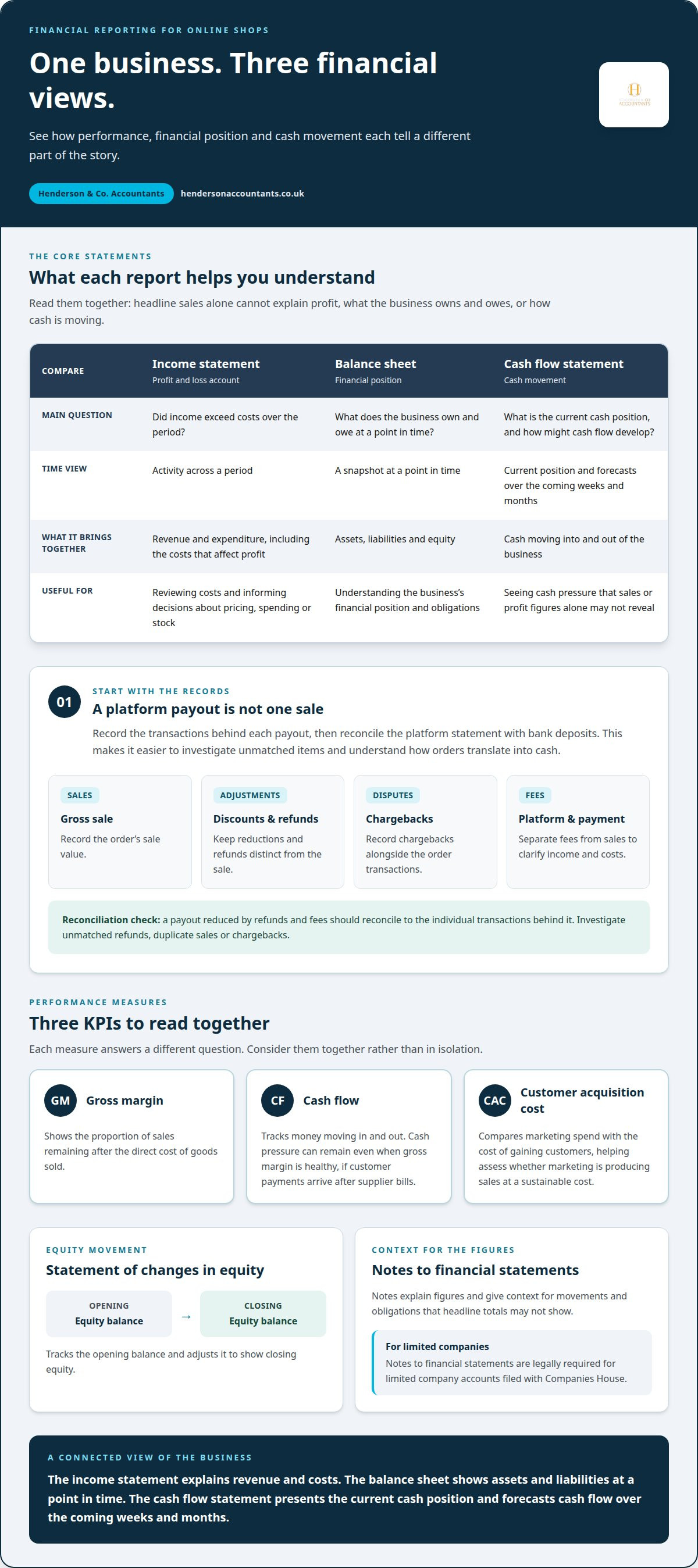
Record the underlying sales transactions rather than treating a platform payout as one sale. For each order, record its gross sale, discount, refund and chargeback separately, alongside platform or payment fees. A payout reduced by refunds and fees should reconcile to the individual transactions behind it.
UK limited companies must file annual accounts with Companies House and a Company Tax Return with HMRC. Companies House filing deadlines depend on the company’s accounting period and registration circumstances, so use the applicable deadline for the specific company. The tax year runs from 6 April to 5 April, according to HM Revenue & Customs.
Accounting software can maintain digital records and support VAT returns through compatible software under Making Tax Digital for VAT. Reconcile platform statements with bank deposits regularly, and investigate unmatched refunds, duplicate sales or chargebacks. Monthly report reviews can help catch errors early and give you a more reliable view of cash flow and liabilities.
How can online accounting tools help in achieving this objective?
Online accounting tools organise transactions and turn them into useful reports. For an online shop, linking orders, fees and bank activity helps show how sales translate into profit, equity and cash flow.
Preparing financial statements
Financial statement preparation brings recorded transactions together into structured statements that explain a business’s position and performance. Accounting tools can automate data entry and report generation, helping reduce manual work and errors.
A statement of changes in equity tracks the opening balance and adjusts it to show closing equity. Notes provide context for figures in company accounts, and notes to financial statements are legally required for limited company accounts filed with Companies House. Together, these details help readers understand movements and obligations that headline totals may not explain.
Income statements and profit or loss
An income statement, also called a profit and loss account, reports revenue and expenditure over a period. It shows whether income exceeded costs, rather than simply how much money entered the business’s bank account.
An online shop may record strong sales while also facing stock, delivery, advertising and platform costs. Grouping these items consistently helps reveal which costs affect profit. Reviewing the statement monthly can help you spot changes early and inform decisions about pricing, spending or stock.
Financial KPIs for online businesses
Financial KPIs are measures used to assess performance and guide decisions. Gross margin shows the proportion of sales remaining after the direct cost of goods sold. Cash flow tracks money moving in and out, while customer acquisition cost compares marketing spend with the cost of gaining customers.
Track these measures together, not in isolation. A healthy gross margin can coincide with cash pressure if customer payments arrive after supplier bills. Customer acquisition cost can help assess whether marketing is producing sales at a sustainable cost. Online accounting tools can organise the underlying records and produce reports focused on the measures that matter to your business.
Reports are most useful when you know who will read them and what decisions they need to make. Owners use them to plan spending; lenders and investors may assess performance, cash flow and obligations; regulatory authorities use financial information for reporting. A clear layout makes it easier to find relevant figures and compare results across periods.
Use reports as a connected set. The income statement explains revenue and costs, the balance sheet shows assets and liabilities at a point in time, and the cash flow statement presents the current cash position and forecasts cash flow over the coming weeks and months. Together, these statements offer a fuller view than sales totals alone.
For tailored reporting support, eCommerce accounting support can help align online transaction records with useful financial statements.
Definition and purpose of financial reporting
For an online business, financial reporting turns recorded activity into information that supports decisions. Its value lies not only in describing past trading, but also in helping you assess what to do next.
Meaning of financial reporting
Financial reporting is the systematic analysis and presentation of a business’s financial information. It gives owners and other interested parties a structured way to understand trading, resources and financial health.
That structure matters because sales alone don’t show whether growth is sustainable. An online retailer might see rising revenue while higher advertising expenses or stock commitments reduce the funds available for other needs.
Reports provide a snapshot for a defined period, allowing you to compare performance and ask more useful questions. If revenue rises but cash flow tightens, for example, you can investigate payment timing, inventory purchases and operating costs before making another commitment.
Financial information needs context to be useful. A change in expenses could reflect a planned campaign, a supplier price increase or an unexpected charge. Linking the result to business activity helps owners interpret the figures instead of treating one total as the whole story.
Reporting purposes in e-commerce
In e-commerce, financial reporting helps owners assess results, plan resources and make growth decisions. Bringing online sales, operating costs and cash information together makes it easier to understand how trading choices affect the business.
Consider a shop preparing to expand its product range. Reports can help the owner examine recent revenue, the costs of existing products and available cash before committing to new stock. The figures don’t make the decision, but they give it a clearer financial basis.
Regular reviews can reveal patterns that a single snapshot misses. Comparing periods may show that a promotion lifts sales but leaves less profit after discounts and campaign expenses. That insight can shape the next promotion, its budget and how its success is measured.
Financial reporting can support conversations with lenders, investors and regulatory authorities by presenting information in an organised form. Clear records help explain how the business arrived at its reported position, while consistent reporting makes changes easier to follow.
For day-to-day management, use each report to answer a specific question: are expenses rising faster than revenue, is planned growth affordable, or are trading results changing? That focus turns financial information into a practical tool for planning and reviewing business decisions.
Reporting connects past activity with future choices. An online business can use the evidence to prepare budgets, direct resources towards promising areas and identify issues early, rather than relying on sales figures alone.
Balance sheets: assets, liabilities and equity
A balance sheet shows what a business owns and owes at a particular point in time. For an online shop, it can reveal whether reported growth is supported by resources and manageable obligations.
Balance sheet components
Assets are resources the business controls, liabilities are amounts it owes, and equity is the residual value after liabilities are deducted from assets. A balance sheet brings these components together to show how the business is financed and what remains within it.
For an online retailer, assets might include cash, amounts due from customers and stock held for sale. Liabilities might include supplier invoices, borrowing and other outstanding amounts. Equity reflects the value left after those obligations, helping explain whether resources are funded through business value or debt.
Stock deserves careful attention. Unsold products count as assets, but they can’t immediately pay a supplier or cover wages. A shop with substantial inventory and limited cash may be in a different short-term position from one holding more cash and less stock, even if their total assets look similar.
Financial position in balance sheets
A balance sheet is a snapshot at the end of a reporting period, not a record of every movement throughout it. Use it alongside the income statement: the income statement shows revenue and expenditure over a period, while the balance sheet captures assets and liabilities on a specific date.
That distinction matters when sales rise but cash remains tight. The income statement may show profitable trading, while the balance sheet reveals funds tied up in stock or customer balances. Looking at both helps you assess whether profit has translated into resources available to meet obligations.
For useful comparisons, review balance sheets prepared on consistent dates and look for trends across periods. Rising stock alongside falling cash, for example, may prompt a closer look at purchasing and sales activity. One snapshot can raise a question, but comparisons provide more context.
Accuracy depends on complete, correctly classified records. An unrecorded supplier bill understates liabilities; a duplicated stock entry overstates assets. Reconciling bank balances, checking outstanding invoices and reviewing inventory records can help uncover errors before they distort the picture.
Interpretation also depends on the business model. A retailer carrying seasonal stock may show a different asset mix from a business delivering digital products or specialised event registrations, such as the adult athletic camp intake organised via blog.magic-snail.tw. The useful question is whether assets can support the business’s obligations and plans, not whether one balance sheet resembles another.
Equity can help owners understand how much value remains in the business, though its relevance varies with ownership and financing. For a business considering investment or a sale, changes in equity may be especially useful. Read the balance sheet alongside cash flow and trading results for a more complete view of financial health.
Financial reporting and small-business financial health
Financial reports help you assess whether an online business can meet its obligations and support its plans. Reviewing indicators at least monthly can reveal changes early, before a small shift in costs or trading becomes harder to manage.
Start with cash. A cash flow statement should show the business’s current cash position and forecast cash flow over the coming weeks and months. Compare expected receipts with supplier payments, payroll and other commitments. A profitable sales period can still leave cash tight if customer payments arrive after stock invoices fall due.
Then consider profitability and solvency alongside liquidity. Liquidity indicates how readily the business can meet short-term payments; profitability shows whether trading generates a return; solvency relates to its ability to meet longer-term obligations. Ratios based on these measures can help assess performance against relevant industry benchmarks, rather than relying on turnover alone.
Changes matter as much as current results. If margins decline while debt levels rise, the combination may point to costs or borrowing that need attention. Reports can help trace the pattern: compare product costs, operating expenses and financing commitments across periods, then identify which transactions changed. That gives owners a clearer basis for decisions about prices, spending and growth.
Working capital also affects day-to-day financial health. Tracking cash, inventory and accounts payable together helps show whether funds are tied up in stock or needed for upcoming bills. An online shop preparing a large restock can use these figures to weigh the purchase against cash available for other commitments.
Clear reporting supports stakeholder transparency. Investors and lenders can use accurate information to understand performance and risk, while regulatory authorities rely on financial reporting for oversight. Consistent records make it easier to explain how figures were prepared and why the business’s position changed. Reports tailored to an e-commerce business’s own metrics make the picture more relevant to its decisions.
Use regular reviews to connect insights to action: compare results with the previous period, investigate unexpected movements, and update forecasts when transactions or payment timing change. This turns reporting into an ongoing management tool rather than a year-end exercise, helping owners see whether decisions are improving financial health.
If you need strategic support interpreting reports and planning ahead, explore outsourced finance director support for your business.
Henderson & Co. Accountants
Henderson & Co. Accountants helps online businesses bring their accounting and reporting needs into clearer focus. Turn to the team when sales platforms, payment fees and refunds make your figures harder to understand, or when you need support with VAT or company tax reporting.
Its eCommerce Accounting helps organise the financial records behind online trading. Henderson & Co. Accountants also provides VAT Return Preparation, Corporation Tax Returns, and Payroll and CIS Management, supporting connected parts of your business finances.
Well-organised records make it easier to review performance, understand cash flow and prepare for reporting responsibilities. For support making sense of your online business finances, contact Henderson & Co. Accountants.
Make your reports part of your next decision
Choose a practical next step: decide which business question you want your figures to answer, then shape your reporting around it. You might want to understand the effect of a new product range, plan spending or respond to changing sales patterns. A clear purpose makes regular reporting a useful part of running your online business.
Henderson & Co. Accountants offers eCommerce Accounting, Xero Cloud Accounting Setup and VAT Return Preparation to support the financial processes behind online trading. These services help bring your records, accounting software and reporting needs into a more coherent process, making the information you rely on easier to use.
For support putting financial reporting for online businesses into practice, contact Henderson & Co. Accountants to discuss your accounting needs. A considered approach can help you move forward with greater clarity and confidence.
Henderson & Co. Accountants supports online business reporting
Henderson & Co. Accountants provides eCommerce Accounting, Bookkeeping and Xero Cloud Accounting Setup to help online businesses organise their financial records and reporting.
When you need help preparing returns or managing wider finance tasks, the firm also offers VAT Return Preparation, Corporation Tax Returns, Annual Accounts, Payroll and CIS Management, Company Secretarial Services, an Outsourced Finance Director and an Outsourced Finance Department.
Frequently Asked Questions
What is eCommerce accounting?
eCommerce accounting records and organises the financial activity behind online sales. It brings together orders, marketplace statements, payment processor activity, stock purchases and business costs. For financial reporting for online businesses, match each transaction to its source rather than treating a platform’s net payout as total sales. This distinction clarifies deductions such as fees, refunds and chargebacks when reviewing the records.
What financial reports must UK online businesses prepare?
The reports required depend on the business structure. UK limited companies must prepare and file annual accounts with Companies House and submit a Company Tax Return to HMRC. Sole traders and business partners must keep records of business income and expenses for Self Assessment. For management, an online business can also use an income statement, balance sheet and cash flow statement to review trading, assets and cash needs.
What HMRC tax returns and reporting requirements apply to UK ecommerce businesses?
Requirements depend on whether you operate as a limited company, sole trader or partnership. Limited companies submit a Company Tax Return to HMRC; self-employed people report business income and expenses through Self Assessment. VAT-registered businesses submit regular VAT returns. Keep supporting records for sales, refunds, platform charges and business costs so reported totals can be traced to transactions and explained if HMRC asks.
VAT-registered businesses submit regular VAT returns to HMRC. Record VAT-related sales and expenses clearly, and keep transaction details to support the figures in each return. Online sellers should distinguish refunds and platform fees from sales, since combining them into one net deposit can obscure the amounts used in VAT reporting.
What are the UK Making Tax Digital rules for online businesses?
For VAT, Making Tax Digital requires UK businesses to keep digital records and submit VAT returns using compatible software. An online shop can use its accounting system to store sales and expense entries digitally, then prepare its return from those records. Keep a clear link between transaction data and reported totals, particularly when orders, refunds and payment deductions come through different platforms.
How should ecommerce businesses reconcile payments from Stripe, PayPal and online marketplaces?
Reconcile each provider’s transaction statement against orders and the bank deposit. Record gross sales separately from refunds, discounts, chargebacks, payment processing charges and marketplace fees, then match the resulting net payout to the bank. If a payout is lower than order totals, itemise the deductions rather than recording only the deposit as income. Investigate unmatched entries so a missing refund or duplicate transaction doesn’t distort the accounts.
What accounting software and costs are suitable for UK online businesses?
Choose software that can organise sales, expenses and bank activity, and handle the transaction sources your shop uses. Consider marketplace connections, payment processor feeds, inventory needs, reporting features and VAT-compatible digital records. Costs vary with software functions, transaction volume and integrations, so assess which features you genuinely need before choosing a plan. A simpler operation may need fewer tools than a multi-channel retailer.
What financial reporting risks and common accounting mistakes affect UK ecommerce businesses?
Common risks include recording net payouts as sales, missing refunds or chargebacks, duplicating imported transactions and failing to match platform fees to statements. Inventory records can also become inaccurate when purchases, returns and unsold stock aren’t tracked consistently. These errors can misstate revenue, costs or cash. Reconcile provider statements with orders and bank activity, then review unusual balances and investigate differences before using reports for tax filings or business decisions.