
Year-End Tax Planning Checklist for UK Businesses

Year-end tax planning for businesses starts with the right deadline: sole traders and partnerships have a tax year ending on 5 April, according to HM Revenue & Customs, while a limited company has its own accounting year-end. Before that date or your company’s year-end, review the decisions that can shape your tax position, rather than treating tax as a task for the filing deadline.
It’s easy to focus on allowances and expenses, but director dividends and overdrawn loan accounts also deserve attention. Dividends need to be supported by available profits and proper records, and a director’s loan still outstanding nine months and one day after the company’s year-end is subject to the s455 tax charge. Timing and accurate bookkeeping matter.
This checklist explains how capital allowances, pension contributions, planned asset sales and profit forecasts can affect your tax position, alongside director accounts. The right steps depend on your business structure and accounting year-end. Use the guidance to review your figures and reduce last-minute surprises.
Key Takeaways
- Match capital allowance claims to the asset, purchase timing and business structure before committing to a purchase.
- Review employer pension contributions alongside available allowances to understand how they may affect company profits.
- Plan the timing of a business sale with Business Asset Disposal Relief in mind, as the rate affects the tax on qualifying gains.
- Use up-to-date accounts and forecasts to estimate taxable profits and tax liability before the year-end.
- Keep director dividends supported by available profits and proper records, and monitor any overdrawn loan account against its repayment deadline.
1. Capital allowances and the Annual Investment Allowance
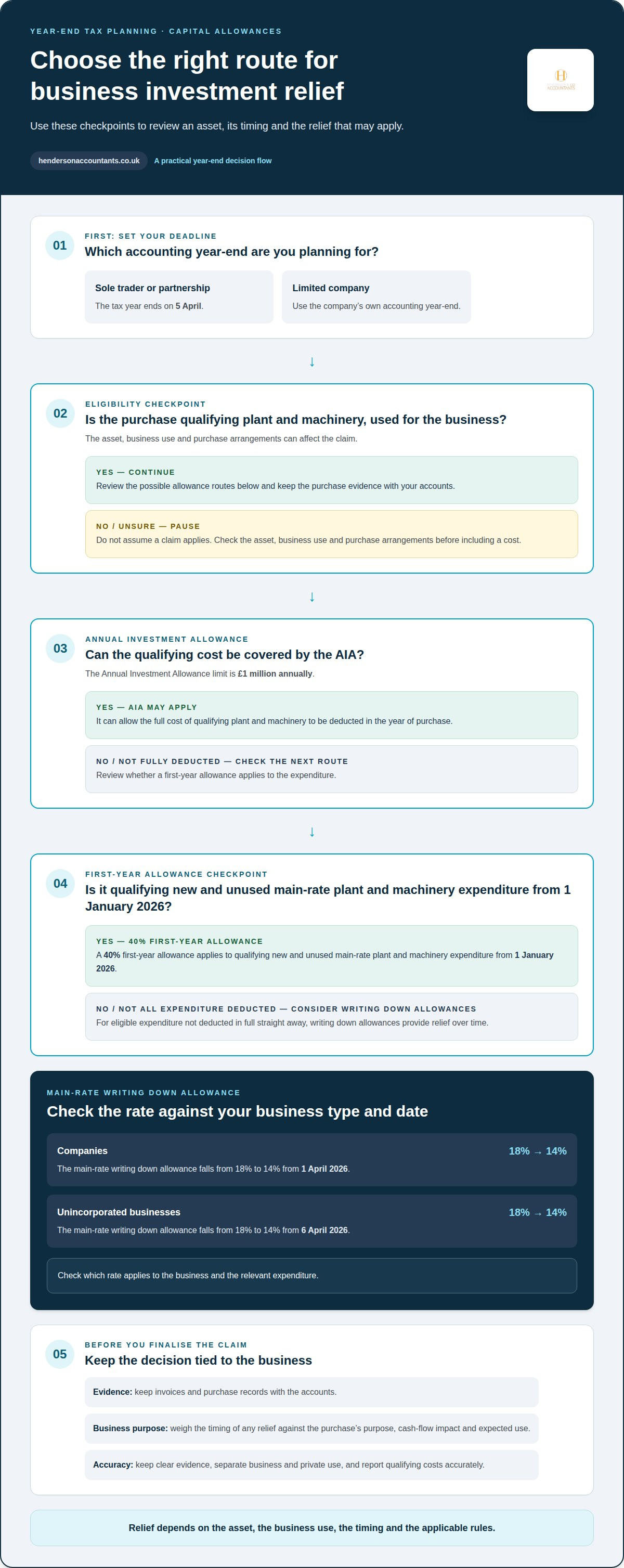
Capital allowances let a business deduct qualifying capital costs from taxable profits. For a sole trader or partnership, timing may matter: HM Revenue & Customs states that the UK tax year ends on 5 April. A limited company instead has its own accounting year-end, so align investment decisions with its accounting period.
According to HM Revenue & Customs, the Annual Investment Allowance limit is £1 million annually. It can allow the full cost of qualifying plant and machinery to be deducted in the year of purchase. Equipment and machinery may qualify, but the asset, business use and purchase arrangements affect the claim. Keep invoices and purchase records with the accounts.
For qualifying new and unused main-rate plant and machinery expenditure, a 40% first-year allowance applies from 1 January 2026. Writing down allowances provide relief over time for eligible expenditure not deducted in full straight away. The main-rate writing down allowance falls from 18% to 14% from 1 April 2026 for companies and 6 April 2026 for unincorporated businesses. Check which rate applies to the business and the relevant expenditure.
How do UK capital allowances and full expensing affect year-end business investment decisions? They may bring tax relief forward and reduce taxable profits sooner, but the allowance depends on the asset and eligibility rules. Weigh the timing of any relief against the purchase’s business purpose, cash-flow impact and expected use. A tax deduction alone does not make an unsuitable purchase worthwhile.
Also consider pension contributions when reviewing taxable income. For a limited company, employer pension contributions are usually deductible for corporation tax. Pension annual allowance limits affect how much can receive tax relief, while carry forward may let a business owner use unused allowances from the previous three years. Review contributions already made before deciding whether further funding fits the business’s cash needs.
Personal allowances and tax bands affect the owner’s income tax position, rather than the company’s capital allowance claim. The UK income tax threshold freeze is stated to continue until 2031, so rising income can affect how much falls within each band. A sole trader should assess business profit alongside other income and available allowances.
What are the risks and HMRC penalties for inaccurate or aggressive year-end tax planning? Unsupported asset claims or overstated business use can make taxable profits inaccurate and expose the return to challenge and penalties. Keep clear evidence, separate business and private use, and report qualifying costs accurately. HM Revenue & Customs states that a Self Assessment tax return is due by 31 January, making accurate records essential well before filing.
2. Pension contributions
For a company owner, a pension contribution can support retirement saving and affect the company’s tax position. Employer contributions are usually deductible for corporation tax and are not subject to National Insurance contributions. Record the payment clearly and distinguish it from salary, dividends and personal contributions.
Compare the main ways to take value from a company before deciding what to contribute. Salary is processed through payroll and affects income tax and National Insurance. Dividends are paid from available company profits and have their own personal tax treatment. An employer pension contribution goes into a pension rather than the owner’s current spending. The right mix depends on company profits, the owner’s income and cash needs.
Personal pension contributions can qualify for tax relief and reduce taxable income, subject to the relevant limits. The amount of relief depends on the contribution and the saver’s tax position. Before paying in, total contributions already made and consider how income for the tax year affects available relief. Pension allowances are not a reason to contribute more than the business or household can comfortably fund.
Carry forward may help an owner with unused pension allowance from earlier years. Review pension statements and contribution records alongside expected income, then establish how much allowance remains available. This can be useful when profits vary between years or a business expects a stronger result. Keep calculations and payment records with the year-end accounts so the contribution can be reported accurately.
Salary sacrifice changes the arrangement: an employee gives up part of their salary and the employer pays that amount into their pension. This may reduce National Insurance costs for both parties, but it changes take-home pay and must be reflected in payroll. The employee National Insurance rate on salary is 8% or 2%, depending on earnings. From April 2029, pension contributions qualifying for National Insurance savings through salary sacrifice will be limited to £2,000 per employee per year.
For an owner-director, compare salary sacrifice with a direct employer contribution before changing payroll. The company’s contribution may offer a clear corporation tax deduction, while salary sacrifice links the pension payment to an agreed salary change. Both affect business cash, so include the payment in forecasts and keep payroll records consistent with the arrangement.
Use a practical year-end review: total contributions made, estimate the owner’s income, assess available allowance, then compare the proposed payment with working-capital needs. If staff contributions or salary sacrifice are involved, accurate payroll management helps align deductions, employer payments and records. This keeps pension decisions connected to the company’s actual cash flow and tax position.
3. Business Asset Disposal Relief on business sales
Business Asset Disposal Relief (BADR) can reduce the Capital Gains Tax rate on a qualifying business disposal. The rate was 10% for many years, increased to 14% in April 2025, and rises to 18% in April 2026. For a planned sale, the completion date can therefore affect the tax calculation.
Consider a qualifying business sale or shareholding with a £1 million gain; the UK annual investment allowance limit is £1 million per year. At the long-standing 10% BADR rate, tax on that gain would be £100,000; at 18%, it would be £180,000. The difference is £80,000, showing why a sale’s timing deserves attention. These figures illustrate the rate change, not a promise that a particular disposal qualifies.
Before agreeing a sale date, assemble the business’s ownership and transaction records, then assess whether BADR applies to the proposed disposal. The buyer’s timetable, trading plans and the owner’s wider finances can all affect the decision. Tax should inform the choice, not replace commercial judgement. Include expected sale proceeds alongside expenses and pension contributions when weighing personal and business needs.
EIS and VCT funding can also affect an informed investment decision, although neither is the same as BADR. From April 2026, Enterprise Investment Scheme tax relief remains at 30%. Income tax relief for new VCT share issues falls to 20% from 6 April 2026. These rates concern qualifying investments, so the relevant share issue date matters.
For VAT year-end accounting, reconcile sales, purchases and VAT records so the return reflects recorded transactions. Bad debt relief and partial exemption depend on the underlying debt and the business’s VAT position; keep supporting records for each calculation. From 1 April 2026, eligible household appliances, furniture, flooring, computers, mobile phones and tablets may be donated without accounting for VAT where their value does not exceed £200.
For expenses, provisions, stock and work in progress, separate amounts relating to the accounting period from estimates and future costs. Match supporting invoices and stock records to period-end figures, and explain adjustments clearly in the accounts. In tightly regulated sectors where inventory valuation and strict deduction rules apply, seeking specialist support like cannabis accounting services can help ensure complex year-end figures remain accurate and compliant.
Disposing of a business asset before or after year-end can change the accounting period in which the transaction appears and may affect tax timing. For a qualifying business sale, the BADR rate also makes the disposal date relevant.
Keep sale agreements, asset details, purchase and improvement costs, invoices, VAT records and calculations supporting each claim. A clear audit trail helps explain the transaction and its tax treatment in the accounts.
Losses may reduce taxable profits under applicable relief rules, while group relief can matter where eligible companies share relevant losses. Carry-back treatment also depends on the loss and claim conditions. Record the period, amount and basis for each claim before calculating corporation tax.
4. Projecting taxable profits and tax liability
Build a forecast from the latest profit and loss account, balance sheet and cash flow statement. Update each with actual sales, supplier costs, payroll and known commitments. Compare the forecast with the current accounting period rather than relying on last year’s result. This gives you a clearer position before making spending or profit-extraction decisions.
Review unusual transactions line by line. Check whether recorded income belongs in the period, whether expenses have supporting documents and whether any large invoice is missing. Separate one-off items from recurring trading activity. For example, a major equipment purchase can affect cash immediately, while its tax treatment may follow capital allowance rules.
Next, forecast revenue and costs for the upcoming period. Include expected customer receipts, stock purchases, payroll and tax liabilities. Compare projected cash with estimated taxable profit: accounting profit and available cash are not the same. A business can show a profit while waiting for customers to pay, so do not base drawings or commitments on profit alone.
For limited companies, salary, dividends and employer pension contributions affect how owners extract value, but each has different tax and cash-flow consequences. Dividends require available profits and proper records. Employer pension payments affect company cash and may be deductible for corporation tax. Model each option against the company’s forecast rather than treating year-end profit as money available for personal use.
What year-end tax deadlines and payment dates apply to UK limited companies and sole traders? HM Revenue & Customs states that a Self Assessment tax return and tax owed through Self Assessment are due by 31 January; payments on account are usually due on 31 January and 31 July. A limited company’s filing and payment timetable depends on its accounting period, so use that period to plan its corporation tax obligations.
For the 2025/26 tax year, what are the UK corporation tax rates and thresholds? The calculation depends on taxable profits and the company’s eligibility for the applicable rate and reliefs. Forecast taxable profits against the relevant thresholds for the accounting period before estimating the liability.
Use the projection to test decisions before committing. If a necessary expense is already planned, model its timing alongside its cash-flow effect and tax treatment. Do not accelerate spending solely to reduce a forecast liability. A sound forecast connects the commercial purpose, payment date and accounting treatment, giving owners a better-informed basis for decisions.
Refresh the figures when new sales, costs or employer commitments arise. Record the assumptions behind the forecast, then compare actual results with estimates at the next review. This makes it easier to spot changes early and revise the company’s cash and tax plans before its accounting year-end. For small businesses seeking hands-on guidance through these financial reviews, business advisors like SY Mathews provide dedicated on-site support to help align operational planning with overarching commercial goals.
5. Director dividends and overdrawn loan accounts
For a company director, year-end planning should include both dividends and any money owed to the company. Keep these separate in the accounting records: a dividend is a distribution supported by available profits, while a director’s loan account records amounts borrowed from or repaid to the company. Treating a loan withdrawal as a dividend without the right basis can make the accounts inaccurate.
From 6 April 2026, the UK dividend tax rate for ordinary-rate taxpayers rises to 10.75%, according to HM Revenue & Customs. From the same date, the rate for higher-rate taxpayers rises to 35.75%, according to HM Revenue & Customs. The basic- and higher-rate dividend tax rates increase by 2 percentage points from April 2026. The additional-rate dividend tax rate remains unchanged at 39.35% from April 2026.
The dividend allowance is £500. Consider the director’s other income and available allowance before deciding whether a dividend fits their personal tax position. A company must have available profits to support a dividend and keep proper records. Record the decision, amount and date consistently in the company’s accounting information, and ensure the accounts reflect the transaction.
Review the director’s loan account before the company year-end. Reconcile withdrawals, repayments and expenses paid personally on the company’s behalf. If the account shows an amount owed by the director, plan how it will be cleared and record any repayment accurately. A director’s loan outstanding nine months and one day after the company’s year-end is subject to the s455 tax charge. The repayment deadline is measured from the company year-end, not the personal tax year.
Do not treat a last-minute journal entry as a substitute for a real transaction. A dividend used to clear a loan must be supported by available profits and proper records. Record a repayment when it happens. These distinctions help keep the company’s accounting position clear and support compliance if the figures are reviewed.
For a practical annual review, compare the director’s loan balance with planned dividends, salary and company cash needs. Include expected tax liabilities in the forecast rather than using all available cash to clear a balance. Capital allowances and other year-end strategies may affect taxable profits, but they do not replace accurate dividend and loan records.
If director balances or dividend records need to be brought together with the year-end figures, arrange support with annual accounts. A clear accounting picture helps directors make informed decisions about withdrawals, repayments and future distributions.
Henderson & Co. Accountants
Henderson & Co. Accountants helps UK businesses bring year-end figures, tax obligations and planning decisions into a clearer picture. Accurate bookkeeping and forecasts can show how investment, pension contributions, asset disposals and director balances affect the company’s position.
When records need organising or year-end is approaching, support with Xero Cloud Accounting Setup, Annual Accounts and Corporation Tax Returns can connect day-to-day figures with reporting and tax requirements. eCommerce businesses can also benefit from accounting support tailored to their trading activity.
For a practical next step, contact Henderson & Co. Accountants to discuss your year-end tax planning.
Turn your tax plan into a practical next step
Year-end tax planning for businesses works best when it supports the direction you want your business to take. Turn your latest figures into a short action plan: identify decisions that need attention, note the records that support them and assign responsibility for each follow-up. This makes year-end decisions easier to manage alongside day-to-day work.
Keep key assumptions with your forecasts and record why significant decisions were made. Revisit them when trading conditions change or new commitments arise. This makes year-end tax planning for businesses an ongoing management tool, rather than a task that starts only when accounts are due.
Henderson & Co. Accountants can help bring your accounting information and tax requirements into focus. If you’re ready to discuss the next steps for your business, start a conversation with Henderson & Co. Accountants. A clear plan can help you move forward with confidence.
Henderson & Co. Accountants can support your year-end tax planning
Henderson & Co. Accountants provides accounting and tax services for businesses, including bookkeeping, annual accounts, Corporation Tax Returns and VAT Return Preparation. As you put your year-end plans into action, these services can help manage the records and filings involved.
Turn to Henderson & Co. Accountants when you need support reviewing your accounting arrangements or preparing for tax and reporting tasks. The firm also offers eCommerce Accounting, Xero Cloud Accounting Setup, payroll and CIS management, company secretarial services and outsourced finance support.
Frequently Asked Questions
What year-end tax planning steps should UK businesses take before their accounting year-end?
Set a review date before the accounting year-end, then reconcile sales, supplier balances, payroll and bank transactions. List expected customer receipts and committed payments separately so the cash forecast reflects timing as well as profit. Record the reason for unusual transactions and keep invoices, agreements and approval records together. For a limited company, include director account balances and planned distributions in the review, not just trading figures.
What are the UK annual investment allowance limit and eligibility rules?
HM Revenue & Customs sets the Annual Investment Allowance limit at £1 million annually. It can apply to qualifying capital expenditure on tangible plant and machinery, such as equipment, machinery and business vehicles. Eligibility depends on the asset and its business use, so identify what the business bought and retain the purchase invoice. Include the asset in the appropriate accounting records, even if the timing of the tax deduction differs from its cash payment.
How do director bonuses, dividends and pension contributions affect UK business and personal tax?
They affect company costs, cash flow and the director’s personal tax position in different ways. A bonus is processed through payroll, so include the payment and related payroll records in the company’s year-end figures. A dividend is a distribution, not a payroll payment, and requires available profits and proper records. An employer pension contribution is paid into a pension and is usually deductible for corporation tax. Compare each option with business cash needs and the director’s income.
What are the UK VAT year-end accounting, bad debt relief and partial exemption rules?
Reconcile sales, purchases and VAT records so the return reflects recorded transactions. Bad debt relief and partial exemption depend on the underlying debt and the business’s VAT position. Keep supporting records for each calculation.