
Closing a Limited Company: A Step-by-Step UK Guide

The right decision may be to keep your company open rather than close it. Closing a limited company usually means applying to strike it off if it is solvent and meets the conditions, or using a liquidation route if it cannot pay its debts. If you may trade again, dormancy is another option, but annual filing duties continue.
It’s understandable to want a clear answer before taking action: the route affects what happens to company assets, tax and creditor claims. This guide explains how to choose between dormancy and closure, how solvency shapes the process, and what to expect from filings and tax. It also covers the key steps involved, so you can approach the decision with a clearer picture.
Key Takeaways
- Use the company’s ability to pay its debts to narrow down which closure route may fit.
- Understand what the DS01 application involves, including who needs to sign it and what happens after submission.
- Plan for final accounts and tax filings as part of closing, rather than treating them as an afterthought.
- See how an MVL can affect distributions to shareholders and the tax they may owe.
- Find out how company secretarial support can help you manage the paperwork involved in closure.
How Do I Dissolve a Limited Company Through Voluntary Strike-Off?
Closing a limited company through voluntary strike-off removes it from the Companies Register and dissolves it. Before applying, address the company’s liabilities and assets, and consider whether anyone could object.
Voluntary strike-off eligibility and application
Voluntary strike-off is an application to Companies House to remove an eligible company from the register. It matters because this route is only suitable when the company meets the required conditions. The Companies Act 2006 governs voluntary strike-off of a limited company, according to UK legislation register.
A company cannot use this route if it is threatened with liquidation or has an agreement with creditors, such as a Company Voluntary Arrangement. Unpaid debts can make strike-off unsuitable, and creditors may object to dissolution. Before closing a limited company, resolve liabilities and deal with its assets. The application generally needs to be signed by the company’s directors. Send a copy to relevant parties within seven days, according to Companies House.
Bank account access after strike-off
After dissolution, the company’s bank accounts become inaccessible, so it cannot send or receive money through them. Deal with outstanding balances and expected payments before strike-off. For example, a payment received after dissolution cannot be handled through the company’s account as usual.
Assets still held by the company when it is struck off may pass to the Crown as ownerless property. If the company needs access to a bank account after strike-off, it must first be restored to the register. Before dissolution, review remaining balances and transactions so they can be dealt with in time.
Closure times and post-dissolution outcomes
Voluntary strike-off typically takes around three months from application to dissolution. After Companies House publishes the Gazette notice, interested parties have two months to object. If no objection prevents dissolution, a later notice confirms that the company has been dissolved.
Dissolution ends the company’s legal existence, so it cannot continue operating or use its bank accounts. Any remaining assets may pass to the Crown. A creditor’s objection can interrupt the process, so settle company affairs before the final notice takes effect.
Director liability and restoration risks
Applying for strike-off does not remove directors’ responsibilities for dealing properly with the company’s affairs. Directors should not use the process to avoid creditors or leave liabilities unresolved. A liquidation report finding wrongful trading can result in director disqualification for up to 15 years.
A former director or shareholder may apply for administrative restoration if the company was struck off and dissolved within the last six years, according to Companies House. Restoration may be relevant if company assets or bank access need attention after dissolution, but it does not erase unresolved closure issues.
Choosing a closure route based on solvency
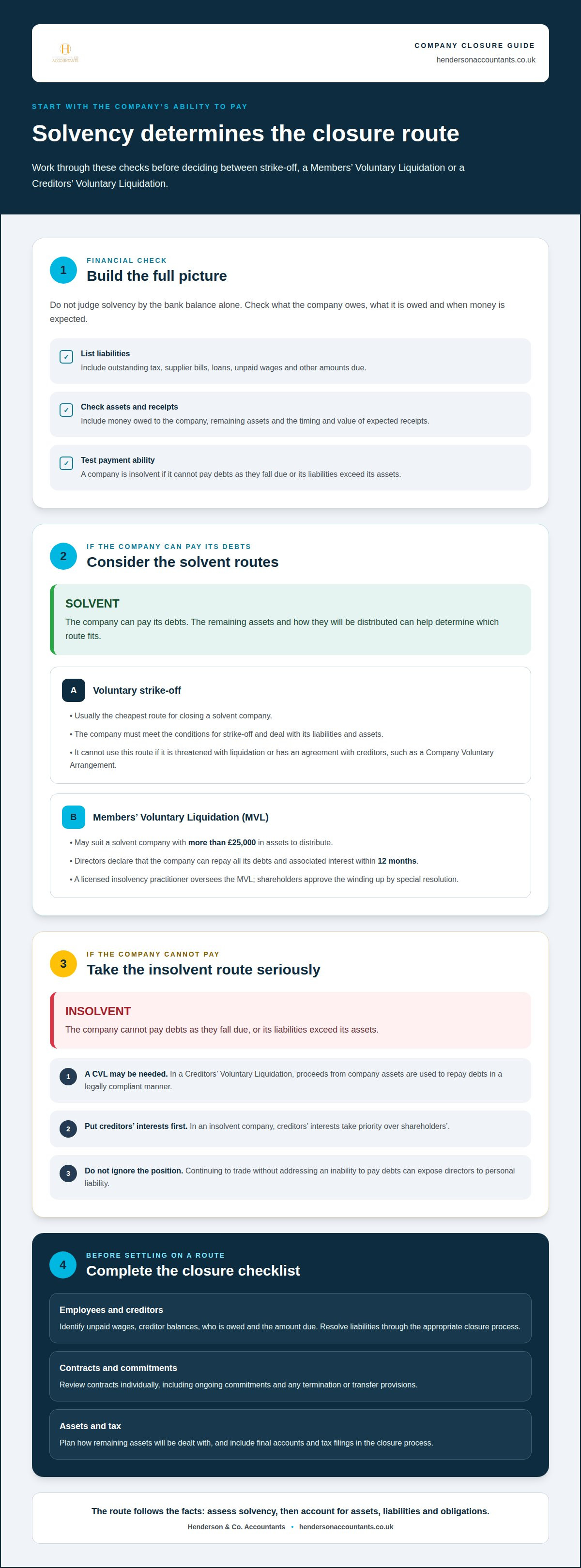
To choose a route for closing a limited company, first establish whether it can pay its debts. That distinction helps determine whether voluntary strike-off, a solvent liquidation or an insolvent route may be appropriate.
Solvent and insolvent closure routes
A solvent company can pay its debts. An insolvent company cannot pay debts as they fall due or has liabilities exceeding its assets. The appropriate routes differ: a solvent company may apply for strike-off or use a Members’ Voluntary Liquidation (MVL), while an insolvent company may need a Creditors’ Voluntary Liquidation (CVL).
For an MVL, directors declare that the company can repay all its debts and associated interest within 12 months, according to UK legislation register. In a CVL, company asset proceeds are used to repay debts in a legally compliant manner under the Insolvency Act 1986. When a company is insolvent, directors should take account of creditors’ interests.
Assess the company’s full financial position, not just its cash balance. Outstanding tax, supplier bills, loans and other liabilities all affect solvency. If the company cannot pay debts as they fall due, continuing to trade without addressing the situation can expose directors to personal liability.
Closing a solvent company
For closing a limited company that can pay its debts, the choice often turns on remaining assets and how they will be distributed. Strike-off is usually the cheapest route, while an MVL may suit a solvent company with more than £25,000 in assets to distribute. Compare the routes by considering tax treatment, closure costs and the work required to settle company affairs.
An MVL is overseen by a licensed insolvency practitioner. Directors make a declaration of solvency, and shareholders approve the winding up by special resolution. A Company Voluntary Arrangement may be an alternative for a company seeking to address its debts, subject to creditor approval.
Before choosing a route, prepare a complete picture of the company’s assets and liabilities. Include money owed to the company, unpaid bills, loans and tax due. A balance sheet alone may not show whether cash will be available when payments fall due, so consider the timing and value of expected receipts too.
Employees, creditors, contracts and debts
Before closure takes effect, deal with the company’s employees, creditors, contracts and outstanding debts. Unresolved obligations can affect solvency and the routes available. Make a list of each obligation, who is owed, the amount due and any relevant contract terms.
For employees, include unpaid wages and other amounts owed in the company’s liabilities. Identify outstanding creditor balances and address them through the appropriate closure process. In an insolvent company, asset proceeds are used to repay debts, and creditors’ interests take priority over shareholders’.
Review contracts individually to understand continuing commitments and any termination or transfer provisions. A company with a creditor agreement, such as a Company Voluntary Arrangement, cannot use strike-off under the conditions for that route. An orderly review of company records and obligations can help clarify the financial picture before you settle on a closure method.
DS01 application process and fees
The DS01 route is the formal application for voluntary strike-off. It asks Companies House to remove an eligible company from the register, so prepare the company’s affairs before submitting. The application must be signed by a majority of the directors. A director should ensure the details are complete and the required signatures are in place.
- Review the closure position. List the company’s assets, liabilities and outstanding payments before starting. A company with unpaid debts, a creditor agreement or a threat of liquidation cannot use strike-off under the conditions for this route. If the company is dormant, make sure dormancy is not being confused with dissolution: a dormant company remains on the register.
- Complete and sign the application. Use the DS01 process and obtain signatures from a majority of directors. This requirement matters where the company has several directors, because a single signature is not enough. Check that the application identifies the company correctly before sending it to Companies House.
- Send copies to relevant parties. Once the application has been made, send a copy to relevant parties within seven days, according to Companies House. This includes people who may have an interest in the company’s closure. Keeping a record of when copies are sent helps show that this step was completed.
- Allow the notice process to run. Companies House publishes a notice in The Gazette after accepting the application. Interested parties can object during the notice period. An objection, such as one from a creditor with an unpaid balance, can interrupt the strike-off process.
From 1 February 2026, an online application to strike off a UK company costs £13. A paper DS01 application costs £18 from the same date. These are different application routes, so choose the method that suits the company’s filing arrangements. Include the correct fee with the application to avoid a preventable delay.
After the Gazette notice, interested parties have two months to object. If no objection is made, a further notice announces dissolution. The company is then struck off and ceases to exist. Deal with remaining assets and payments beforehand, because dissolution can prevent the company from managing them normally.
Strike-off is not a substitute for liquidation if the company cannot pay its debts. An insolvent company may need a Creditors’ Voluntary Liquidation, overseen by an appointed insolvency practitioner. If the business may trade again, dormancy keeps the company registered instead of ending its legal existence. The route you choose affects the remaining filings and closure steps.
Final accounts and tax filings
Before dissolution, bring the company’s accounts and tax position up to date. The figures should reflect its final trading activity, assets, liabilities and payments. For example, record unpaid customer invoices and supplier bills rather than treating the bank balance as the complete picture. These records help establish what the company owes and what remains before closure.
Corporation Tax, VAT and PAYE liabilities must be settled in full before applying for voluntary strike-off. Prepare the relevant tax returns and reconcile them with the company’s books. Returns should reflect actual activity, including income received and costs incurred. Outstanding liabilities can affect whether strike-off is suitable.
A practical accounts review can cover:
- Income and costs: record sales, purchases and other business transactions up to the end of trading.
- Assets and liabilities: account for money owed to the company, outstanding creditor balances and tax due.
- Tax records: reconcile Corporation Tax, VAT and PAYE figures against payments and returns.
A company’s filing duties do not end just because it has stopped trading. A company without a director still needs to pay Corporation Tax and file a tax return. Its legal existence and tax responsibilities are separate, so an empty bank account or inactive business does not settle outstanding tax.
Dormancy has separate accounting requirements. A company is dormant for tax purposes only if it is not carrying on business activity, trading or receiving income. A dormant company must file annual accounts with Companies House, including a balance sheet and relevant notes, and file a confirmation statement each year. These duties continue while the company remains registered, even without trading activity.
For a dormant company, keep the accounts consistent with its inactive status. Receiving business income, for example, means it no longer meets the stated tax definition of dormant. If the company resumes trading, its accounts and tax position must reflect that activity. If it is closing, deal with final figures and tax liabilities before dissolution.
Company records help explain the final figures to shareholders and support accurate filings. Keep invoices, bank records, tax calculations and copies of submitted returns together. If an insolvency practitioner oversees a liquidation, organised accounts help show the company’s financial position and how its assets and debts are treated. Annual Accounts support can help keep reporting complete as closure approaches.
MVL distributions and tax treatment
A Members’ Voluntary Liquidation (MVL) closes a solvent company and distributes its remaining assets to shareholders. Tax treatment matters: the amount shareholders receive is not the only consideration. The company’s retained profits, eligible reliefs and each shareholder’s tax position can affect the outcome.
An MVL may be considered where a company has £25,000 or more in retained profits to distribute tax-efficiently. That figure is a threshold to consider, not a promise of a particular tax result. Compare the expected distribution with the costs and formalities of liquidation, and with the simpler strike-off route. The company must be solvent and able to pay its debts before directors make the required declaration.
Distributions to shareholders in an MVL may qualify for Business Asset Disposal Relief (BADR), which can reduce Capital Gains Tax. Where the relief applies, the stated rate is 10% on the first £1 million of eligible lifetime gains. Eligibility depends on the relevant conditions and the shareholder’s circumstances, so not every distribution or shareholder will receive that treatment.
Separate the key questions before deciding how to proceed:
- Company position: identify retained profits, assets available for distribution and outstanding liabilities.
- Shareholder position: establish who will receive each distribution and whether they may meet the conditions for BADR.
- Route: compare an MVL with strike-off, considering the size of the distribution and the formal liquidation process.
Tax treatment can differ if funds are received as dividends rather than through an MVL. Dividend distributions can be subject to Income Tax, with the stated rate reaching 39.35%. This is why it helps to distinguish the type of payment before estimating what shareholders may retain. The company’s final accounts and tax position also need to support the figures used for distributions.
Keep a clear record of the calculations behind each shareholder payment. For example, record the company’s available assets, amounts set aside for liabilities and the basis for each distribution. Directors should also consider timing: continued trading can change profits, debts and the assets available to distribute. A licensed insolvency practitioner oversees an MVL, including the distribution process.
Before choosing an MVL, map the expected distribution against the company’s retained profits and shareholders’ circumstances. Discuss the company’s financial position to organise the figures that inform this decision.
Henderson & Co. Accountants: Company Secretarial Services
Henderson & Co. Accountants can support you with company administration when planning a closure. Company Secretarial Services can help you keep company records and filings organised as you work through the next steps.
If you’re preparing final figures, Annual Accounts and Corporation Tax Returns can support the company’s reporting and tax obligations. For an eCommerce business, eCommerce Accounting or Xero Cloud Accounting Setup can also help keep records clear and up to date while you decide whether to close the company or leave it dormant.
Turn to Henderson & Co. Accountants when you need help bringing company administration and accounting tasks into a clear plan. Contact the firm to discuss your company’s needs.
Make your next step a clear one
If you’re closing a limited company, treat it as a transition, not just an administrative finish. List what needs to happen before the company’s affairs are complete, who is responsible for each task and how you’ll manage the remaining business records. A clear plan can help prevent unfinished company matters from carrying into your next venture or commitments.
Consider what comes next for you: starting another business, returning to employment or pausing before you decide. This context can help you organise your records and make practical choices about the company’s final arrangements. Choose a closure route that reflects the company’s actual position and your plans.
For support with the accounting and administration around your next steps, contact Henderson & Co. Accountants. A straightforward conversation can help you clarify what support fits your situation and move forward with greater confidence.
Henderson & Co. Accountants can help with the work around closing a limited company
Henderson & Co. Accountants provides accounting and company secretarial services to support you through closing a limited company. Its services include annual accounts, corporation tax returns, VAT return preparation and bookkeeping.
Turn to the firm for help managing accounting and company administration tasks. Henderson & Co. Accountants also offers payroll and CIS management, Xero Cloud Accounting Setup, eCommerce Accounting and outsourced finance support.
Frequently Asked Questions
Should you close the company or make it dormant?
Close the company if you’ve finished with the business and it meets a suitable closure route; keep it dormant if you may trade again. Dormancy means the company remains registered and filing responsibilities continue. For example, a company waiting to restart after a pause may remain dormant, while one with no future purpose may be better suited to closure. Consider its plans, assets and outstanding obligations before deciding.
Can HMRC stop my company from being struck off?
Yes. HMRC can object if the company owes tax or has unresolved tax matters. Corporation Tax, VAT and PAYE liabilities should be settled in full before applying for strike-off. An unpaid VAT balance, for example, could give HMRC reason to challenge the application as a creditor. Resolve tax filings and payments before applying, allowing time to address outstanding returns or liabilities.
What are the ways to close a limited company in the UK?
The main routes are voluntary strike-off for an eligible company, a Members’ Voluntary Liquidation (MVL) for a solvent company, and a Creditors’ Voluntary Liquidation (CVL) for an insolvent one. A creditor may also seek compulsory liquidation over unpaid debts of £750 or more, according to the UK legislation register. A Company Voluntary Arrangement may help an eligible company address debts without liquidation, subject to creditor approval.
What are the eligibility requirements for voluntary strike-off (DS01) in the UK?
A company must not be threatened with liquidation or have an agreement with creditors, such as a Company Voluntary Arrangement. It also needs to address its liabilities, including tax owed to HMRC. Consider whether creditors, employees or other interested parties have grounds to object. An unpaid supplier, for instance, may challenge the application, making strike-off unsuitable while debts remain unresolved.
How do you apply to strike off a UK limited company, and how much does it cost?
Submit a DS01 application signed by a majority of the company’s directors, then send copies to relevant parties within seven days, according to Companies House. From 1 February 2026, online filing costs £13; a paper DS01 costs £18. Companies House publishes a notice in The Gazette, giving interested parties time to object. If no objection prevents the process, a later notice confirms dissolution.
How do you close a solvent UK limited company through a members’ voluntary liquidation (MVL)?
An MVL is a formal liquidation for a company able to pay its debts. Directors make a declaration that the company can repay all debts and associated interest within 12 months, according to the UK legislation register. Shareholders then pass a special resolution, and a licensed insolvency practitioner oversees the liquidation and distributions. This route is generally considered where a solvent company has substantial assets to distribute.
What tax is due when closing a UK limited company, including Corporation Tax and distributions to shareholders?
The company must settle Corporation Tax, VAT and PAYE liabilities before strike-off. Shareholders may also owe tax on distributions. MVL distributions may qualify for Business Asset Disposal Relief, which reduces Capital Gains Tax to 10% on the first £1 million of eligible lifetime gains. Dividend distributions can be subject to Income Tax as high as 39.35%. The treatment depends on the type of payment and individual eligibility.
What final accounts, tax returns, and Companies House filings are required before closing a UK company?
Prepare accounts showing the company’s final activity, assets and liabilities, and submit outstanding tax returns and payments. Required filings depend on the closure route and the company’s activity. A dormant company still files annual accounts with Companies House, including a balance sheet and relevant notes, as well as a confirmation statement each year. Keep supporting records, such as invoices and bank statements, to explain the figures.