
Cash Flow Forecasting: The UK Guide to Financial Control

A profitable business can still run short of cash. Cash flow forecasting helps you see what money is expected to come in and go out, and how those movements may affect your balance over time. By setting out expected receipts and payments alongside your opening balance, you can spot potential shortfalls and plan for costs such as wages and supplier bills.
A spreadsheet can be a practical starting point for cash flow forecasting, but realistic assumptions and regular updates are essential. Learn how to compare spreadsheets with software, build scenarios around changing income or spending, adjust projections as plans shift and keep your forecast aligned with actual performance.
This guide also explains how to choose a useful forecasting period and why timing matters: record income when you expect the cash to reach your bank account, not simply when you issue an invoice. A clearer view of future cash helps you make day-to-day decisions with greater confidence and plan for your business’s needs.
Key Takeaways
- See how opening cash, expected receipts and planned payments combine to show your projected balance.
- Choose between a spreadsheet and forecasting software based on the level of detail and flexibility your business needs.
- Use different scenarios to understand how changes in sales, costs or payment timing could affect available cash.
- Compare actual results with projections and revise assumptions when business performance or market conditions change.
- Build a small-business spreadsheet around when money is expected to arrive or leave, not just invoice dates.
What is cash flow forecasting?
A cash flow forecast estimates when money will enter and leave your business over a chosen period. It helps you predict available cash and spot when the timing of receipts and payments could put pressure on your balance.
Forecast components and cash balances
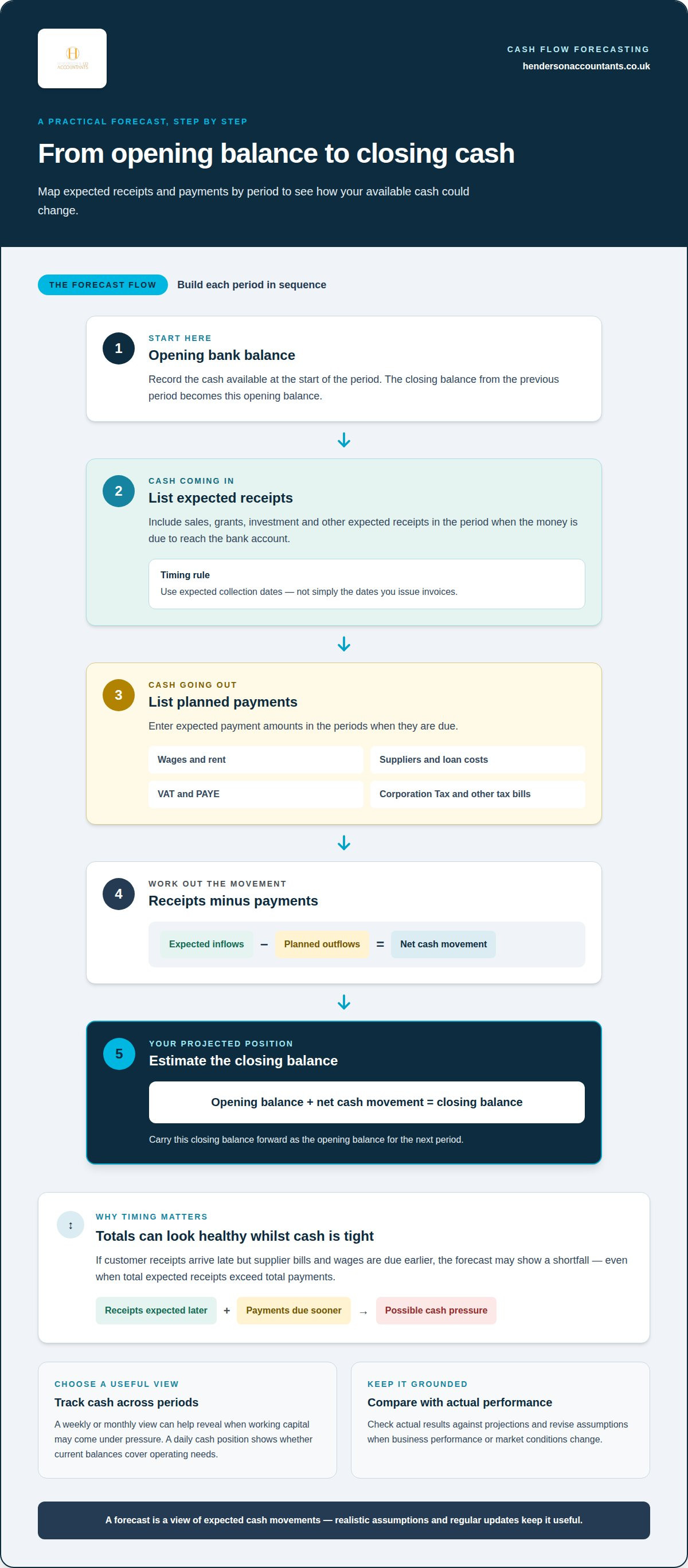
A forecast combines the opening bank balance with expected cash inflows and outflows to estimate the closing balance. Include sales when you expect the money to reach your account, along with other receipts such as grants or investment. Record payments for costs such as wages, rent, suppliers, loan costs and tax bills. This timing-based view helps you understand your working capital needs.
To create a forecast, start with your opening balance and list expected receipts and payments by period. Subtract outflows from inflows, then add the net cash movement to the opening balance to estimate the closing balance. Use expected collection and payment dates, rather than relying only on invoice dates.
Include UK tax payments in the periods when you expect to pay them. Add VAT, PAYE and Corporation Tax, along with any other relevant tax bills, using the expected payment amounts and dates for your business.
Bring account balances and transactions together to get a practical view of available funds. A daily cash position shows whether current balances cover operating needs, while a forecast projects how receipts and payments could change that position.
Predicting cash balance peaks and troughs
A forecast maps expected cash movements across each period, showing when balances may rise or fall. For example, a strong sales month may be followed by a low point if supplier bills and wages are due before customer receipts arrive. The closing balance for one period becomes the opening balance for the next.
Timing matters as much as totals. If income is expected late and spending is due early, the forecast can show a shortfall even when total expected receipts exceed total payments. A weekly or monthly view helps you spot when working capital may come under pressure and plan for it.
Cash forecasting versus profit forecasting
A cash forecast predicts receipts, payments and bank balances. A profit forecast estimates income and expenses to show expected profitability. The two can differ because a sale may be recorded before its cash reaches your account, while a payment may fall in a different period from the expense it relates to.
That difference matters when making decisions. A profitable business can still face a cash shortfall if customers pay later than expected or several bills fall due together. An indirect forecast can support longer-range planning, while expected cash movements show whether funds are available for near-term commitments.
Forecasting without trading history
A new business without trading history can build a forecast from realistic sales estimates, planned costs and expected payment timing. Set out when you expect customers to pay, then include outflows such as rent, wages, materials, assets and tax bills. Include non-sales receipts, such as owner investment or grants, where relevant.
When past results are unavailable to guide estimates, make assumptions visible and use cautious timing for uncertain movements. Assume spending could happen at the earliest opportunity and income may arrive at the latest. Forecasts become less reliable further into the future, so compare projections with actual results as trading develops.
Cash-flow forecasting software compared with spreadsheets
A spreadsheet may be enough when your financial activity is straightforward and the figures are easy to maintain. It lets you control categories, periods and assumptions without a dedicated forecasting tool. Excel also recalculates the forecast when you update income or spending. Choose based on how many accounts and transactions you need to track and how often your plans change.
Preparing a forecast takes time, especially when information is spread across several accounts or records. Building a complete forecast in Excel can require substantial effort. Each new assumption may mean reviewing connected formulas and checking that totals still make sense. A clear layout, consistent categories and a separate place for assumptions make the spreadsheet easier to maintain.
Cash positioning brings account balances and transaction information together to show available liquidity. For a business with several bank accounts, a consolidated view clarifies its overall position and whether funds can cover operating needs. Multibank reporting is useful when balances sit in different accounts, because a snapshot of one account may not show the full picture. The forecast then adds expected movements to the current position.
Accounting software can make it easier to explore seasonal peaks, quieter periods and possible changes in income or spending. What-if calculations let you compare scenarios, such as delayed customer receipts against planned supplier payments, without rebuilding every figure. This helps you consider growth plans alongside near-term cash needs. The value lies in testing assumptions, not treating a software projection as a certainty.
Before choosing a method, consider the work involved in keeping its figures current. A spreadsheet may suit a simpler forecast with limited accounts and occasional changes. Software may be more practical when you need to review several scenarios or regularly consolidate transaction data. Neither approach removes the need for realistic assumptions and comparisons with actual results.
Whichever tool you use, organise the forecast so someone else can follow its logic. Keep assumptions visible, group similar receipts and payments, and make the opening and closing balances easy to identify. If your accounting records need a clearer structure to support forecasting, accounting software setup may be a useful place to start.
Scenario planning and manual projection adjustments
A cash flow projection is more useful when it shows how different decisions or changes could affect available funds. Scenarios help you spot pressure points early and consider practical responses.
Adjusting projections for scenarios
Scenario planning compares a base projection with alternative outcomes, such as slower customer receipts or higher supplier costs. A forecast based on a single expected outcome can hide risks to working capital. Change the relevant assumptions, then compare the resulting balances and any cash shortfalls. Link each adjustment to a clear reason, such as a delayed contract or planned purchase, so you can explain why the figures changed.
Short-, mid-term and strategic planning
Cash forecasting supports near-term decisions, medium-range planning and strategic choices by matching projections to the decision’s timescale. A medium-term forecast usually covers 2 to 6 months, while strategic growth and budgeting can use a 6-12-month estimate. Review medium- and long-term projections monthly. Shorter views help assess immediate commitments; longer ones show whether a growth plan may leave enough capital for normal operations.
Planning borrowing and surplus cash
A forecast shows when expected outflows may exceed available receipts, helping you estimate whether borrowing might be needed and when. It can also identify periods when cash may exceed immediate operating needs. Use the projected balance and timing of commitments to assess whether funds are genuinely available. Include the expected timing of borrowing or planned spending, then compare the revised projection with the original.
Managing cash shortfalls and improving cash flow
A projected shortfall is a prompt to review the timing of receipts and outflows before the balance becomes difficult to manage. If the balance is falling despite an overall income and expenditure surplus, consider rescheduling spending, asking funders to bring grants forward or discussing the forecast with your bank. If negative cash flow continues, plan ahead for enough working capital to meet everyday needs.
Manual adjustments make potential responses visible in the figures. For example, move a planned purchase to a later period and compare the revised closing balance with the original projection. Record the reason and expected timing, then update the forecast when actual receipts or payments differ. This keeps decisions grounded in current information, not assumptions that no longer reflect trading conditions.
Scenarios also support wider risk management. A business considering expansion can model launch costs alongside expected income, then examine how a delay could affect available capital. Compare each projection with the funds needed for existing commitments. This helps decision-makers weigh growth plans against liquidity needs and consider borrowing or spending changes before deciding how to proceed.
Updating forecasts to reflect changing performance
A forecast remains useful when its estimates keep pace with actual trading and changing conditions. Regularly compare expected and actual cash movements, then revise projections when differences affect future balances.
Common risks include relying on outdated assumptions, overestimating receipts or overlooking changes in payment timing. These errors can hide a cash shortfall and lead to decisions based on money the business may not have.
Regular updates and forecasting practices
Regular updates bring new information into a forecast so it reflects current business performance. For a UK small or medium-sized organisation without immediate financial difficulty, monthly updates and a rolling 12-month forecast are considered reasonable practice. Short-term forecasts are best updated daily or weekly. Choose a review rhythm that matches how quickly your receipts and outflows change.
Keep forecast and actual figures in separate columns, and revisit assumptions at each review. For example, check whether expected customer receipts still match current payment patterns. A consistent process helps decision-makers spot changes early and identify which estimates need attention.
Forecast updating and variance analysis
Variance analysis compares forecast figures with actual receipts and payments to show where results differed from expectations. A gap can reveal a changed pattern, not just an isolated error. If income arrives later than estimated, record the difference and move the expected receipt to the period when the cash is now likely to arrive.
Review both the size and timing of variances. A delayed receipt can affect one period’s balance and decisions in the next. Use what you learn to adjust related estimates, then note the reason so future reviews can distinguish a recurring trend from a one-off change.
Adjusting estimates as performance changes
Adjusting estimates means replacing assumptions that no longer reflect actual trading with updated expectations. This matters when sales, costs or market conditions change, because older figures can make future cash balances misleading. If a customer changes its payment schedule, move the expected receipt to the new period rather than leaving it in its original forecast slot.
Update related inflows and outflows together. A change in sales may affect supplier payments, stock purchases or other planned spending. Recording the reason for each adjustment helps explain why projections shifted and supports clearer decisions about upcoming commitments.
Monthly cash flow updates
A monthly update replaces the elapsed period’s forecast with actual results and extends the forecast forward. For example, after a month closes, compare receipts and payments against estimates, then add a new future month to keep a rolling 12-month view. This gives the business a continuing outlook rather than a forecast that ends at a fixed date.
Use each review to revisit assumptions and identify changes in actual performance or market trends. If a short-term balance is under pressure, a daily or weekly view can add detail between monthly reviews. This helps you respond to immediate cash movements without losing sight of longer-term needs.
Record the reason for each material change, such as a revised sales estimate or a supplier payment moved to another period. At the next review, compare the updated estimate with actual results. This makes recurring differences easier to spot and helps the forecast reflect current conditions instead of simply carrying forward last month’s figures.
Small-business cash flow spreadsheets
A well-structured spreadsheet gives a small business a clear view of cash coming in and going out. A common approach forecasts inflows and outflows for at least 90 days. That period can reveal whether expected receipts cover upcoming commitments, while a separate balance sheet provides a broader view of assets, liabilities and equity.
Set up the spreadsheet with a column for each period and a clear row for each cash movement. Keep receipts separate from payments, using practical categories such as customer income, supplier bills, wages, rent, tax and loan costs. Add an opening balance, then show how expected movements affect the balance at the end of each period. Clear labels make figures needing attention easier to find.
Use expected payment dates, not invoice dates, to place transactions in the forecast. An invoice sent to a customer is not cash in the bank until payment arrives. Likewise, record a supplier invoice in the period when payment is due. If timing is uncertain, assume spending happens at the earliest opportunity and income arrives at the latest. This gives you a cautious view of available cash.
Set up the sheet to compare actual results with estimates. Keep forecast and actual columns side by side, then update each period as transactions happen. For example, if a customer pays later than expected, move the estimate to the period when payment is now expected. Check that each closing balance carries forward as the next opening balance and that changes update the relevant totals.
Choose the detail to match the business’s cash position. A short-term view of 2-4 weeks can support daily cash management, while a daily forecast may help during an extremely difficult cash-flow period. If your business has seasonal sales or irregular spending, separate those movements so quieter periods and upcoming costs remain visible. Extend the forecast as new information changes what is coming in or going out.
Keep the spreadsheet simple enough to update consistently. Use one row for each useful category, avoid mixing personal and business movements, and note the assumption behind uncertain receipts or outflows. A complicated structure can make errors harder to find. A consistent layout makes changes easier to trace and helps you decide whether cash is available to invest or should remain accessible.
If maintaining the records behind your forecast is taking time away from running the business, explore bookkeeping support to help keep your financial information organised.
Henderson & Co. Accountants
Henderson & Co. Accountants helps businesses organise their financial records and obligations, giving you a clearer basis for reviewing cash projections. Accurate bookkeeping, payroll and tax information can help you understand when outflows are due and make informed decisions as trading changes.
If your forecast is difficult to maintain alongside day-to-day accounting, Henderson & Co. Accountants provides eCommerce Accounting, VAT Return Preparation, Corporation Tax Returns, and Payroll and CIS Management. These services help keep relevant business information organised, while your forecast remains a planning tool for expected cash movements.
To discuss how Henderson & Co. Accountants can support your business, get in touch with the firm.
Make your next financial decision with confidence
Choose an upcoming business decision and give your forecast a clear purpose. You might be planning a purchase, preparing for a quieter trading period or deciding how much cash to keep available. Cash flow forecasting is more useful when its figures inform a real choice rather than sitting untouched in a spreadsheet.
Set a time to review the assumptions behind that decision, then use what you learn to refine your next projection. If you want support with the financial information behind your planning, Henderson & Co. Accountants can help with services such as Xero Cloud Accounting Setup and VAT Return Preparation.
Contact Henderson & Co. Accountants to discuss support for your business. A considered next step can help you turn clearer financial information into steady progress.
Henderson & Co. Accountants and Cash Flow Forecasting
Henderson & Co. Accountants provides bookkeeping, eCommerce Accounting and Xero Cloud Accounting Setup. These services help organise the financial information used to prepare a cash flow forecast.
Turn to Henderson & Co. Accountants when you need help maintaining financial records or managing your wider finance function. Services include an Outsourced Finance Director and an Outsourced Finance Department, alongside VAT Return Preparation, Corporation Tax Returns, Payroll and CIS Management, Company Secretarial Services and Annual Accounts.
Frequently Asked Questions
What is cash flow forecasting and why is it important for UK businesses?
Cash flow forecasting estimates when a business expects money to arrive and payments to leave its accounts. It matters because a positive profit figure does not necessarily mean cash is available when bills fall due. For example, a business can use its forecast to judge whether a planned stock order fits alongside upcoming wages and supplier commitments, then adjust the timing before confirming the purchase.
What information and assumptions are needed for a cash flow forecast?
Start with current bank balances, expected customer receipts, supplier payment dates and committed costs. Add relevant tax payments, loan repayments, planned purchases and other expected income. Document assumptions that could affect timing or amounts, such as seasonal sales, a customer’s payment pattern or a planned increase in stock. Keep confirmed commitments distinct from estimates so you can see which figures depend on future events.
Which cash flow forecasting methods and software are best for small UK businesses?
Choose an approach based on the decisions your forecast needs to support. A spreadsheet may suit a business with straightforward accounts and a manageable number of transactions. Software may be more useful when you need to bring accounting data together or compare alternative plans. Direct forecasting focuses on expected near-term cash movements; indirect methods can support longer-range planning. Choose a format you can keep accurate and review consistently.
How often should a business update its cash flow forecast?
For a small or medium-sized organisation not facing immediate financial difficulty, monthly updates with a rolling 12-month outlook are considered reasonable practice. Review short-term movements daily or weekly if changing receipts or payments could affect near-term decisions. Update sooner when a key estimate changes, such as a customer payment being delayed or a planned cost shifting. Match the review frequency to how quickly your cash position can change.