
Financial Forecasting for SMEs: A Practical Guide

A forecast is not a promise about what your business will earn. It is a practical way to prepare for what might happen next. Financial forecasting for SMEs uses past performance, current conditions and clear assumptions to estimate future income, costs and cash flow. A useful forecast compares a base case with stronger and weaker scenarios, showing how different outcomes could affect your plans.
Sales and profit matter, but so does the timing of money coming in and going out. A profitable business can still face cash pressure when customers pay late, stock costs rise or tax bills fall due. Forecasting helps bring these pressures into view earlier, giving you more time to make informed decisions.
This guide explains what financial forecasting involves, why cash flow needs close attention and how forecasts can support decisions about growth, hiring, risk and resource allocation. It also covers how forecasting differs from budgeting and how regular reviews keep plans aligned with what is happening in your business.
Key Takeaways
- Use best-case, most-likely and worst-case scenarios to see how changing assumptions could affect your plans.
- Consider seasonal patterns and payment timing when estimating revenue, so cash needs are easier to anticipate.
- Separate forecasts, which predict likely results, from plans, which set out the actions to reach your goals.
- Use projected cash flow and costs to guide decisions about hiring, investment and other priorities.
- Review forecasts against actual results and update assumptions when business conditions change.
What is financial forecasting?
Financial forecasting estimates future business performance using historical figures, current market trends and expected industry developments. A useful forecast brings together projected income, cash flow and balance sheets, then tests how different assumptions could change the results.
Scenario types for forecasting
A forecast scenario models expected business performance using a particular set of assumptions. Comparing scenarios matters because a single sales estimate cannot show every risk or opportunity your business may face.
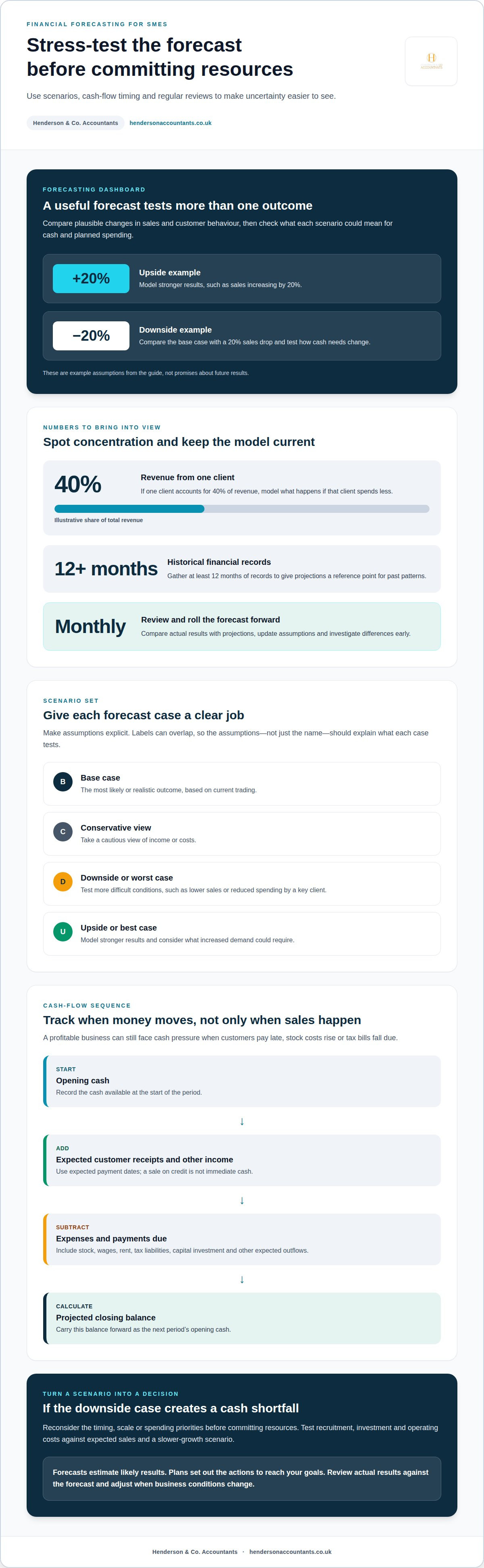
The base case represents the most likely or realistic outcome, using assumptions that reflect current trading. A conservative scenario takes a cautious view of income or costs, whilst a downside or worst-case scenario tests more difficult conditions. An upside or best-case scenario models stronger results, such as sales increasing by 20%.
These labels can overlap, but each scenario should make its assumptions clear. For example, compare a base case with a 20% sales drop, then test whether expenses can be reduced or cash needs change. If one client accounts for 40% of revenue, model what happens if that client spends less. This makes exposure visible before it affects decisions.
Scenario planning for business decisions
Scenario planning connects growth plans to possible future conditions, helping you consider the financial impact before committing resources. It is especially useful when a decision could affect profitability, cash flow or funding needs.
For example, model a recruitment plan against expected sales, then compare it with a slower-growth scenario. You can also test how changes in interest rates, capital investment or operating costs might affect the outcome. If the downside case creates a cash shortfall, reconsider the timing, scale or spending priorities.
Use scenarios to examine a specific decision, rather than trying to predict every market change. A practical model might compare keeping current capacity with expanding to meet stronger demand. Reviewing the differences helps owners weigh potential growth against the costs and working capital each option requires.
Forecasting methods and tools
Small businesses can combine trend analysis with qualitative judgement when forecasting; quantitative methods are useful when reliable data is available. Accounting software and dashboards can support projections, scenario analysis and visual comparisons.
Trend analysis uses past results to identify patterns, while scenario analysis tests a forecast under different conditions. A forecast should include projected income, cash flow and balance sheets, with assumptions linked to drivers such as sales volume, prices and expenses. Gathering at least 12 months of historical financial records gives the projections a reference point.
Common risks include relying on one optimistic scenario, using outdated figures or treating estimates as certain. UK small businesses should use current data, record assumptions and compare actual results with projections regularly. Updating figures monthly and rolling the forecast forward helps reveal differences early, so owners can investigate what changed and adjust plans.
Why is cash flow forecasting particularly important?
Cash flow forecasting estimates when money will enter and leave your business, not just whether it will make a profit. This timing helps you plan for operating expenses, tax liabilities and changes in working capital.
Revenue forecasts and seasonal fluctuations
A revenue forecast estimates future income by combining past performance with market conditions and seasonal patterns. This matters because sales can rise or fall across the year, while rent, payroll and supplier payments continue.
For example, a retailer may receive more orders during a busy trading season but need to buy stock beforehand. Its forecast should show when sales are expected, when customers are likely to pay and when suppliers need payment. A business with several income streams can forecast each separately, such as online sales, subscriptions or project work. This makes it easier to see whether one stream can offset a quieter period in another.
To create a cash flow forecast, list opening cash, expected customer receipts and other income, then add the due dates for expenses and payments. Calculate the projected closing balance for each period and carry it forward as the next period’s opening balance.
Revenue, expense and cash flow projections
Revenue, expense and cash flow projections connect expected trading activity with the timing of payments. Together, they show whether forecast income can cover costs when they fall due, even if the business expects to make a profit.
Start revenue projections with historical results, then account for seasonal fluctuations and changes in demand. Estimate costs such as stock, wages, rent and other operating expenses. For cash flow, use expected receipt and payment dates rather than treating every sale as immediate cash. A sale on credit can increase recorded revenue before the customer pays, leaving less cash available in the meantime.
Working capital also shapes the picture. Higher stock levels tie up cash, while slow-paying customers delay receipts. Corporation Tax liabilities or capital investment can create further outflows. Include these expected movements alongside regular costs, then compare projected balances with the cash needed to keep daily operations running.
Use cautious revenue estimates and allow for possible fluctuations. Each month, compare actual results with projections and investigate differences. If sales arrive later than expected or expenses rise, revise the forecast and consider which spending or timing changes could help. Regular review makes the figures more useful for decision-making without treating projections as fixed outcomes.
If coordinating projections and regular reviews takes time away from running the business, an Outsourced Finance Department can support ongoing financial management.
Financial forecasting versus financial planning
A forecast estimates likely financial results using current information and assumptions. A plan sets out actions to reach business goals, such as budgeting, investment choices, tax planning and cash flow management. A budget is part of that plan: it sets revenue goals and spending limits, while a forecast updates expectations as results or conditions change. For example, if sales fall below a budget target, a revised forecast can show the effect on planned spending.
These tools work best together. The forecast shows what current trading may deliver; the plan sets out how owners will respond. If a business intends to recruit after winning a contract, the forecast can help assess expected income and costs, while the plan determines when to proceed and how to fund the role.
In the UK, forecasts should include the business’s relevant VAT, Corporation Tax, payroll and Companies House filing or payment dates. Add the expected amounts and timing to the cash flow plan, using the actual obligations and reporting arrangements that apply to the business. This helps owners anticipate upcoming outflows and plan how to fund them.
Tax planning turns projections into practical actions. If a forecast indicates that a tax liability is building before its payment date, the business can plan to set money aside rather than treat all available cash as free to spend. The same approach can help manage VAT payments and payroll-related outflows alongside regular costs.
The cost of budgeting and forecasting software depends on factors such as features, user numbers, accounting integrations and support. A business needing straightforward budgets may have different requirements from one modelling several scenarios. Compare the software’s functionality with the decisions it needs to support, and include its ongoing cost in the financial plan.
Planning should also cover how to respond to unexpected changes. An emergency fund or contingency budget can help a business manage an unexpected downturn or cost increase. The forecast can indicate when that buffer may be needed, while the plan can identify spending to delay or reprioritise if conditions worsen.
Review the plan against actual results and update it when assumptions no longer reflect trading. For instance, if a planned investment depends on income that arrives later than expected, owners can reassess its timing. Linking forecasts to clear actions makes financial planning more responsive to the business’s changing position.
Benefits for decision-making, risk management and resource allocation
A forecast gives business decisions a financial basis by showing how choices may affect future results. Rather than relying only on historical accounting figures, owners can compare projected income, costs and cash needs before committing resources. For a growing SME, this can clarify whether expansion fits expected trading or whether a more cautious approach is needed.
Hiring is one example. A forecast can show the extra income needed to cover a new role’s ongoing costs, and how a slower sales period could change the picture. Investment decisions benefit in the same way. Compare the expected costs and potential returns of new equipment, premises or marketing, then assess whether cash will remain available for essential operations.
Scenario analysis can help identify risks and ways to reduce their impact. A business preparing for a large contract, for instance, can model the staffing, stock and working capital it may require. If the contract is delayed or costs rise, the forecast shows how those changes could affect cash flow and profitability. That insight can inform a plan to adjust timing or expenditure.
Forecasts can also inform wider strategic decisions. UK businesses may use them when raising or refinancing finance, seeking external investment, managing banking covenants, preparing for going-concern assessments, planning acquisitions or tendering for major contracts. In each case, projected outcomes help explain the financial effect of a decision and the assumptions behind it. A forecast supports discussion, but does not replace judgement about the business’s priorities.
Resource allocation becomes clearer when expected needs are mapped against available funds. An SME can assess how much to direct towards operations, marketing and research and development, then identify competing demands. If forecast costs rise, owners can consider which activity best supports revenue or long-term goals. This helps prevent one exciting opportunity from absorbing resources needed elsewhere.
Accuracy depends on up-to-date figures and assumptions that reflect actual business drivers. Accounting records provide a historical starting point, while sales trends, expected costs and planned changes shape projections. Comparing actual performance with the forecast helps identify differences and refine future estimates. If the numbers diverge, investigate the cause before changing the plan: a delayed customer payment calls for a different response than lower demand or higher supplier costs.
Used consistently, a forecast links operational choices to financial consequences. It can help leaders spot pressure earlier, direct resources towards priorities and make informed decisions as conditions change. Its practical value comes from turning projected numbers into timely actions, then reviewing those actions as new results become available.
Financial forecasts for SMEs
A useful SME forecast combines projected income, cash flow and balance sheets into one financial picture. Its value depends on the historical data and assumptions behind the models, and on updating them as the business changes.
Data for a reliable forecast
Reliable forecasts depend on the financial and operational information used to build their projections. Incomplete or outdated inputs can distort the insight a forecast provides.
Gather historical income statements, balance sheets and cash flow statements, alongside current accounting records. At least 12 months of historical financial records can provide a starting point; three years of statements can help reveal longer-term patterns where available. Include sales, costs, overheads, cash balances, amounts owed and upcoming payments.
Then connect those figures to business activity. A retailer might use units sold, average transaction value and stock levels; a service business might consider customer numbers, project fees and staff utilisation. Keeping the information in one model makes it easier to trace a projected change back to its underlying driver.
Assumptions behind forecasts
Forecast assumptions are estimates about the business conditions and drivers that may shape future results. Making them explicit lets owners review what changed instead of treating a projection as fact.
Focus on five to eight key financial drivers, such as sales volume, prices, wage costs, supplier costs and payment timing. Record each assumption and its basis. For example, assumed revenue growth of 10% can be labelled as an estimate, then tested against historical results and current trading information.
Choose a method that fits the available evidence. Quantitative forecasting uses numerical data and trends, while qualitative judgement can help a new business with little trading history. You can combine both: use actual sales data where available and document informed estimates for new products or changing market conditions.
Match the model to the decision horizon. A 30-90-day forecast can focus on near-term cash needs, while a 6-12-month view can support operating plans. Longer projections of 1-5 years can help frame growth decisions, but depend on assumptions that become less certain over time.
Present projected income, cash flow and balance sheets together, then compare actual results with the forecast. A monthly review can identify a missed sales assumption or unexpected cost, allowing the model to be adjusted. If you want support turning financial records and assumptions into a practical forecast, explore forecasting support.
Henderson & Co. Accountants
Henderson & Co. Accountants can help you build a clearer financial picture through accounting and finance support. If your forecast relies on figures spread across systems, Xero Cloud Accounting Setup can help organise your accounting records. For decisions requiring wider financial insight, an Outsourced Finance Director can provide finance leadership tailored to your business needs.
Accurate bookkeeping, annual accounts and tax return preparation also provide useful information for reviewing performance and planning ahead. This support can be especially relevant when your business is growing, income patterns are changing or you are weighing investment and recruitment decisions. The right focus depends on what you need your forecast to help you decide.
Contact Henderson & Co. Accountants to discuss the financial support that fits your business.
Put your next business decision on a clearer footing
Your next forecast does not need to answer every possible question. Start with the decision in front of you, identify the financial information it depends on, and use the forecast to make your next move with greater clarity. As your plans develop, keep the assumptions connected to real trading activity.
Financial forecasting for SMEs is more useful when supported by reliable financial records and services that reflect how your business operates. Henderson & Co. Accountants offers eCommerce Accounting, Xero Cloud Accounting Setup and VAT Return Preparation to help businesses organise key financial information and manage practical accounting needs.
If you’re ready to strengthen the financial information behind your business decisions, contact Henderson & Co. Accountants to discuss the support that fits your needs. A clearer financial view can help you take your next step with purpose.
Henderson & Co. Accountants can support your financial forecasting
Henderson & Co. Accountants offers bookkeeping, Annual Accounts and Xero Cloud Accounting Setup to help SMEs organise the financial information used in forecasting. Its eCommerce Accounting service also supports businesses selling online.
When you need help connecting forecasts with ongoing financial management, Henderson & Co. Accountants offers an Outsourced Finance Director or Outsourced Finance Department. It also provides VAT Return Preparation, Corporation Tax Returns, Payroll and CIS Management, and Company Secretarial Services.
Frequently Asked Questions
What is the difference between a budget and a forecast?
A budget sets targets for income and spending, while a forecast estimates what current information suggests may happen. For example, a budget might allocate funds for a marketing campaign, while a forecast adjusts expected sales if orders slow. Use the budget to define financial boundaries and the forecast to see whether trading is on track. Reviewing both helps distinguish a missed target from a change in expected performance.
How does ongoing forecasting outperform static budgeting?
Ongoing forecasting adapts as new information arrives, whereas a static budget can become less useful when trading conditions change. If a supplier changes payment terms or a customer delays a major order, an updated forecast can show the effect on cash and planned spending. This gives owners a timely basis for adjusting decisions rather than relying on assumptions made earlier in the financial year.
How often should a small business update its forecast?
Update a small business forecast monthly by comparing actual figures with projections and rolling the outlook forward. This can reveal changes in sales, costs or payment timing while there is still time to respond. A monthly review does not mean rebuilding every assumption from scratch. Focus on the figures that have changed and check whether they affect upcoming decisions or cash requirements.
How often should a small business update its financial forecast?
Check actual performance monthly and review the full forecast quarterly. Refresh it sooner after a major business change, such as winning a large contract, facing an unexpected cost increase or deciding to expand. This provides a regular view of performance without treating the forecast as fixed. If a change affects sales, costs or payment timing, reflect it in the projections rather than waiting for the next scheduled review.
How can SMEs model best-case, base-case and worst-case financial scenarios?
Build three versions of the same model, changing a small set of assumptions in each. The base case reflects the most likely trading picture; the best case tests stronger demand, while the worst case explores weaker sales or higher costs. Keep assumptions visible and compare the effect on cash and profit. For instance, assess whether the business could still cover planned commitments if a large customer reduced orders.
What UK tax, VAT, payroll and Companies House deadlines should forecasts account for?
Include the business’s applicable VAT, Corporation Tax, payroll and Companies House filing or payment dates, with the expected amounts and timing, in the cash flow plan.